
shoulder pain when sleeping on side
Shoulder Pain When Sleeping on Your Side: A Practical Decision Guide

Start with what side sleeping can—and cannot—tell you
Shoulder pain that appears when you lie on your side tells you that position or pressure may be affecting your symptoms, but it does not identify the cause. Sleeping on the affected side can worsen pain or discomfort in several shoulder conditions, including rotator-cuff problems, bursitis, arthritis, frozen shoulder, impingement, and instability. The same position can also make an existing problem more noticeable because your shoulder remains under pressure while you sleep.
That distinction matters. You can use the nighttime pattern to choose a lower-pressure position and decide how closely to watch your symptoms. You cannot use the position alone to determine whether the problem involves a tendon, bursa, joint, muscle, neck, or another structure.
Start with three questions:
- Does pressure on one side reliably make the pain worse?
- Does changing position reduce the discomfort, or does the pain continue regardless of position?
- Does the problem affect movement, strength, daily activities, or sleep even after you remove direct pressure?
Use the answers as a simple decision path:
- If reducing pressure makes mild discomfort easier and you have no warning signs, try a supported sleep adjustment.
- If pain persists, returns repeatedly, worsens, or limits ordinary activity, move toward a professional evaluation.
- If you have sudden severe symptoms, major loss of use, chest symptoms, breathing difficulty, or a serious injury, use urgent medical care rather than testing another position.
The answers help you choose between a brief comfort adjustment, a planned evaluation, and urgent medical attention. They are not a diagnosis. If your shoulder pain began after an injury, suddenly became severe, or comes with weakness or inability to move the shoulder, skip the self-care experiment and use the urgent-care pathway described below.
Understand why the affected side may hurt more at night
The affected shoulder may hurt more at night because lying directly on it adds pressure to an already sensitive area. Several symptom patterns can become more noticeable in that position, but none should be treated as a self-diagnosis.
Common patterns described in shoulder guidance include:
- Rotator-cuff symptoms: An injury may cause aching, stiffness, reduced motion, disrupted sleep, and worse symptoms when you use the shoulder. Lying on that side can make those symptoms more noticeable.
- Bursitis-type symptoms: Bursitis can hurt more during sleep, so direct pressure may make nighttime discomfort more apparent.
- Arthritis or stiffness: Shoulder arthritis can produce pain and stiffness, and lying on the shoulder may aggravate those symptoms.
- Frozen shoulder or impingement: These conditions may also become more uncomfortable in certain positions, including when you lie on the affected side.
A review of shoulder pain and sleeping position reported that 52 of 58 participants in one study were side sleepers and described an association between the painful shoulder and the preferred sleeping side. That number measures the participants in that study; it does not show that side sleeping caused the shoulder problem.
Pain location and movement response can give you useful information to record, but they do not settle the diagnosis. Front-of-shoulder pain, side-of-arm pain, aching at night, or difficulty reaching overhead can occur in more than one condition. Even a clear relationship between the painful side and your preferred sleeping side does not prove that the sleeping position caused the underlying problem.
Use the pattern to reduce aggravation rather than to name the condition. If the painful side becomes more uncomfortable under direct pressure, move pressure away from it. If raising or lowering the arm repeatedly increases symptoms, avoid repeating that movement while you decide whether an evaluation is needed. If symptoms continue away from the bed or begin limiting ordinary activity, the question has moved beyond sleep positioning.
Use a low-pressure sleep experiment first
A low-pressure sleep experiment gives you a practical first step when the discomfort is mild and no warning sign is present. The aim is to see whether reducing direct pressure changes your comfort, not to prove what structure is injured.
Try one of these supported options:
- Sleep on your back with the arm supported. Support can reduce pressure on the shoulder while keeping the arm from falling into a position that feels uncomfortable.
- Use a reclined position. A reclined posture may minimize pressure when lying flat is uncomfortable.
- If you must sleep on your side, choose the unaffected side. For symptoms associated with the rotator cuff, positioning guidance recommends avoiding the affected side and keeping the arm below shoulder height.
Let comfort guide the experiment. If a position increases pain, stop using it rather than forcing your shoulder to remain there. If a supported position reduces pressure but the pain returns as soon as you move normally, record that change without treating it as proof of a particular condition.
You can compare the position you tried with what happened afterward:
- Note whether you woke because of pain or pressure.
- Record whether supporting the arm changed the discomfort.
- Notice whether the pain returned when you rolled onto the affected side.
- Record whether the shoulder still hurt during ordinary daytime movement.
You do not need to test every position in one night. A change that feels better is useful for comfort, but it does not establish that home positioning is enough or that a particular treatment is appropriate. If no supported position makes a meaningful difference, stop treating the sleep experiment as the answer and consider whether the pattern now warrants evaluation.
To make the comparison easier to interpret, change one sleep variable at a time, such as moving off the painful side or adding arm support, rather than changing several positions and supports at once. This will not identify a diagnosis, but it can show whether direct pressure or a particular support affects comfort. Stop any trial that increases pain. A more comfortable night supports using that arrangement for comfort; it does not show that the underlying problem has resolved or that a particular treatment is appropriate. Do not let one better night outweigh daytime weakness, loss of motion, swelling, redness, fever, or a recent injury. Those findings change the next step regardless of which sleep position feels best.
Adjust support instead of forcing one best position
Sleep support should reduce pressure and strain without forcing you into a position your shoulder cannot tolerate. There is no single position that fits every symptom pattern: back sleeping with arm support or a reclined position may help minimize pressure, while guidance for rotator-cuff symptoms also allows back sleeping or the unaffected side with the arm below shoulder height.
Use that difference as a decision point rather than a contradiction to solve by force:
- If your back is comfortable: Try back sleeping with the affected arm supported, or try a reclined position.
- If side sleeping is more comfortable: Avoid placing your weight on the painful side. If rotator-cuff symptoms have already been identified, keep the arm below shoulder height and use the unaffected side instead.
- If your pillow or support changes the pain: Adjust or remove it. A supportive pillow may help maintain alignment and reduce strain on the shoulder joint, but support should not create new pressure.
Support is useful only if it makes the position easier to tolerate. A pillow that pushes the shoulder into pain is not helpful simply because it is supportive. Change the support when it increases pressure, and do not hold the arm in a position that causes more discomfort.
The useful question is not which position is universally correct. Ask which position lets you rest with less direct pressure and without increasing symptoms. If every position remains painful, if you cannot keep the shoulder supported comfortably, or if sleep disruption continues, stop treating the problem as a positioning issue alone and consider an evaluation.
Reduce daytime triggers that carry into bedtime
Daytime shoulder use can shape what you feel at bedtime. Shoulder bursitis may hurt more during sleep, while rotator-cuff tendinitis may cause pain or swelling when you raise or lower the arm. These patterns do not tell you which condition you have, but they give you specific triggers to notice.
For minor shoulder pain, use a short, practical review of the day:
- Note whether reaching overhead, raising the arm, lowering the arm, or another repeated movement made the shoulder more uncomfortable.
- Rest the shoulder from activities that worsen the discomfort rather than repeatedly testing the painful motion.
- Consider ice for comfort if the pain is minor.
- At bedtime, compare the symptom level with the daytime activity that preceded it instead of assuming that the sleep position was the only factor.
A simple activity-and-symptom note can separate pressure-related discomfort from pain that is continuing through the day. Record what you were doing, which movement changed the pain, whether resting helped, and whether the same limitation appeared during ordinary tasks. Keep the focus on what you can observe; do not use the pattern to assign yourself a condition.
Avoid turning this into complete immobilization or a personal treatment plan. The useful boundary is narrower: do not continue an activity that clearly worsens the discomfort while you are deciding whether professional assessment is needed. If ordinary movements, work, exercise, or self-care tasks remain limited, nighttime positioning is no longer the only decision in front of you.
Read the pattern without trying to name the condition
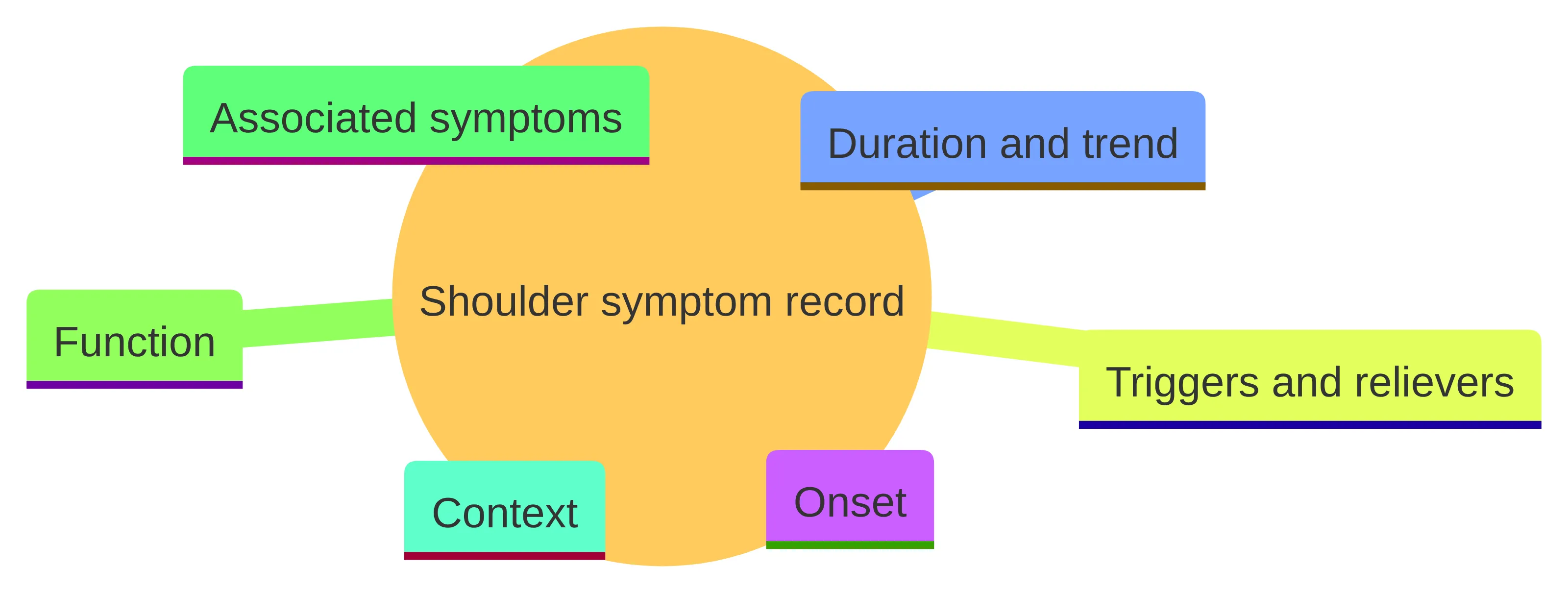
A shoulder symptom record can show how position, movement, and time affect your pain without asking you to diagnose yourself. Identifying the cause requires a history and examination that consider more than the place where the pain appears.
Record the details that change the next decision:
- Onset: Write when the pain began and whether it followed a fall, impact, lifting episode, workout, or another event.
- Duration and trend: Note how long the problem has been present and whether it is improving, unchanged, or worsening.
- Triggers and relievers: Record the sleep positions, arm movements, activities, and support changes that increase or decrease discomfort.
- Function: Note whether you can raise, lower, reach with, or otherwise use the arm as usual.
- Associated symptoms: Record weakness, stiffness, swelling, redness, fever, symptoms in another joint, or symptoms that extend beyond the shoulder.
- Context: Include your usual activity level, relevant medical conditions, and any recent trauma.
A pattern such as “pain increases with pressure but eases when the arm is supported” can help frame a clinical conversation. It still cannot distinguish among rotator-cuff problems, bursitis, arthritis, or other causes. A pattern such as “pain continues in every position and now limits daily activity” points toward evaluation rather than more sleep-position testing.
Bring the record if you seek care. The purpose is not to arrive with a condition name; it is to give the evaluating professional a clear account of onset, duration, aggravating and relieving factors, activity, trauma, other symptoms, and warning signs. Those details help place the nighttime complaint in the context of how your shoulder behaves during the rest of the day.
Evaluation and imaging are related but separate decisions. A history and examination are used to understand the pattern first, including onset, duration, triggers, function, activity, trauma, other symptoms, and warning signs. The cited clinical guidance says that two-view shoulder X-rays may be useful when symptoms do not improve with conservative treatment; it places their possible use in that context rather than treating a nighttime complaint alone as an imaging decision. If you already have MRI or X-ray images, note when they were obtained and bring them to an evaluation so they can be reviewed alongside your current symptoms. A symptom record can also show whether the problem is changing despite reduced pressure, which is more useful for deciding what to discuss next than trying to infer a diagnosis from one painful sleeping position.
Know when comfort measures are no longer enough
Comfort measures are no longer the whole plan when shoulder pain worsens, interferes with daily activities, or occurs with swelling or redness. Arrange a medical evaluation in those circumstances instead of repeatedly changing pillows or sleep positions.
Persistent or worsening pain also deserves attention when it affects how you use the arm. Those patterns require more than a home positioning experiment.
Use function as a practical checkpoint:
- If you can sleep more comfortably after removing pressure and your daytime function is returning, continue observing the pattern without assuming a diagnosis.
- If you still wake repeatedly, cannot use the arm normally, or find that routine activities increase the problem, arrange an evaluation.
- If the symptoms are getting worse rather than staying stable, do not keep extending self-care simply because the pain began at night.
Recurring pain deserves a closer look when it is becoming more frequent, more limiting, or harder to settle. A symptom that improves in one position but repeatedly returns with normal use still merits attention if it is affecting sleep or function. The goal of evaluation is to identify what information is still needed, not to assume that one symptom automatically leads to an injection, procedure, or other specific treatment.
Keep the timing decision separate from the treatment decision. Persistent, recurrent, or function-limiting pain without an emergency feature belongs in a timely evaluation pathway, even if changing positions provides partial relief. Urgent attention is a different threshold: seek it for sudden severe or rapidly worsening pain, marked weakness or inability to move the shoulder, fever or other systemic symptoms, or a serious injury. After an injury, a visible deformity, intense pain, inability to use the joint, or sudden swelling also calls for immediate medical attention. Shoulder pain with difficulty breathing or chest tightness requires immediate medical attention rather than a sleep-position experiment. If none of those warning signs is present, do not use persistence alone to label the situation an emergency; use its effect on sleep, movement, and ordinary activities to decide how soon to arrange an evaluation.
Make an evaluation the next question, not a treatment promise
An evaluation becomes the sensible next question when side-related shoulder pain persists, returns with increasing impact, worsens, or limits your normal use of the arm. Sleep positioning can reduce pressure, but it cannot establish the cause or determine which treatment, if any, fits your situation.
At RegenCore Method, our evaluations include a thorough history, hands-on orthopedic examination, diagnostic ultrasound, review of prior MRI or X-ray imaging, and a personalized treatment and recovery plan. This assessment considers your symptom pattern, functional concerns, and relevant history before any individual treatment suitability is decided.
A qualified professional must decide individual suitability for any treatment. Bring your symptom record, describe what happens when you lie on each side, identify movements that worsen or relieve the pain, and mention any injury, weakness, swelling, redness, fever, or loss of motion. If urgent symptoms are present, seek immediate medical attention rather than arranging a routine evaluation.
When the problem is persistent, recurrent, worsening, or function-limiting but not urgent, the next step is a focused assessment rather than a promise about PRP, BMAC, or another regenerative option.
Questions to consider before seeking shoulder-pain guidance
What common conditions can cause shoulder pain when sleeping on your side?
Shoulder pain while sleeping on your side can be caused by conditions such as rotator cuff tendinitis, bursitis, arthritis, frozen shoulder, and shoulder impingement. These conditions may worsen when pressure is applied to the affected side.
What are some self-care measures to alleviate shoulder pain at night?
To alleviate shoulder pain at night, consider sleeping on your back with arm support, using a reclined position, or sleeping on the unaffected side. A supportive pillow may also help maintain proper alignment and reduce strain.
How can I determine if my shoulder pain is serious?
Serious shoulder pain may be indicated by symptoms such as sudden severe pain, difficulty breathing, chest tightness, or visible deformity of the joint. These symptoms require immediate medical attention.
What should I include in a symptom record before seeking evaluation?
When preparing for an evaluation, include details such as the onset and duration of pain, activities that worsen or relieve symptoms, any associated symptoms like weakness or swelling, and how the pain affects your daily function.
What is the RegenCore evaluation process for shoulder pain?
The RegenCore evaluation process includes a thorough history, hands-on orthopedic examination, diagnostic ultrasound, and review of prior imaging. This helps determine the appropriate treatment plan based on individual needs.
Can sleeping position affect shoulder pain over time?
Yes, poor sleeping posture can contribute to shoulder pain. Adjusting your sleep position and using proper support can help prevent worsening discomfort.
Next step
Have a question for RegenCore?
Concierge regenerative & orthobiologic orthopedics in San Francisco and Palo Alto. Research-backed, non-surgical treatment — PRP, bone marrow concentrate (BMAC), stem cell therapy, shockwave, EMTT and spinal disc care — to help the body heal itself.
Get in touch