
can't put arm behind back without pain
Can’t Put Your Arm Behind Your Back Without Pain? How to Choose Your Next Step

Treat Behind-the-Back Pain as a Clue, Not a Diagnosis
Pain or limited motion when you reach an arm behind your back is a useful clue, but it does not identify a single shoulder problem. Shoulder pain and weakness can occur with rotator-cuff problems, frozen shoulder, labral or biceps injuries, joint disease, and instability. A deep ache, outer-shoulder pain, sudden loss of strength, and tingling into the hand point the evaluation in different directions, yet those patterns can overlap.
The practical question is not whether one movement lets you name the condition. The practical question is what the entire pattern suggests about your next step. Start with four parts of the story:
- How the movement fails: Pain may stop the reach, or the shoulder may feel restricted before pain becomes the main limit.
- Where you feel it: Deep, outer-shoulder, front-of-shoulder, neck, and hand symptoms provide different context.
- How it began: Gradual change after repeated activity carries a different context from pain that began with a fall or forceful pull.
- What else changed: Weakness, night discomfort, progressive stiffness, tingling, or loss of everyday function can change how soon you should arrange an assessment.
A single symptom should not settle the question. Shoulder symptoms overlap because several structures contribute to movement, and identifying a specific shoulder problem may require a clinical examination rather than relying on one movement or symptom alone.
Use the rest of this guide as a sorting process. Mild symptoms without a clear injury may fit cautious activity modification and monitoring. Ongoing, worsening, or function-limiting symptoms support arranging a shoulder evaluation. Sudden weakness after a fall or forceful pull warrants prompt examination rather than watchful waiting. Tingling into the hand also deserves specific attention because the neck and nerve function may be part of the assessment.
The goal is not to choose a label from a search result. The goal is to recognize the pattern that changes your next action, preserve useful details for an evaluation, and avoid repeatedly provoking a movement that already hurts.
First Separate Stiffness From Pain-Limited Movement
Stiffness changes how your shoulder moves across several directions, while pain-limited movement may be most noticeable during a particular reach. That distinction is a starting point, not a diagnosis.
A deep ache with progressive stiffness and restriction in several movements, including gentle passive rotation, can occur with frozen shoulder or shoulder arthritis. The key detail is breadth: behind-the-back reach may be only one of several movements that feel restricted. Those additional limitations make the stiffness pattern more useful to report than the single painful motion alone.
Pain-limited movement has a different feel. You may be able to move the shoulder through more of its range when the aggravating position is not demanded, but pain stops the reach when your arm moves into a particular position. Describe where the pain begins and whether the restriction feels like pain, tightness, or both. Also describe whether you can move farther when the arm is relaxed or whether several directions remain restricted.
Do not force the arm farther to test the limit. Gentle passive rotation is a clinical examination detail, not a home diagnostic test. A clinician can compare how much motion is available when you move the arm yourself with how much is available when the shoulder is moved during an examination. That comparison is one part of a broader assessment of range of motion, strength, tenderness, and nerve or blood-vessel function.
Use a wider pattern to choose your next step. If stiffness is progressive or several ordinary movements are becoming restricted, arrange an evaluation rather than treating the behind-the-back symptom in isolation. If the limitation is mild, tied to one activity, and not worsening, reduce the provoking demand and monitor the pattern while keeping a clear boundary for reassessment if function declines.
Write down whether the limitation is changing from day to day, whether the opposite shoulder moves normally, and which routine tasks have become harder. Those observations do not diagnose the cause, but they make the difference between “it hurts sometimes” and a useful account of how motion and function are changing.
Look for Tendon and Rotator-Cuff Clues
Outer-shoulder pain during reaching or lifting can occur with rotator-cuff or subacromial problems, and night discomfort or pain with active movement may provide useful context. These clues can help you describe the pattern, but they do not confirm a tendon injury.
Reaching into a high cabinet, lifting equipment, putting on a jacket, or moving the arm behind your back may expose the problem in different ways. Note whether the pain is present throughout the movement or appears only at a particular point. Also note whether the shoulder feels weak or whether pain simply prevents you from using your full effort. Those are different experiences to explain during an evaluation.
The location matters, but location alone does not settle the source. Outer-shoulder pain may occur with rotator-cuff or subacromial pain. A deep ache and broad restriction may fit a stiffness pattern more closely. Pain that travels with tingling into the hand may shift attention toward the neck and nerve function rather than the shoulder alone.
Activity history adds context. Repeated overhead work, swimming, throwing, or training can place repeated demands on the shoulder. Heavy lifting and a sudden injury can create a different concern from a gradual increase in symptoms. You do not need to identify which tissue is involved before seeking help. You do need to record the activity, the movement that triggered symptoms, and whether the shoulder recovered afterward.
A useful account separates pain from weakness. Pain may make you stop before you can show what the shoulder can do; weakness describes a change in the ability to use the arm even when you try. You may not be able to distinguish the two with certainty at home, but you can report what happened: whether the arm suddenly dropped, whether you could still lift it, and whether the change followed a specific event.
Arrange an evaluation when shoulder pain interferes with dressing, work, exercise, sleep, or ordinary reaching, especially if the pattern is progressing. While you decide, avoid using the painful movement as a repeated test. A symptom that reliably returns with a specific demand is information to bring to an examination, not a reason to keep provoking it.
Keep Impingement and a Rotator-Cuff Tear Distinct
Rotator-cuff tears and shoulder impingement are different problems, even though both can produce shoulder pain and involve rotator-cuff tendons. Tears are commonly linked to overuse or a sudden injury. Impingement involves tendons being pinched as they rub against the shoulder blade and is often associated with repetitive overhead activity.
Impingement-related pain can involve irritation of the bursa or rotator-cuff tendons, sometimes from bone spurs. Pain may be worse when the arm is raised to shoulder height. That detail can help you describe a pattern that includes overhead reaching, but it does not explain every painful behind-the-back movement. Pain in that position can still fit more than one category.
A tear raises a different question about the change in function. Sudden weakness after a fall or forceful pull can signal a substantial rotator-cuff tear or another injury and warrants prompt examination. Weakness is not the same as pain alone. If you suddenly cannot use the arm normally after an event, do not keep testing the movement at home or place that pattern in a routine monitoring lane.
The distinction also matters because the cause and onset tell a different story. Gradual pain after repeated overhead activity may prompt questions about tendon irritation or impingement. Sudden pain and weakness after a fall, forceful pull, or heavy demand may prompt questions about a tear or another acute injury. Neither history establishes the answer by itself.
Behind-the-back reach cannot separate these conditions on its own. Use the movement as one part of your account, then add the onset, strength change, pain location, overhead triggers, and night symptoms. A shoulder examination can compare motion and strength and use targeted tests to reproduce symptoms before the next care discussion is chosen.
Do not treat “impingement” or “tear” as interchangeable shorthand for any painful shoulder. The terms refer to different possibilities, and the difference affects what the clinician needs to clarify. Until that clarification occurs, respond to the functional change and onset rather than trying to prove one explanation at home.
Let Onset and Associated Symptoms Change the Level of Concern
The way shoulder pain began can change the appropriate pace of evaluation. A gradual limitation after repeated activity, a progressive stiffening pattern, and a sudden loss of strength after an injury should not be treated as interchangeable stories.
Use the onset to sort the pattern:
- After a fall, collision, or forceful pull: An acute injury can involve a shoulder joint, the rotator cuff, nerves or blood vessels, the clavicle or upper arm bone, or nearby structures. Sudden weakness in this setting warrants prompt examination.
- After repeated overhead activity: Repetitive overhead activity is associated with shoulder impingement, while overuse can also be linked to rotator-cuff tears. Record the activity, how often it occurred, and whether the pain is worse when the arm rises to shoulder height.
- Without a clear event: Progressive stiffness, several restricted movements, or a deep ache gives a clinician a broader pattern to assess. The absence of one memorable injury does not identify the cause.
- With tingling into the hand: Shoulder pain with hand tingling may involve irritation of a neck nerve. Changes linked to neck movement, along with any changes in sensation or reflexes, are details to mention during evaluation.
Sudden weakness after a fall or forceful pull is a reason to move out of self-monitoring and seek prompt assessment. Tingling into the hand should also move the conversation beyond a shoulder-only assumption, particularly if sensation or strength is changing.
Other changes can increase the value of an evaluation even when they do not identify a condition: worsening night discomfort, increasing restriction across several movements, or growing difficulty with dressing, work, training, or ordinary reaching. Arrange an assessment when the pattern is persistent, progressive, or limiting your function. Keep the description specific rather than trying to label it yourself.
Also record what happened immediately before the first symptom and what happened afterward. Note whether you continued the activity, whether the shoulder became weaker later, and whether the limitation stayed in one movement or spread to others. A delayed description can still be useful; the point is to preserve the sequence rather than reduce it to “shoulder pain.”
If the shoulder problem followed a sports collision, a fall, a heavy lift, or repeated training in the Palo Alto or broader Bay Area setting, include that context when you arrange care. The activity itself does not establish a diagnosis, but it helps frame the history that an examination needs to address.
Use a Three-Lane Next-Step Decision
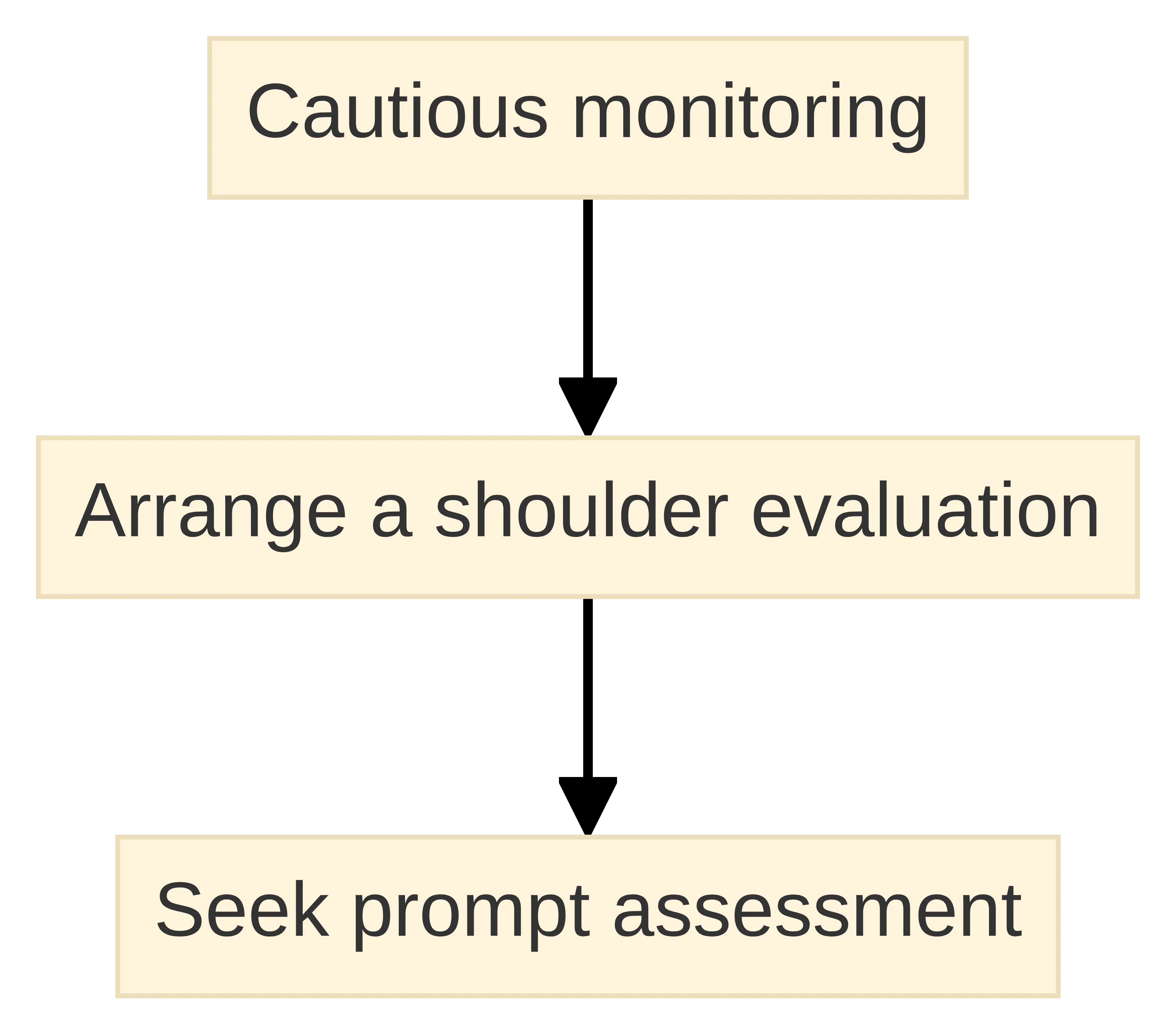
The next step for painful behind-the-back movement depends on severity, onset, associated symptoms, and how much function has changed. Use three practical lanes rather than trying to choose a diagnosis from one symptom.
Monitoring has a boundary: worsening pain, progressive stiffness, increasing weakness, or loss of everyday function should move you to an evaluation.
Lane two: arrange a shoulder evaluation. Choose this lane when the problem persists, progresses, limits dressing or work, disrupts sleep or exercise, or remains unclear after you modify the provoking activity. Several restricted movements, a deep ache with progressive stiffness, outer-shoulder pain during reaching or lifting, and pain with active movement are useful details to bring. The purpose is to sort overlapping possibilities through history and examination, not to confirm a diagnosis from the behind-the-back reach alone.
Lane three: seek prompt assessment. Use this lane after a fall or forceful pull when sudden weakness appears, because that pattern can signal a substantial rotator-cuff tear or another injury. An acute shoulder injury can involve joints, the rotator cuff, nerves or blood vessels, bones, or nearby anatomy. Do not wait for repeated home testing to clarify that pattern.
If tingling travels into your hand, mention it specifically and include whether neck movement changes the symptom or sensation has changed. That pattern may involve a neck nerve and calls for an evaluation that considers more than the shoulder. Choose the lane that matches the most concerning feature, not the feature that is easiest to dismiss.
You can make the decision more concrete by asking four questions:
- Did a distinct event start the problem?
- Is strength changing, or is pain limiting an otherwise available movement?
- Are several directions becoming restricted, or is one activity the main trigger?
- Is the problem stable, improving, worsening, or interfering with ordinary function?
If your answers point in different directions, use the more cautious lane and arrange an evaluation. You do not need to resolve the uncertainty before asking for help. The purpose of the lanes is to prevent a concerning onset or function change from being hidden by a familiar-sounding symptom.
Keep Interim Activity Choices Conservative
Activity modification gives you a way to avoid repeatedly provoking the shoulder while you decide whether monitoring is reasonable. It does not tell you which condition is present or guarantee that symptoms will improve.
Keep interim choices simple:
- Stop using the painful behind-the-back reach as a repeated self-test.
- Reduce the lifting, throwing, or overhead activity that reliably brings on the symptom.
- Keep ordinary movement within a range that does not force the shoulder into sharper pain.
- Choose lighter demands for work, training, or household tasks when a heavier demand reproduces the problem.
- Write down what you changed and whether pain, stiffness, strength, or function changed afterward.
Repetitive overhead activity is associated with shoulder impingement, and heavy lifting is a common context for rotator-cuff tears in the cited material. That does not mean every overhead movement is harmful or that every painful shoulder has a tear. It does support reducing a repeated trigger while you arrange appropriate help if symptoms continue.
Do not turn conservative activity choices into a rigid exercise program. This guide cannot determine which movements, stretches, medication, support, or rehabilitation plan fits your shoulder. Avoid forcing a restricted range or copying a strengthening routine based only on a symptom description. A targeted plan depends on the history and examination findings.
Use function as your monitoring boundary. If you can no longer dress, work, train, sleep, or reach as you normally do, arrange an evaluation rather than extending self-monitoring indefinitely. If a fall or forceful pull caused sudden weakness, skip this monitoring lane and seek prompt assessment.
A useful activity change is temporary and specific. Instead of deciding that you must stop all shoulder use, identify the demand that reliably brings on the symptom and reduce that demand while keeping your account of what happens. If a lighter version still produces pain, weakness, or a growing restriction, that is a reason to move toward evaluation rather than keep adjusting the activity indefinitely.
Bring a Useful Symptom Account to Evaluation
A clear symptom account helps a shoulder evaluation begin with the right question. Before the appointment, record what changed, what you can no longer do, and what makes the pain or limitation better or worse.
Bring these details:
- Onset and trigger: Write down the date or general period when symptoms began, whether the change was gradual, and whether a fall, collision, forceful pull, heavy lift, or repeated overhead activity came first.
- Movement pattern: Describe the behind-the-back reach that causes trouble, along with reaching overhead, lifting, dressing, reaching across your body, and any other restricted movement.
- Pain quality and location: Note whether the sensation is deep, outer-shoulder, front-of-shoulder, sharp, aching, or mainly tight. Include night discomfort and the point in the movement where symptoms begin.
- Strength and function: Explain whether pain stops you from using the arm or whether the arm feels suddenly weak. Record changes in work, exercise, sleep, dressing, and ordinary household tasks.
- Nerve-related details: Mention tingling into the hand, altered sensation, or changes linked to neck movement.
- What you changed: List activities you reduced and what happened afterward. Include prior shoulder injuries, imaging, or care when relevant.
A simple timeline can make this information easier to use:
- Record what you were doing when the first symptom appeared.
- Mark when behind-the-back reach first became limited.
- Note when weakness, night discomfort, stiffness, or tingling appeared, if they did.
- List the activities you reduced and whether function changed afterward.
The history matters because acute shoulder injuries can involve joints, the rotator cuff, nerves or blood vessels, bones, and nearby structures. The same behind-the-back limitation can therefore require different questions depending on how it began and what accompanies it.
Ask the clinician to explain which findings are guiding the next step, what remains uncertain, and which change should prompt follow-up. You can also ask what information from prior MRI or X-ray imaging is relevant and whether the examination suggests a shoulder-only question or a need to consider the neck. Those questions keep the conversation tied to your function instead of a label chosen too early.
You do not need a polished medical vocabulary. “I could reach behind my back last month, then after a fall I suddenly could not lift the arm” is more useful than trying to decide whether the problem is a tear. Describe the sequence in ordinary language and let the examination address the interpretation.
Know What a Shoulder Evaluation Is Trying to Establish
A shoulder evaluation is designed to compare your symptom pattern with the structures and functions that could explain it. Shoulder symptoms overlap, so identifying the specific problem may require a clinical examination rather than relying on one movement or symptom alone.
The examination may include:
- Looking at the shoulder and comparing how it is positioned or used.
- Feeling for tenderness and other changes around the shoulder.
- Checking active and passive range of motion.
- Assessing strength in movements that involve the shoulder and rotator cuff.
- Assessing nerve and blood-vessel function.
- Performing targeted tests intended to reproduce symptoms or signs.
This sequence gives the clinician more information than the statement that reaching behind your back hurts. Range of motion can help place the symptom within a broader stiffness or movement pattern. Neurovascular assessment matters when an acute injury or tingling raises questions beyond the tendons and joints.
A targeted test is not a diagnosis by itself. A finding gains meaning from the history, the other examination findings, the onset, and the effect on your function. That is why a shoulder evaluation should begin with your complete account rather than a request to confirm a condition you found online.
The examination also creates a boundary for the next conversation. It may support monitoring, additional assessment, rehabilitation discussion, imaging review, or consideration of a broader care pathway. The appropriate direction depends on what the history and examination establish. Keep the goal specific: understand what needs to be clarified before you choose care.
Ask what each part of the examination is intended to answer. If a motion test reproduces your pain, ask how that finding fits with the rest of the pattern. If strength appears reduced, ask whether pain, an injury history, or another finding changes its interpretation. If tingling is present, ask how nerve function and the neck fit into the assessment. These questions help you understand the reasoning without treating one test as conclusive.
Use the Evaluation to Narrow the Question Before Discussing Care
The evaluation should turn a broad symptom into a clearer clinical question before you discuss treatment. Shoulder pain can arise from several conditions, and an acute injury can involve more than the rotator cuff, so the first useful answer is what the history and examination are trying to distinguish.
Use questions such as:
- What feature of my history or examination is driving the next step?
- Does the restriction look more like pain-limited movement, broader stiffness, weakness, or a combination?
- Which findings support a shoulder source, and which findings would make the neck or another nearby structure relevant?
- Did the examination identify a reason for prompt assessment rather than monitoring?
- What change in strength, sensation, motion, or function should bring me back for reassessment?
- What would prior MRI or X-ray imaging add to this question, if anything?
- Which care options are reasonable to discuss after the working problem is clearer?
These questions do not ask for certainty where the pattern remains overlapping. They ask for the reasoning behind the next decision and the boundary that would change it. That distinction protects you from treating a symptom label as a confirmed diagnosis.
A treatment discussion should follow the assessment rather than replace it. If the examination identifies a likely tendon, joint, stiffness, injury, or nerve-related question, the care conversation can address that specific problem and its alternatives. If the findings remain uncertain, ask what information is still needed and what you should monitor in the meantime. Keep the next decision tied to the findings that can actually be established.
You can also ask how success or failure of the next step will be judged. The answer should relate to a function you care about, such as dressing, work, training, sleep, or ordinary reaching, rather than to a vague promise that the shoulder will “feel better.” Ask what would lead to reassessment and which new symptom would change the pace of care.
If imaging is discussed, keep it connected to a question raised by the history and examination. A prior scan may be relevant, but its meaning depends on the current symptom pattern. Bring the report or images when possible and ask what finding matters for the decision in front of you.
What RegenCore Method Can Contribute to a Shoulder Evaluation
RegenCore Method treats conditions related to the shoulder.
That process gives you a way to bring the behind-the-back symptom into a broader assessment. Your history can establish whether the limitation followed an injury, developed with repeated activity, or progressed alongside stiffness. The hands-on examination can assess motion, strength, tenderness, and relevant nerve or blood-vessel function. Prior imaging can be reviewed in relation to the current symptoms rather than treated as an answer in isolation. Diagnostic ultrasound is part of the evaluation process we describe for this setting.
Bring the same practical account whether you seek evaluation in Palo Alto, San Francisco, or another appropriate setting in the Bay Area: when the problem began, what movement causes it, whether strength changed, what function has been lost, and whether tingling reaches the hand. Those details help keep the conversation focused on your actual concern.
Our role is to evaluate the shoulder-related problem and develop a personalized treatment and recovery plan after that assessment. The presence of a painful behind-the-back reach does not by itself establish which treatment, if any, fits your situation. Use the appointment to ask what the examination found, what remains uncertain, and what would change the plan.
This means the evaluation is a place to clarify the question, not a commitment to a particular procedure. Bring prior imaging and your symptom timeline, then ask how the findings relate to your function. If the pattern suggests that another type of assessment is needed, that question belongs in the conversation before you decide on care.
Keep Non-Surgical Options Downstream of Assessment
Non-surgical care belongs after the shoulder problem has been assessed, not before a painful movement is treated as a diagnosis. Your next discussion may need to account for stiffness, tendon or rotator-cuff findings, impingement-related pain, an acute injury, joint involvement, or a neck-related symptom pattern.
RegenCore Method guides patients across the full spectrum of care and reserves surgery for when it is the right answer. That means the evaluation comes before a decision about whether a non-surgical path, further assessment, rehabilitation discussion, or surgical consideration belongs in your plan. It does not mean that any particular option is appropriate from the symptom alone.
Keep three questions separate:
- What is the working problem? Ask what the history and examination support and what remains uncertain.
- What is the immediate priority? Sudden weakness after a fall or forceful pull requires prompt examination rather than a treatment comparison. Tingling into the hand may require attention to the neck and nerve function.
- What choices fit the findings? Discuss options only after the clinician explains how they relate to the assessed problem, your function, and the expected follow-up.
A non-surgical label should not lower the standard for assessment. “Non-surgical” describes the position of an option in the care pathway; it does not establish that the option fits your shoulder or that it will produce a particular result. Ask what the plan is intended to address, how progress will be assessed, and what finding would change direction.
When the question is still broad, return to the symptom account and examination rather than choosing a treatment from a symptom search. That keeps care proportional to what can actually be established.
You can use this order when discussing care:
- Clarify the symptom pattern and the working problem.
- Identify whether the immediate priority is monitoring, prompt assessment, rehabilitation discussion, imaging review, or another pathway.
- Compare the options that relate to the findings, including what each option is intended to address.
- Agree on what change or follow-up would cause the plan to be reconsidered.
This order keeps the treatment conversation connected to your actual shoulder findings. It also leaves room for the plan to change if the examination, imaging review, strength, sensation, or function points in another direction.
Choose the Next Conversation When the Pattern Remains Unclear
Painful or limited behind-the-back movement is a decision point, not a diagnosis. Use the wider pattern to choose your next step: broad progressive stiffness points toward evaluation, outer-shoulder pain with reaching or lifting adds tendon or subacromial context, sudden weakness after a fall or forceful pull warrants prompt examination, and tingling into the hand means the neck and nerve function should be considered.
If symptoms are mild, no clear injury occurred, and function is stable, keep activity choices conservative and monitor without repeatedly forcing the painful movement. If symptoms persist, progress, interfere with work or daily life, or leave you uncertain about what is happening, arrange a shoulder evaluation. Bring the onset, movement limits, pain location, strength changes, night symptoms, tingling, activity triggers, and prior imaging to that conversation.
A qualified professional must decide what your findings mean and whether any treatment fits you. An evaluation can then place your symptom account in context before care is discussed.
If the pattern remains persistent, progressive, function-limiting, or unclear, make the next conversation about establishing what is driving the limitation and what should happen next. A clear account of onset, function, strength, and associated symptoms gives that conversation a useful starting point.
Questions to Consider Before Seeking Shoulder-Pain Guidance
What are common causes of shoulder pain when reaching behind the back?
Shoulder pain when reaching behind the back can arise from various conditions, including rotator-cuff disorders, frozen shoulder, labral or biceps injuries, joint disease, and instability. Each of these conditions may present with different symptoms and patterns.
How can I differentiate between stiffness and pain-limited movement in my shoulder?
Stiffness affects the shoulder’s range of motion across multiple directions, while pain-limited movement is typically noticeable in specific positions.
What should I expect during a shoulder evaluation?
A shoulder evaluation typically includes a thorough history, hands-on orthopedic examination, assessment of range of motion and strength, and possibly diagnostic imaging. The clinician will look for tenderness, check nerve and blood vessel function, and perform specific tests to reproduce symptoms.
What steps can I take to manage shoulder pain while monitoring my symptoms?
You can manage shoulder pain by avoiding movements that provoke pain, reducing overhead activities, and keeping ordinary movements within a comfortable range. It’s important to monitor any changes in symptoms and seek evaluation if they worsen.
How does RegenCore Method approach shoulder pain evaluations?
RegenCore Method conducts comprehensive evaluations that include a detailed history, physical examination, diagnostic ultrasound, and personalized treatment plans. They focus on understanding the underlying issues before discussing treatment options.
When should I consider scheduling a shoulder evaluation?
Consider scheduling a shoulder evaluation if your symptoms persist, worsen, or interfere with daily activities, especially if you notice progressive stiffness, multiple restricted movements, or if you have experienced a recent injury.
Next step
Have a question for RegenCore?
Concierge regenerative & orthobiologic orthopedics in San Francisco and Palo Alto. Research-backed, non-surgical treatment — PRP, bone marrow concentrate (BMAC), stem cell therapy, shockwave, EMTT and spinal disc care — to help the body heal itself.
Get in touch