
soreness on inside of knee
Soreness on the Inside of Your Knee: How to Choose the Right Next Step

Inner-Knee Soreness Is a Location, Not a Diagnosis
Inner-knee soreness refers to discomfort on the medial, or inside, part of your knee. That location gives you a useful starting point, but it does not identify one condition by itself. Several different problems can produce pain in the same area, so the next step depends on more than where the soreness is felt.
The inside of your knee includes structures and regions that can be affected by different problems. The medial collateral ligament, or MCL, runs along the inner side of the knee and helps stabilize it. The medial compartment is also a common location for knee osteoarthritis, while an injury to the medial meniscus can cause pain along the inner aspect of the knee. These possibilities can overlap in how they feel.
A location-based label such as medial knee pain therefore answers only one question: where is the symptom? It does not answer why it started, whether an injury occurred, how serious it may be, or which care approach fits. Inner-knee soreness alone cannot confirm an MCL injury, meniscus injury, arthritis, or another condition.
Use the symptom as a prompt to organize the rest of the story. Note when it began, whether a fall or twist preceded it, whether swelling appeared, whether the knee feels unstable, whether you can bear weight, and whether the soreness is improving or interfering with activity. Those details help you choose between cautious monitoring and professional evaluation without trying to diagnose the cause at home.
The most useful first question is not “Which condition do I have?” It is “What changed, and how is my knee functioning now?” That shift keeps you focused on information that can change the pace of your next step.
Read the Timing and Trigger Without Self-Diagnosing
Timing and trigger can help you describe inner-knee soreness, but neither feature proves what caused it. A symptom that began after a direct impact raises a different question from soreness that appeared gradually during repeated activity, yet both still require the rest of the symptom history and, when appropriate, an examination.
Start by separating the main patterns:
- A sudden event: Overuse, a sudden twisting movement, or a direct impact to the inner knee can be associated with an MCL injury. Those circumstances do not establish that the MCL is injured.
- A twisting or loading event with continuing inner pain: A medial-meniscus injury can cause pain on the inner aspect of the knee. The location and the event alone cannot determine whether the meniscus is involved.
- Gradual or recurring soreness: Knee osteoarthritis often affects the medial compartment and can cause pain on the inside of the knee. Inner-knee pain alone still does not confirm arthritis.
- Symptoms without a clear local injury: Inflammatory or systemic conditions can affect the knee, so the absence of one obvious incident does not reduce every possibility to overuse or wear-related change.
Your symptom timeline should include the date or approximate period when soreness began, what you were doing at the time, whether symptoms changed suddenly or gradually, and what has happened since. Also note whether the soreness stays in one spot or changes, whether swelling appeared, and whether particular activities make it worse. This account is more useful than choosing a diagnosis from a list of symptoms.
Ask yourself four practical questions:
- Did the soreness begin during one identifiable event or build over time?
- What activity, movement, or impact came before it?
- Has the pattern changed since it began?
- What can you do now that you could not do comfortably before?
A clear trigger can guide what you tell a clinician. It cannot replace the evaluation.
Keep the Possible Causes Broad
The main cause categories for inner-knee soreness include injury, overuse, degenerative joint changes, and inflammatory or systemic conditions. Keeping these categories broad prevents you from treating one symptom location as if it were a diagnosis.
Injury-related possibilities include an MCL problem after overuse, a sudden twist, or a direct impact, as well as a medial-meniscus injury that produces pain along the inner aspect of the knee. Swelling, instability, or difficulty bearing weight after an acute event changes how quickly you should seek evaluation. It also makes self-diagnosis less appropriate.
Degenerative possibilities include knee osteoarthritis. Osteoarthritis often affects the medial compartment, which means it can cause soreness on the inside of the knee. That association does not mean every episode of inner-knee soreness is arthritis. A gradual pattern may be relevant, but it is only one part of the assessment.
Overuse-related possibilities deserve attention when symptoms followed repeated activity rather than one identifiable impact or twist. Overuse is also described as a possible mechanism associated with an MCL injury, so the word does not point to one specific tissue or condition. Repeated activity may be part of the story even when you cannot identify a single moment when the soreness began.
Inflammatory or systemic possibilities include rheumatoid arthritis, psoriatic arthritis, gout, and reactive arthritis. These conditions can affect the knee as part of a broader health problem. If your knee symptoms occur alongside other concerning or unusual symptoms, describe the complete pattern rather than assuming that local soreness has a purely mechanical explanation.
These categories are questions to bring into an evaluation, not labels to assign yourself. Your location, onset, trigger, swelling, stability, weight-bearing ability, duration, and overall health history all matter. The same symptom can require different next steps depending on that combination.
You can use the categories to organize your notes without deciding among them. Write down what supports each question and what remains unknown. That approach gives an evaluation something specific to clarify.
Use Swelling, Stability, and Weight-Bearing to Set the Pace
Swelling, knee stability, and your ability to bear weight help set the pace for responding to inner-knee soreness. These features do not diagnose the problem, but they can move your situation out of a casual monitoring lane.
Swelling can occur with several knee problems, including an acute injury, osteoarthritis, rheumatoid arthritis, or bursitis. Swelling after a fall or twisting event may signal a more serious injury, such as a ligament injury or fracture. Treat that combination as a reason to seek clinical advice rather than assuming that the soreness will settle on its own.
Instability also matters. Severe pain with swelling and instability after an acute injury is included among circumstances that generally require urgent medical evaluation. Inability to bear weight after acute trauma is another reason to seek urgent evaluation, particularly when it occurs with severe pain or swelling.
After a fall or acute twist, clinicians consider findings such as focal tenderness, an effusion, and inability to bear weight when deciding whether initial imaging is appropriate. Imaging decisions are therefore connected to the examination and the injury history. A fall or twist does not automatically mean that every type of scan is needed.
Use these questions to choose the pace:
- Did swelling appear after a fall, impact, or twist?
- Does the knee feel unstable?
- Can you bear weight normally, or is doing so difficult or impossible?
- Is the pain severe, especially together with swelling or instability?
- Has your range of motion become limited?
If the answer to these questions raises concern, seek medical evaluation rather than trying to identify the injured structure yourself. The purpose of these questions is triage, not diagnosis.
A change in function can matter even when the pain score seems manageable. Difficulty walking, an altered gait, or a knee that does not move as usual gives you additional information to report. Record when the change began and whether it is improving, stable, or worsening.
When Cautious Monitoring May Be Reasonable
Cautious monitoring may be reasonable when inner-knee soreness is mild, improving, and not accompanied by warning signs or a substantial loss of function. This is a general monitoring approach, not a determination that your knee is unaffected or that a particular diagnosis is absent.
Many cases of medial knee pain may be managed at home, while healthcare guidance advises you to seek evaluation when the pain lasts more than a few days in a row. That boundary matters because early improvement can be reassuring without explaining why the soreness occurred. If symptoms continue instead of settling, the reason for the soreness remains unresolved.
While monitoring, pay attention to the direction of change rather than trying to name the condition. Record whether soreness is becoming less frequent, less intense, or less limiting. Also note whether swelling appears, whether walking becomes harder, whether the knee feels unstable, or whether a new injury changes the pattern.
A simple monitoring note can include:
- When the soreness was noticeable during the day.
- Which activity brought it on or made it worse.
- Whether the knee looked swollen or felt unstable.
- How walking and ordinary activity changed.
- Whether the overall pattern is improving, unchanged, or worsening.
Monitoring should not become a reason to ignore a concerning change. Move toward professional evaluation if the soreness persists beyond a few days, interferes with ordinary activity, follows a significant injury, or develops alongside swelling, instability, inability to bear weight, fever, redness, or limited motion. Seek urgent medical evaluation for the specific severe or possible-infection patterns described in the next section.
Know Which Warning Signs Should Not Wait
Warning signs such as severe pain, swelling, instability, inability to bear weight, fever, redness, or limited motion should change how quickly you seek care. These signs do not tell you the exact cause, but they can indicate that waiting for the soreness to resolve without evaluation is not appropriate.
Seek urgent medical evaluation when you have:
- Severe pain with swelling and instability after an acute injury.
- Severe pain with swelling after an acute injury when you cannot bear weight.
- Inability to bear weight after a fall, twist, or other sudden knee trauma.
- Fever together with knee swelling, redness, or limited range of motion.
- Knee swelling, redness, and restricted movement that raise concern for a possible joint infection.
Swelling after a fall or twist may indicate a more serious injury, including a ligament injury or fracture. Fever, redness, swelling, and limited motion can occur with possible joint infection. Neither pattern should be reduced to ordinary soreness based only on where it hurts.
If your symptoms are concerning but do not match the urgent patterns above, arrange timely professional evaluation rather than relying on an indefinite wait. The reason for evaluation may be persistent pain, reduced function, a changing symptom pattern, or uncertainty after an injury. Bring the timing, trigger, swelling history, and functional changes with you so the assessment can begin with a clear account.
Do not use this list to rule out a condition when none of the warning signs is present. The absence of a warning sign does not identify the cause. If you are unsure whether your symptoms fit an urgent pattern, use the severity, function, injury history, and associated symptoms together rather than relying on one sign in isolation.
Persistent or Activity-Limiting Soreness Deserves Assessment
Persistent or activity-limiting inner-knee soreness deserves assessment even when the initial symptoms did not seem urgent. Healthcare guidance advises seeing a provider when medial knee pain lasts more than a few days in a row, and an initial knee evaluation considers duration, function, swelling, associated symptoms, and injury history as relevant parts of the clinical picture.
Activity limitation can be practical and specific. You may notice that soreness changes how you walk, prevents you from hiking around the Bay Area, interrupts sports participation, or makes a usual daily activity harder. You do not need to decide whether that limitation comes from a ligament, meniscus, joint change, or another source before asking for help. Describe what you can no longer do comfortably and what you have changed because of the symptom.
Duration also matters. For chronic knee pain lasting more than six weeks, radiographs may be appropriate; imaging is not automatically indicated for every knee complaint. That does not mean every pain episode lasting six weeks needs the same imaging, and it does not mean you should order imaging on your own. It means the history and examination help determine whether imaging answers a useful clinical question.
Seek evaluation when soreness persists, returns repeatedly, or limits an activity you want to maintain. Bring your symptom timeline, any injury details, changes in swelling or stability, and the treatments or activity changes you have already tried. A focused evaluation can replace guesswork with a clearer question about what should happen next.
An activity goal can make that conversation more concrete. “I want to return to hiking,” “I cannot finish a tennis session,” or “walking across campus now hurts” tells the clinician how the symptom affects your life. It also gives the evaluation a function to consider alongside the pain location.
Prepare a Symptom Account for Your Knee Evaluation
A useful symptom account gives your clinician the timeline, functional impact, and background needed to assess inner-knee soreness. You can prepare it before the appointment instead of trying to remember every detail during the conversation.
Bring or write down:
- Your activity goal: Name the activity you want to keep doing or return to, such as hiking, tennis, golf, strength training, travel, or longer walks.
- Your symptom timeline: Record when soreness began, whether it followed an injury, exactly where it hurts, what it feels like, and what makes it better or worse.
- Changes in function: Note how soreness affects walking, exercise, work, recreation, or other activities that matter to you.
- Swelling and associated symptoms: Describe whether swelling appeared, when it appeared, and whether you noticed instability, limited motion, or other symptoms.
- Your health history: Include relevant medical and surgical history, along with allergies.
- Your medication and supplement list: Include doses when possible and identify any blood thinners.
- Prior imaging: Bring available X-ray or MRI images as well as written reports. The images can provide information that a report alone does not show.
- Treatment history: List physical therapy, injections, braces, medications, surgery, or activity changes, and note how much each helped and for how long.
- Your questions: Write the two or three decisions you most want help making.
Your account does not need to use medical terminology. A simple sequence is enough: what happened, what you felt, what changed, what you tried, and what you cannot do now. That sequence helps connect the symptom location with onset, injury, swelling, function, and duration.
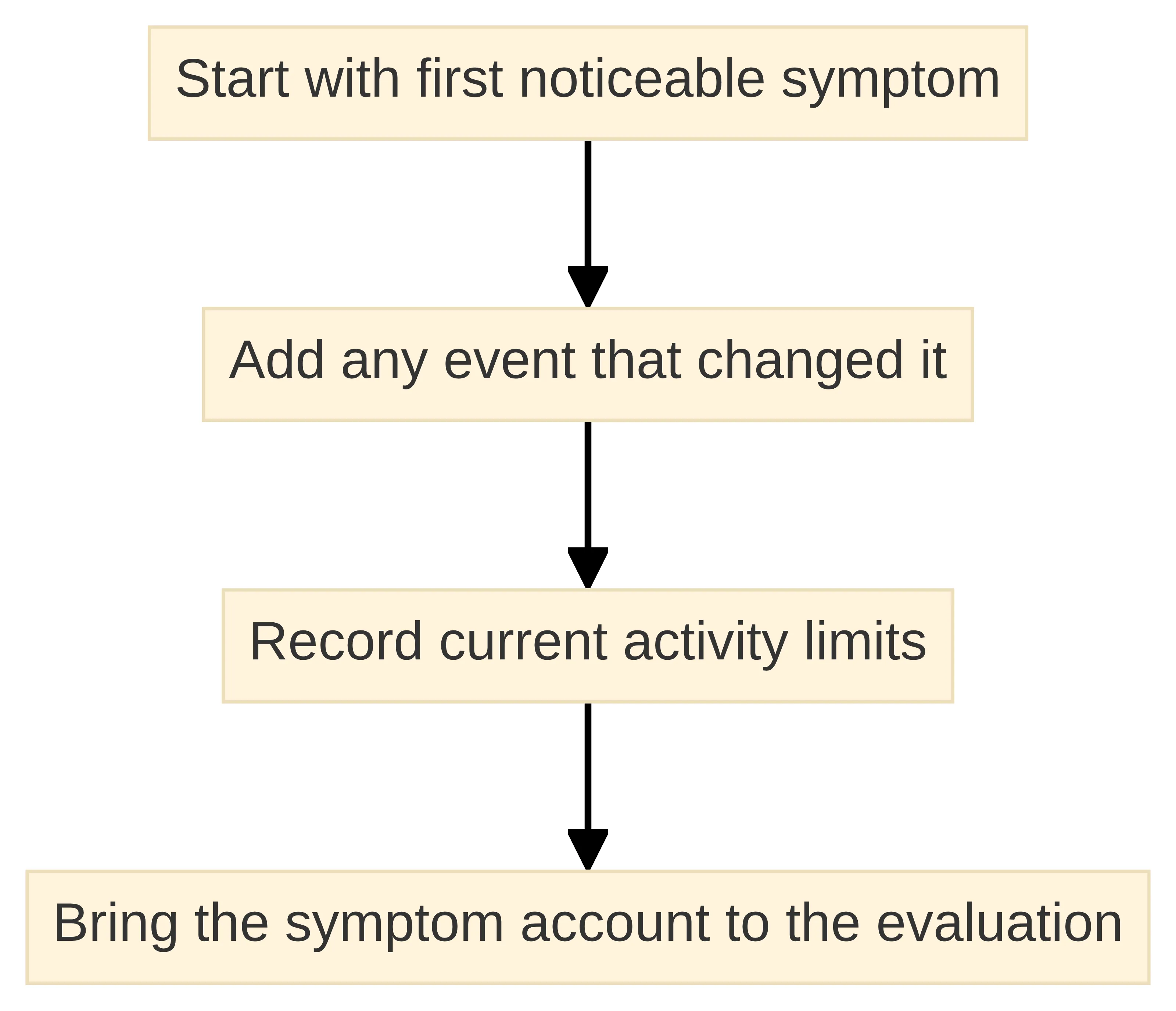
Before the visit, put the information in the order it happened. Start with the first noticeable symptom, add any event that changed it, and finish with your current activity limits. This makes it easier to distinguish the original pattern from later changes.
What the Evaluation Needs to Clarify
A knee evaluation needs to clarify the likely source of your symptoms, how urgently they require attention, and whether additional testing could answer a specific question. The goal is not to force inner-knee soreness into a diagnosis based on location alone.
A systematic knee examination can include inspection, palpation, range-of-motion assessment, strength testing, neurovascular testing, and special tests. Your history remains part of that process. Age, pain location, onset, duration, quality, swelling, mechanical or systemic symptoms, precipitating trauma, and relevant medical or surgical history can all shape the evaluation.
Imaging is considered in context. After an acute fall or twist, clinicians consider focal tenderness, an effusion, and inability to bear weight when deciding on initial imaging. For chronic knee pain lasting more than six weeks, radiographs may be appropriate; imaging is not automatically indicated for every knee complaint. A prior MRI or X-ray can be useful, but it does not replace the history and examination.
At RegenCore Method, our evaluations include a thorough history, hands-on orthopedic exam, diagnostic ultrasound, review of prior MRI or X-ray imaging, and a personalized treatment and recovery plan. This process gives you a structured place to discuss what started the soreness, how it affects your activity, and what remains uncertain.
If treatment options become part of the discussion, they should follow the clinical question established by the evaluation. The symptom location alone should not determine whether any particular non-surgical approach is appropriate.
You can ask questions that keep the visit focused:
- What findings could explain the location and timing of my soreness?
- Does my history suggest that imaging would answer a specific question?
- Which changes in swelling, stability, motion, or function should change my next step?
- What should I monitor if the initial plan is observation?
- How does the proposed plan relate to my activity goal?
These questions do not require you to arrive with a diagnosis. They help you leave with a clearer understanding of what has been established and what still needs attention.
Choose a Local Evaluation When the Next Step Remains Unclear
A local knee evaluation is a reasonable next step when inner-knee soreness persists, limits an activity, follows a concerning injury, or leaves you unsure what to do next. Connecting the location with the timing, trigger, swelling, stability, weight-bearing ability, duration, and functional impact gives the evaluation a useful starting point.
At RegenCore Method, we treat conditions affecting tendons, ligaments, cartilage, muscles, and joints associated with osteoarthritis and injury. Our evaluation process includes a thorough history, hands-on orthopedic exam, diagnostic ultrasound, review of prior MRI or X-ray imaging, and a personalized treatment and recovery plan. A qualified medical professional must decide whether any particular treatment is suitable for your individual circumstances.
For adults in Palo Alto and the Bay Area, bring your symptom account and the questions you want answered. A focused conversation can help clarify whether continued monitoring, further assessment, or discussion of non-surgical care fits the findings. If the soreness is severe with swelling and instability after an injury, if you cannot bear weight after acute trauma, or if fever, redness, swelling, and limited motion raise concern for infection, seek urgent medical evaluation rather than using a routine appointment as your only plan.
What Should You Bring to a Knee Evaluation?
What are common causes of soreness on the inside of the knee?
Soreness on the inside of the knee can arise from various issues, including injuries to the medial collateral ligament (MCL), medial meniscus injuries, knee osteoarthritis, and inflammatory conditions such as rheumatoid arthritis or gout.
When should I seek professional evaluation for inner-knee soreness?
You should seek professional evaluation if you experience severe pain with swelling and instability after an injury, inability to bear weight, or if symptoms persist for more than a few days without improvement.
What should I prepare for a knee evaluation?
For a knee evaluation, prepare a symptom timeline, details about any previous injuries, a list of medications, prior imaging results, and specific questions you want to discuss with the clinician.
How can I manage mild inner-knee soreness at home?
Mild inner-knee soreness can often be managed at home through rest, ice, compression, and elevation. However, monitor your symptoms closely and seek medical advice if they do not improve.
What warning signs indicate I need urgent medical attention for knee pain?
Warning signs that require urgent medical attention include severe pain with swelling, inability to bear weight, fever, redness, or limited range of motion in the knee.
What is the RegenCore Method's approach to knee pain evaluation?
The RegenCore Method includes a thorough history, hands-on orthopedic examination, diagnostic ultrasound, review of prior imaging, and a personalized treatment and recovery plan.
What types of treatments does RegenCore offer for knee pain?
RegenCore offers treatments such as regenerative therapy, shockwave therapy, and various injection therapies like Platelet-Rich Plasma (PRP) and Bone Marrow Aspirate Concentrate (BMAC) to address knee pain.
Next step
Have a question for RegenCore?
Concierge regenerative & orthobiologic orthopedics in San Francisco and Palo Alto. Research-backed, non-surgical treatment — PRP, bone marrow concentrate (BMAC), stem cell therapy, shockwave, EMTT and spinal disc care — to help the body heal itself.
Get in touch