
knee pain after sitting with legs bent treatment
Knee Pain After Sitting With Legs Bent: How to Choose Your Next Step
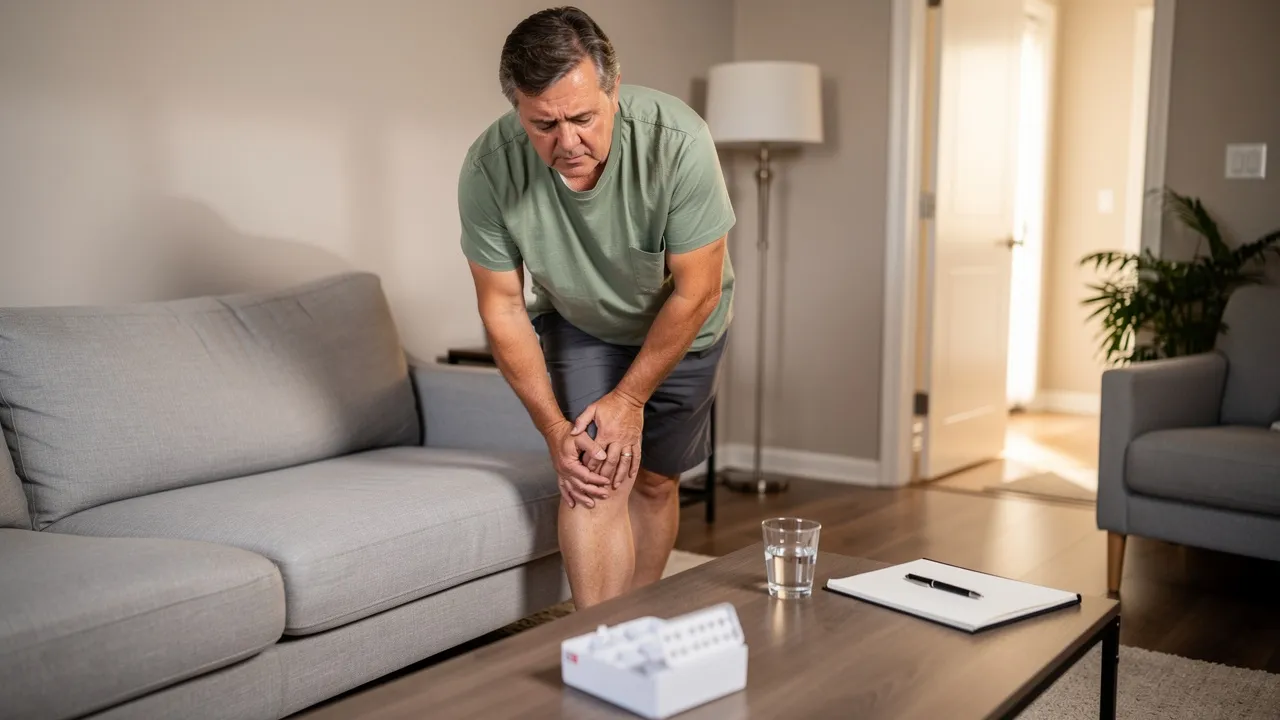
The Sitting Position Is a Clue, Not a Diagnosis
Knee pain after holding a bent-knee sitting position is a clue about what provokes your symptoms, not a diagnosis. The same position-linked discomfort can occur with several different problems, and the position alone cannot tell you whether the source is arthritis, a meniscus problem, tendon irritation, bursitis, ligament strain, a fracture, or an infection. Knee pain when bending can have numerous causes, including osteoarthritis, meniscus tears, bursitis, ligament strain, tendonitis, fractures, and infection.
A bent knee also describes more than sitting in an office chair. You may notice symptoms while sitting on the floor, kneeling, sitting on your heels, or keeping your knee folded during a long drive or meal. Positions such as cross-legged floor sitting, kneeling, and sitting on your heels can place more stress on the ligaments around the kneecap. If one of those positions increases your discomfort, limit it while you work out what the pattern means.
The useful question is not “Which diagnosis does this symptom prove?” Ask instead: when did the pain begin, what else happens with it, and is it changing what you can do? A mild symptom that appears only in one position may call for a period of adjustment and observation. Pain after an injury, pain with swelling or locking, or pain that persists and limits activity points toward an evaluation rather than a prolonged guess.
The position may be exposing a movement or loading problem that becomes noticeable only when the knee stays bent. That observation can help you describe the complaint, but it cannot identify which knee structure is involved. Use the sitting position as the starting point for a symptom pattern, not as proof that you have a particular condition.
Read the Pattern Around the Pain
The pattern around your knee pain gives you more decision information than the sitting position alone. Start with four observations: how the pain began, where you feel it, what happens when you move, and whether the knee swells, catches, locks, or gives way. These observations cannot diagnose the problem, but they can help you explain it clearly and decide how quickly to seek assessment.
Gradual onset can fit more than one explanation. Osteoarthritis is described as a chronic, progressive disease that can cause joint degeneration and deep, diffuse inflammation, with symptoms that develop gradually and worsen over time. If your discomfort has built up over weeks or months and is becoming more noticeable during everyday activities, record that pattern rather than assuming the sitting position caused it.
A sudden start after a twist or pivot gives the symptom a different context. A meniscus tear can involve the knee’s shock-absorbing cartilage and may follow a twist or pivot, with symptoms such as sharp pain, swelling, instability, catching, or locking. You do not need to decide that you have a meniscus tear; you do need to mention the movement and any mechanical symptoms during an assessment.
Location and activity can also help organize the conversation. Tendinitis can cause localized inflammation of a knee tendon and activity-related pain, typically without joint damage or mechanical symptoms. Bursitis can involve superficial inflammation of a bursa, with localized swelling and tenderness at the front of the knee. Those descriptions are clues to discuss, not labels to apply to yourself from a sitting symptom alone.
A practical symptom note can include:
- The first day or period when you noticed the pain.
- Whether a fall, twist, pivot, increase in activity, or no clear event came before it.
- The exact area of pain and whether it feels diffuse or localized.
- Swelling, instability, giving way, catching, or locking.
- Whether the pain appears only with a bent knee or also during walking and other activities.
- Any previous knee surgery or symptoms that seem to come from the hip.
A knee-pain pathway considers referred hip pain, previous knee surgery, instability, locking, swelling, age, and symptom onset when directing further assessment. Bringing these details to an appointment can make the remaining question more specific.
Function adds another useful layer. Note whether you can walk normally, use stairs, exercise, work at a desk, get up from a chair, or sit through a meal without changing position. A symptom that appears only after prolonged bending presents a different decision question from pain that also affects walking, causes the knee to give way, or keeps you from your usual activities.

Change the Sitting Load While You Monitor
Sitting habits can change the duration and positions that provoke your discomfort while you decide whether it needs assessment. If you sit for six to eight hours during the workday, stretch your legs and get up to walk around every hour or half hour. These are general measures to try while observing your symptoms, not a way to establish the cause.
Your chair setup can give you another practical variable to adjust. Choose a comfortable chair that keeps your knees about the same level as your hips and at about a 90-degree angle, with your feet flat on the floor. If the position increases your pain, change it rather than forcing yourself to remain there.
Use a short observation period to answer a narrow question: does reducing the aggravating position change when the discomfort appears? During that period, limit cross-legged floor sitting, kneeling, or sitting on your heels if those positions increase your knee discomfort. Note what you changed, when the pain appears, and whether the symptom is becoming more frequent, more intense, or more limiting. Stop treating observation as the right path if swelling, instability, locking, a relevant injury, or difficulty bearing weight enters the picture.
Keep the experiment simple. Change one sitting habit at a time when possible, record what happens during sitting and afterward, and avoid using temporary comfort as proof that the underlying problem has been identified. The purpose of these adjustments is to give you useful information and reduce a known aggravating position while you decide whether assessment is needed.
Warning Signs That Should Change Your Timeline
Warning signs change the timeline because swelling, instability, locking, and injury details can change what an assessment needs to address. Arrange professional assessment rather than continuing to monitor indefinitely if you notice any of the following:
- The knee repeatedly gives way or feels unstable.
- The knee locks or catches in a way that interferes with movement.
- Swelling develops or keeps returning.
- The pain began after a fall, twist, or pivot.
- A previous knee surgery changes the context of the current symptoms.
- Your symptoms may be referred from the hip rather than originating only at the knee.
A knee-pain pathway uses these features to direct further assessment. Their presence does not identify one diagnosis, but it does make a symptom-only decision less appropriate.
Acute trauma creates an additional reason to change your timeline. After a fall or twisting injury, focal tenderness, an effusion, or inability to bear weight are features clinicians consider when deciding on initial imaging.
The absence of a warning sign does not prove that the knee is fine. It simply leaves more room for a measured adjustment-and-observation approach when the pain is mild, position-linked, and not interfering with function. Worsening symptoms or a growing effect on walking, work, exercise, or daily activities should move you toward an evaluation.
A relevant injury and an inability to bear weight deserve more attention than the fact that the pain first appeared while sitting. Likewise, repeated locking or giving way matters even if the knee feels better after you stand. Let the associated sign set the pace of your next step.
When Persistent Pain Calls for an Evaluation
Persistent knee pain deserves a different response from a brief, position-linked twinge. If knee pain when bending persists or concerns you, seek a proper medical evaluation for accurate diagnosis and a personalized treatment plan. Persistence does not prove arthritis, a meniscus problem, or another specific cause; it means that continued guessing is less useful than clarifying the problem.
Activity limits are another practical threshold. Arrange an evaluation if the symptom keeps you from hiking, exercising, working comfortably, using stairs, sitting through a meeting, or completing ordinary tasks. The relevant question is not whether you can tolerate the discomfort for a few more days. It is whether the symptom is narrowing your choices or continuing despite the adjustments you have tried.
Before the appointment, write down what you changed and what happened afterward. Include the onset, location, provoking positions, activity effect, swelling, locking, instability, and any injury or prior surgery. That record gives the clinician a clearer starting point and helps separate a position that provokes pain from the condition that may be producing it.
Persistent symptoms do not automatically point to a procedure. They point to a need for better information. The evaluation may support continued conservative care, identify a reason for further testing, or create a basis for discussing other treatment categories. Your job before the visit is to describe the pattern accurately, not to select a treatment from the symptom alone.
What an Evaluation Can Clarify
A knee evaluation is designed to connect your symptom history with the findings needed to decide what happens next. The discussion may cover whether the pain could be referred from the hip, whether you have had knee surgery, whether the knee gives way or locks, whether swelling is present, and whether the onset was gradual or linked to an event. Your activity limits and the positions that provoke symptoms also give the clinician useful context.
A clinician may combine that history with a physical examination and then decide whether imaging is relevant to the question. Imaging is not a diagnosis by itself, and the most useful test depends on the pattern being assessed. For acute trauma, the mechanism of injury, tenderness, swelling, and ability to bear weight help shape the initial imaging decision.
The ACR criteria give a specific example of why conditions matter. After acute knee trauma without focal tenderness or an effusion, when you can walk, clinicians may consider knee radiography for initial imaging; the criteria list MRI as “Usually Not Appropriate” in that situation. This statement applies to that acute-trauma scenario and should not be generalized to every person with pain while sitting or bending.
You can make the evaluation more useful by asking:
- What features of my history are most relevant to the next decision?
- Does the symptom pattern suggest that the hip or another area should also be considered?
- What does the examination need to clarify?
- If imaging is proposed, what clinical question will it answer?
- What findings would support monitoring, conservative care, or a discussion of other options?
These questions keep the appointment focused on decisions rather than on naming a condition from one symptom.
The value of an evaluation is not limited to receiving a label. It can help distinguish a position that aggravates symptoms from a condition that needs a different response, identify features that change the urgency of assessment, and connect any proposed treatment with a defined clinical question. Ask what each finding changes before treating an image or symptom as the whole explanation.
Start With Conservative Care Before Choosing a Procedure
Conservative care is a treatment discussion about what you can change or monitor before a procedure is considered. For this symptom pattern, that discussion may begin with changing the sitting positions that aggravate you, taking movement breaks during long periods of sitting, and setting up a chair that allows a comfortable knee position. We consider changing behavior essential for long-term improvement in knee pain management.
Conservative care is not the same as ignoring persistent symptoms. It is a deliberate path with a boundary: make a reasonable adjustment when the pattern is mild and position-linked, then reassess whether the pain is changing. If the symptom continues, worsens, or limits activity, use an evaluation to clarify whether the plan should remain focused on adjustments or move toward another treatment discussion.
Avoid turning a general measure into a personal prescription. Your history, examination, and any relevant imaging may change which options make sense. A chair adjustment or movement break may be reasonable to try while you observe the pattern, but neither confirms the cause nor guarantees that the pain will resolve.
Conservative care can also give you a clearer treatment conversation. Bring your response to sitting changes, movement breaks, and activity adjustments to the appointment. A change in symptoms may be useful context, but it does not by itself establish whether the source is the joint, meniscus, tendon, bursa, or another structure.
Where PRP or BMAC May Enter the Discussion
PRP and BMAC belong in a diagnosis-led treatment discussion, not in a decision based on bent-knee pain alone. At RegenCore Method, we provide research-backed, non-surgical treatments including PRP, bone marrow concentrate (BMAC), stem cell therapy, shockwave, EMTT, and spinal disc care. Whether one of these options fits depends on what an evaluation establishes.
We commonly use PRP for conditions such as knee osteoarthritis, patellar and Achilles tendinopathy, and hip and gluteal tendon pain. That description identifies conditions we discuss; it does not turn a position-linked symptom into a diagnosis or promise a particular result. An evaluation still needs to clarify what structure or condition may be involved before you discuss whether PRP belongs in your options.
We commonly use BMAC for moderate to advanced knee osteoarthritis, cartilage injury in select candidates, severe or chronic tendon injuries, and cases beyond what PRP alone can address. “Select candidates” is a meaningful boundary: you cannot determine from sitting pain alone whether you meet it. The relevant conversation depends on the condition being assessed, the severity and context of the problem, and the alternatives that remain available.
If regenerative treatment comes up, ask questions that connect the option to your unanswered clinical question:
- What diagnosis or tissue problem is the treatment intended to address?
- What findings make this option relevant to my situation?
- What conservative measures should be considered or continued?
- What uncertainty remains about the cause of my pain?
Those questions leave PRP or BMAC as options to discuss after the cause has been clarified.
The treatment category should follow the assessment, not replace it. Bent-knee pain can occur in several contexts, while the descriptions of PRP and BMAC apply to particular conditions and, for BMAC, select candidates. Discuss these options only after the evaluation has connected your symptoms with a condition that the treatment is intended to address.
Choose the Next Conversation Based on What You Still Need to Know
Your next step should match the uncertainty, warning signs, and effect of the knee pain on your activity. Use this decision rule:
- If the pain is mild, linked to a particular sitting position, and free of swelling, instability, locking, or a relevant injury, adjust the position, take movement breaks, and observe the pattern for a limited period.
- If the pain follows a fall or twist, or you have focal tenderness, swelling, instability, locking, or difficulty bearing weight, arrange prompt professional assessment.
- If the pain persists, concerns you, or limits activity despite reasonable adjustments, arrange an evaluation to clarify the cause and discuss the next treatment category.
A qualified clinician must decide what your symptoms mean and whether any treatment is suitable for you.
For adults in Palo Alto and the Bay Area, a focused evaluation can help turn a vague position-linked complaint into a clearer treatment conversation. At RegenCore Method, we offer non-surgical options including PRP and BMAC, but those options remain dependent on what the evaluation establishes. The immediate goal is not to choose a procedure from a symptom; it is to decide whether monitoring is still reasonable or whether clarification should come next.
Persistent or activity-limiting knee symptoms deserve a clearer basis for discussing diagnosis and treatment options. A qualified professional can decide whether an evaluation is suitable for your situation.
Questions to Ask About Knee Pain After Sitting With Your Legs Bent
What should I do for knee pain after sitting with legs bent?
If the pain is mild, appears mainly in one position, and is not accompanied by swelling, locking, instability, injury, or difficulty bearing weight, try changing the position, taking regular movement breaks, and using a chair that keeps your knees near hip level with your feet supported. Track whether the symptom improves, persists, or begins affecting activity. Do not treat temporary relief as proof of the cause.
Can knee pain when sitting with a bent knee tell me whether I have a meniscus or ligament problem?
No. The position alone cannot identify the injured or irritated structure. A clinician may consider whether symptoms began after a twist or pivot, along with swelling, catching, locking, instability, or giving way. These clues help guide assessment but do not establish a diagnosis without an appropriate history and examination.
When should knee pain after sitting prompt an evaluation?
Arrange professional assessment if the pain persists, worsens, limits walking or daily activities, or continues despite reasonable position and activity adjustments. Seek prompt assessment after a fall or twisting injury when there is focal tenderness, swelling, or difficulty bearing weight, and when the knee repeatedly locks, catches, or gives way.
What might a clinician review before recommending knee treatment?
The evaluation may review when symptoms began, the location and pattern of pain, aggravating positions, activity limits, prior knee surgery, hip-related symptoms, swelling, locking, and instability. A physical examination may be followed by imaging when it addresses a specific clinical question. Conservative care is often discussed alongside other options; PRP or BMAC suitability depends on the condition identified and the individual evaluation.
Next step
Have a question for RegenCore?
Concierge regenerative & orthobiologic orthopedics in San Francisco and Palo Alto. Research-backed, non-surgical treatment — PRP, bone marrow concentrate (BMAC), stem cell therapy, shockwave, EMTT and spinal disc care — to help the body heal itself.
Get in touch