
east bay shoulder clinic & sports rehabilitation
How to Choose an East Bay Shoulder Clinic and Sports Rehabilitation Provider

Start with the shoulder-care decision you need to make
Choosing an East Bay shoulder clinic and sports rehabilitation provider starts with the decision you need to make, not with a treatment name. You may be trying to understand pain that affects sleep, dressing, overhead reaching, work, or exercise. You may also be weighing what to do after a fall, collision, lifting injury, or gradual decline in shoulder function. Shoulder pain can interfere with sleep, dressing, overhead reaching, and physical activity, while shoulder injuries can involve the joints, rotator cuff, neurovascular structures, clavicle, humerus, or nearby anatomy.
A useful comparison follows three stages:
- Define what needs evaluation. Describe how the problem began, where you feel it, which movements affect it, and what you can no longer do comfortably.
- Judge the evaluation and rehabilitation plan. Look for a clear connection between the findings, the exercises or activity changes proposed, and the demands of your work or sport.
- Discuss treatment scope afterward. Ask about available options only after the clinic has explained what the examination is trying to establish and how the options relate to your situation.
That order gives you a way to compare clinics without assuming that a familiar label, scan, injection, or rehabilitation package fits your shoulder. The aim is a useful next conversation: one that clarifies the problem, identifies the information still missing, and connects care with your daily demands.
An East Bay shoulder-care decision can be practical even when your options extend into the wider Palo Alto and Bay Area context. Start by deciding whether you need help interpreting a new injury, understanding persistent limitations, planning rehabilitation, or discussing non-surgical options. Your reason for seeking care should shape the questions you bring and the kind of assessment you expect.
Describe the shoulder problem in terms a clinic can evaluate
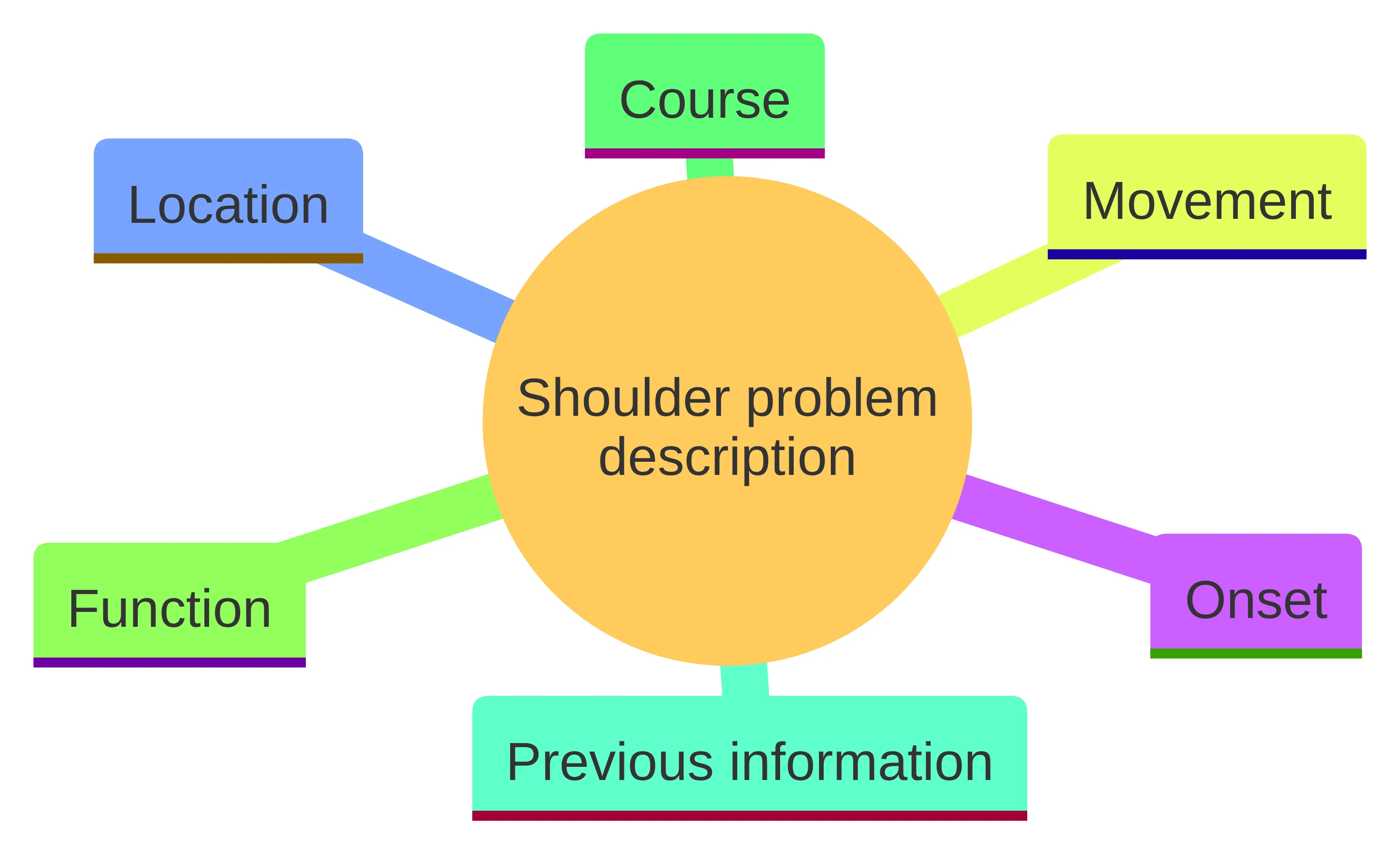
Your shoulder problem becomes easier to evaluate when you describe the pattern rather than trying to settle on a diagnosis. A clinician needs enough detail to connect the symptom to its onset, location, movement, and effect on function.
Write down the following before you contact a clinic:
- Onset: Record whether the problem followed a fall, direct blow, collision, lifting effort, repetitive activity, or gradual change.
- Location: Note whether the discomfort feels centered around the shoulder joint, the top of the shoulder, the front or back of the shoulder, or an area that extends beyond it.
- Movement: Identify which actions change the symptom, such as reaching overhead, reaching behind your back, pushing, pulling, throwing, or sleeping on one side.
- Function: Describe the task that has changed. You might be avoiding a jacket, a reaching task at work, a swim stroke, a tennis serve, or a gym movement.
- Course: Explain whether the problem is improving, staying similar, or becoming more limiting.
- Previous information: Bring prior MRI or X-ray reports and note any earlier treatment, exercise program, injection, or period of rest.
Shoulder injuries can involve several structures, so the same word—such as strain, impingement, tendon problem, or stiffness—does not replace an examination. Your description gives that examination a workable starting point.
A strong opening question is: What does my symptom pattern make you want to examine first? That question does not ask the clinician to diagnose you from a message. It asks how the evaluation will move from your account to a more specific clinical question. If your shoulder problem followed trauma, include the exact event and the movement or load involved. If the problem developed gradually, explain the activity pattern and the change that made you seek help.
Use functional impact to decide when professional evaluation is worthwhile
Your loss of function is a practical reason to seek professional evaluation, especially when shoulder symptoms affect ordinary tasks or an activity you need to perform. Shoulder pain can interfere with sleep, dressing, overhead reaching, and participation in physical activities. Acute injuries commonly follow a fall or direct trauma in contact and collision sports, and the appropriate assessment depends on the injury pattern.
Consider arranging an evaluation when any of these descriptions fit:
- You cannot perform a work, household, or training task that was previously routine.
- Sleep, dressing, or reaching overhead has become difficult because of the shoulder.
- A distinct injury changed your shoulder function or created a concern you cannot interpret.
- Your activity goal matters enough that guessing about progression would carry a meaningful cost.
- You have tried to adjust activity but still need help understanding the next decision.
Professional evaluation does not commit you to an injection, procedure, surgery, or specific rehabilitation plan. It gives you a way to clarify what the problem may involve and what information should guide the next step. Self-directed movement can be difficult to judge when you do not know which limitation matters or how much loading your shoulder can tolerate.
Your activity restriction should influence the pace and scope of the discussion. Tell the clinic how the shoulder affects work, home, and leisure activities. Tell the clinic which of those areas matters most to you, then ask how that priority will shape the evaluation and rehabilitation conversation.
Compare evaluation quality before comparing treatments
Evaluation quality is the first meaningful comparison between shoulder clinics because treatment choices depend on what the examination establishes. A useful assessment relates its findings to the activity or work limitation you want to address.
Use these criteria when comparing clinics:
- The history is specific. The clinician asks about onset, activity, prior injury, work demands, sport demands, and changes in function.
- The examination has a purpose. You learn what the clinician is testing and how the findings may change the next decision.
- The plan acknowledges the actual problem. A shoulder plan should relate to your limitations rather than treating every shoulder complaint as the same.
- The clinic explains boundaries. You understand what the assessment can establish and what may require another evaluation or a different pathway.
- The next step is clear. You leave knowing what to do, what to monitor, and which question remains unresolved.
A polished treatment menu does not answer these questions by itself. Ask how the clinic moves from evaluation to recommendation. The response should help you understand the reasoning, even when the answer is that more information is needed. To make that comparison concrete, ask each clinic to explain the same four links: what it heard in your history, what the examination is meant to clarify, how the result would affect rehabilitation or activity advice, and what would trigger a different pathway. You are not looking for identical wording or identical equipment. You are looking for a chain of reasoning that you can follow. If a clinic cannot say what question a proposed scan, test, or treatment is meant to answer, record that as an unresolved comparison point rather than assuming the option is necessary. Also ask what information the clinic would want before making a recommendation and what you should do while that information is being gathered. Before booking, compare these answers rather than relying on the most extensive treatment list. These questions help separate a thorough evaluation from a treatment list and give you a fair basis for comparing providers.
At RegenCore Method, we offer shoulder evaluations in Palo Alto and the Bay Area. The evaluation itself does not determine suitability for a particular treatment before your individual findings are considered.
A useful comparison note has two columns: what the clinic examines and what decision each finding is meant to inform. If you cannot fill in the second column after an appointment or phone conversation, ask for a clearer explanation before moving to treatment options.
After each conversation, label each topic as clear, uncertain, or not addressed. Mark four decision points: what the clinician believes needs examination; what activity limitation is being targeted; what would change the rehabilitation plan; and what circumstance would lead to a different pathway. A provider does not need to offer every modality, and two clinics may reasonably propose different next steps. The useful comparison is whether each can explain its reasoning and acknowledge what remains unknown. If a response depends on an individual examination, treat that as appropriate uncertainty rather than as a refusal to help. If the response bypasses your stated limitation or presents a procedure before explaining the clinical question, ask for the missing connection. This record can help you decide whether to request an evaluation in Palo Alto or elsewhere in the Bay Area, based on fit rather than a treatment label. Keep the same headings for every provider so the comparison reflects the care conversation, not differences in marketing language.
Check whether rehabilitation is specific to your condition and daily demands
Your rehabilitation plan should connect the shoulder problem with the tasks you need to resume, while allowing the clinician to adjust the approach as your response becomes clearer. Reviews of exercise therapy for chronic shoulder pain vary substantially in outcomes, timelines, treatment duration, follow-up, and case definitions.
Ask what the plan is meant to address:
- Range of motion, strength, control, tolerance for a specific load, or a combination of these.
- The movement or activity that currently causes the main limitation.
- The difference between an exercise that is appropriate now and one that belongs later.
- The signs that should lead to a modification, pause, or new evaluation.
- How the plan relates to your work posture, lifting needs, recreation, or sport.
Shoulder-specific strengthening and range-of-motion work may be part of exercise therapy, but the name of an exercise is less useful than its purpose in your plan. Ask how often you should perform it, what response is expected, and what change would make the clinician reconsider it. Your rehabilitation should remain a clinical discussion rather than a fixed sequence copied from a general shoulder program. One way to test specificity is to restate the plan in a finding-purpose-progress format: this part addresses the limitation being considered, this is how it connects to your task, and this is what the clinic will look for before changing the load. If that connection is unclear, ask for it before treating the exercise list as a complete plan. A plan can be individualized without promising a timeline. Compare whether it distinguishes your current tolerance from the eventual demands of work or sport, and ask how the clinic will decide when to add complexity. You can also ask what response would mean that the exercise dose needs to change. Keeping a simple record of the task, the exercise, your response, and your next question gives the next visit concrete material without turning self-monitoring into a diagnosis. If a clinic uses a general program, ask which part has been adapted to the finding and goal discussed in your evaluation.
At RegenCore Method, we provide hands-on assessment and correction of muscle imbalances that drive pain and limit performance. If that approach is part of your discussion, ask which finding it is intended to address and how the change will be assessed in relation to your activities. A clear answer keeps a technique connected to your shoulder-care question instead of treating it as a universal solution.
Ask how progress will be measured against your work or sport goal
Your work or sport goal should be specific enough to shape the rehabilitation discussion. Returning to desk work, lifting equipment, swimming, climbing, tennis, baseball, or overhead construction work can place different demands on the shoulder. Tell the clinic which task matters, how often you perform it, and what part of the task currently stops you.
Return-to-sport testing should reflect the demands of the sport, with different considerations for overhead athletes and macro-trauma injuries. Return-to-sport assessment may include range of motion, absence of apprehension, and clinical stability on relevant tests. Those measures are not a guarantee that you are ready for unrestricted activity; they are examples of the type of activity-specific information a clinic may use in the discussion.
Ask the clinic to define progress in terms you can recognize:
- What movement or task will be reassessed?
- Which limitation should change before you increase activity?
- Will the assessment reflect the demands of your sport or job?
- What would make the plan advance, stay at the same level, or change direction?
- How will you distinguish temporary soreness from a response that needs attention?
A clinic that can connect evaluation findings with your actual goal gives you a more useful basis for deciding how to proceed. If your goal is general daily function rather than sport, say that plainly; dressing, sleep, reaching, and household tasks are valid measures of meaningful change.
Write your goal as an observable task rather than a broad outcome. For example, you might want to place an item on a shelf, complete a work shift, return to a controlled gym movement, or practice a sport-specific motion. The task gives you and the clinician something concrete to discuss without promising a particular recovery timeline. Because work, home, and sport demands can compete, choose one primary task for the first discussion and list secondary tasks separately. This does not make the other activities unimportant; it gives the clinic a clear first measure. Tell the clinic whether the priority is reducing a restriction in daily life, understanding a post-injury limitation, or planning a return to a defined activity. Then ask whether the proposed measure reflects that priority or is only a general shoulder check. If your priority changes, update the discussion rather than treating an earlier goal as a permanent standard. This makes provider comparison more useful: you can judge whether a clinic listens to the goal and shows how it affects assessment and progression.
Treat treatment scope as a clinical discussion, not a promise
Treatment scope belongs after evaluation because the appropriate approach depends on the injury or condition. Many acute shoulder injuries are treated conservatively, often with comfort measures and targeted rehabilitation, but the approach depends on the injury. Surgery may also need consideration for some patterns, which is why a clinic should explain what the examination is trying to establish before presenting a treatment menu.
At RegenCore Method, we combine orthobiologics with advanced energy-based therapy to repair joints, tendons, or discs. We also state that regenerative treatment can be a genuine alternative to surgery for many patients with tendon, ligament, and early-to-moderate joint conditions. That statement describes our treatment perspective, not a determination that a regenerative option fits your shoulder. Your evaluation must establish whether the relevant condition, goals, and clinical circumstances support discussing it.
At RegenCore Method, we treat conditions related to the shoulder among other musculoskeletal areas. You can use that scope as a starting point for questions, not as a conclusion about your eligibility or expected result. Ask what finding would make PRP relevant, what alternatives should be considered, and how the recommendation connects with your work or sport goal.
A responsible treatment discussion should answer four practical questions:
- What finding makes this option relevant?
- What other care pathways remain reasonable?
- What part of the plan addresses rehabilitation and activity progression?
- What uncertainty would remain after choosing this option?
Those questions help you separate treatment availability from treatment suitability. They also keep non-surgical care, rehabilitation, and any procedure in the same decision pathway rather than treating one option as an automatic endpoint.
Choose the next conversation that resolves the most uncertainty
The next shoulder-care conversation should connect your symptom pattern and functional limits with your work or sport goal. Start with what needs to be examined. Then compare how clearly each clinic connects what it finds to a rehabilitation plan that fits your daily demands. Discuss treatment scope only after that foundation is in place.
A qualified professional must determine your individual suitability for any treatment. Use your next conversation to clarify that decision rather than choosing a procedure in advance.
What should you ask a shoulder clinic before booking?
What should I consider when evaluating a shoulder clinic?
When evaluating a shoulder clinic, consider the quality of the evaluation, the clarity of the rehabilitation plan, and how well the treatment options align with your specific needs and daily activities.
How can I describe my shoulder problem to a clinic?
Describe your shoulder problem by detailing the onset, location, movements that affect it, and how it impacts your daily functions. This information helps the clinician understand your condition better.
What symptoms indicate that I should seek professional evaluation for shoulder pain?
You should seek professional evaluation if you cannot perform routine tasks, experience difficulty with sleep or dressing, have a distinct injury that affects your shoulder function, or need help understanding your next steps.
What questions should I ask before booking an evaluation at a shoulder clinic?
Before booking an evaluation, ask about the components of the initial assessment, what you should bring, the focus of the evaluation, how rehabilitation will be tailored, and how progress will be measured.
What is the role of rehabilitation in shoulder treatment?
Rehabilitation plays a crucial role in shoulder treatment by connecting the specific shoulder problem with the tasks you need to resume, allowing for adjustments based on your response to treatment.
What factors influence the treatment options for shoulder pain?
Treatment options for shoulder pain depend on the phase of the condition, severity of symptoms, and how the pain affects your work, home, and leisure activities.
Next step
Have a question for RegenCore?
Concierge regenerative & orthobiologic orthopedics in San Francisco and Palo Alto. Research-backed, non-surgical treatment — PRP, bone marrow concentrate (BMAC), stem cell therapy, shockwave, EMTT and spinal disc care — to help the body heal itself.
Get in touch