
herniated disc treatment
Herniated Disc Treatment: How to Choose the Right Next Step

Start with the decision, not the scan
Care for a herniated disc is a staged decision, not a contest between surgery and nonsurgical treatment. The useful first question is not simply what your scan shows; it is how the scan, your symptoms, your neurological findings, and your response over time fit together. That context helps determine whether your next conversation belongs in a routine evaluation, a monitored nonsurgical pathway, an interventional discussion, or a surgical consultation.
Conservative treatment is commonly considered first-line for lumbar disc herniation because symptoms may improve over time, although high-level evidence defining its efficacy is limited. Surgery may provide faster symptom relief in selected situations, while the cited evidence indicates that longer-term outcomes can be similar between surgical and nonsurgical treatment at one and two years. Those findings do not select a treatment for you. They give you a way to frame the decision without assuming that one pathway fits every case.
Your next step should answer three practical questions:
- What is causing the symptoms, and does the diagnosis fit the examination and imaging together?
- Are the symptoms stable enough for a planned discussion, or are neurological changes making prompt assessment necessary?
- If nonsurgical care is considered, what response would support continuing, changing, or escalating the plan?
This approach keeps a scan in its proper role. It informs the decision, but it does not make the decision by itself. An imaging finding may be relevant, but the treatment discussion still needs to connect that finding with what you feel, what the examination shows, and what you need to do in daily life.
Understand what a herniated-disc evaluation is trying to establish
A herniated-disc evaluation is meant to connect your reported symptoms with the clinical findings and any available imaging. A disc finding can be discussed in isolation, but treatment selection depends on your condition and other factors. Ask the clinician to explain what the suspected herniation is expected to account for, what remains uncertain, and which finding would change the treatment path.
A useful evaluation addresses the story behind the symptom rather than only its location. Be prepared to describe when the problem began, what changed, how it affects your daily activities, and whether the pattern has improved, stayed the same, or worsened. Describe the activities that are harder now, whether symptoms limit sitting, walking, exercise, work, or sleep, and whether the limitation is changing. Bring prior MRI or X-ray reports and images when available, along with a list of prior care and the response you noticed. These details give the clinician material for a more specific conversation.
Those components describe the structure of our evaluation; they do not establish that a particular treatment is suitable for your condition.
Use the appointment to separate three kinds of information:
- What is established: the symptoms, examination findings, and imaging observations that are documented.
- What is plausible but uncertain: the connection between a disc finding and a particular symptom pattern.
- What requires a decision: whether to monitor, pursue nonsurgical care, discuss an intervention, or seek a surgical opinion.
Ask the clinician to explain the working diagnosis in plain language and to identify the finding that supports it. Ask what finding would weaken that explanation. The most useful evaluation leaves you knowing what the clinician thinks is happening, what the reasonable options are, and what change would prompt a different plan. To make that plan usable, separate a decision point from a treatment promise. A decision point is a change or follow-up finding that prompts reconsideration; it is not a prediction that an option will work. Ask the clinician to state:
- What is being monitored and how the response will be described.
- When the plan will be reviewed.
- What would make the working diagnosis or treatment direction less convincing.
- What change would require prompt professional assessment rather than routine follow-up.
This structure also helps when an imaging finding and symptom pattern do not align neatly. Instead of forcing a treatment choice, ask what uncertainty remains, whether more information is needed, and which part of the examination or history will help resolve it. The goal is not to make the appointment longer; it is to leave with a reasoned next step and a boundary for revisiting it.
Before you leave, try to restate the plan in a simple chain: the finding the clinician thinks matters, the option being discussed, the response that will be watched, and the event that would change course. If those links are unclear, ask the clinician to explain them rather than filling the gaps with assumptions from an imaging report or an online treatment description. This is especially useful when several options remain reasonable. You can compare them by asking what each option is intended to change, how soon the decision will be reviewed, and what alternatives remain if the result is inadequate. A clear chain also makes it easier to report a new symptom change accurately rather than relying on a general impression that things are better or worse. The record should describe the plan and its boundaries, not promise an outcome.
Move urgent or progressive patterns out of the routine pathway
Progressive neurological symptoms move a herniated-disc problem out of a routine wait-and-see discussion and into prompt professional assessment. A 2024 narrative review reported that surgery may be considered when conservative management fails or neurological symptoms progress. That is a general escalation principle, not a way to determine your diagnosis from a description online.
Contact a qualified medical professional promptly when you notice a concerning progression, and seek urgent care when the situation feels urgent. The appropriate setting depends on the symptoms and their severity, so an online guide cannot assign that setting to you.
Stable symptoms and progressive symptoms belong to different decision lanes. Stable symptoms may allow time for a structured evaluation and discussion of nonsurgical options. Progressive neurological symptoms require the clinician to reconsider the urgency and whether a surgical assessment is indicated. The distinction is not based on how dramatic an MRI report sounds; it is based on the full clinical picture.
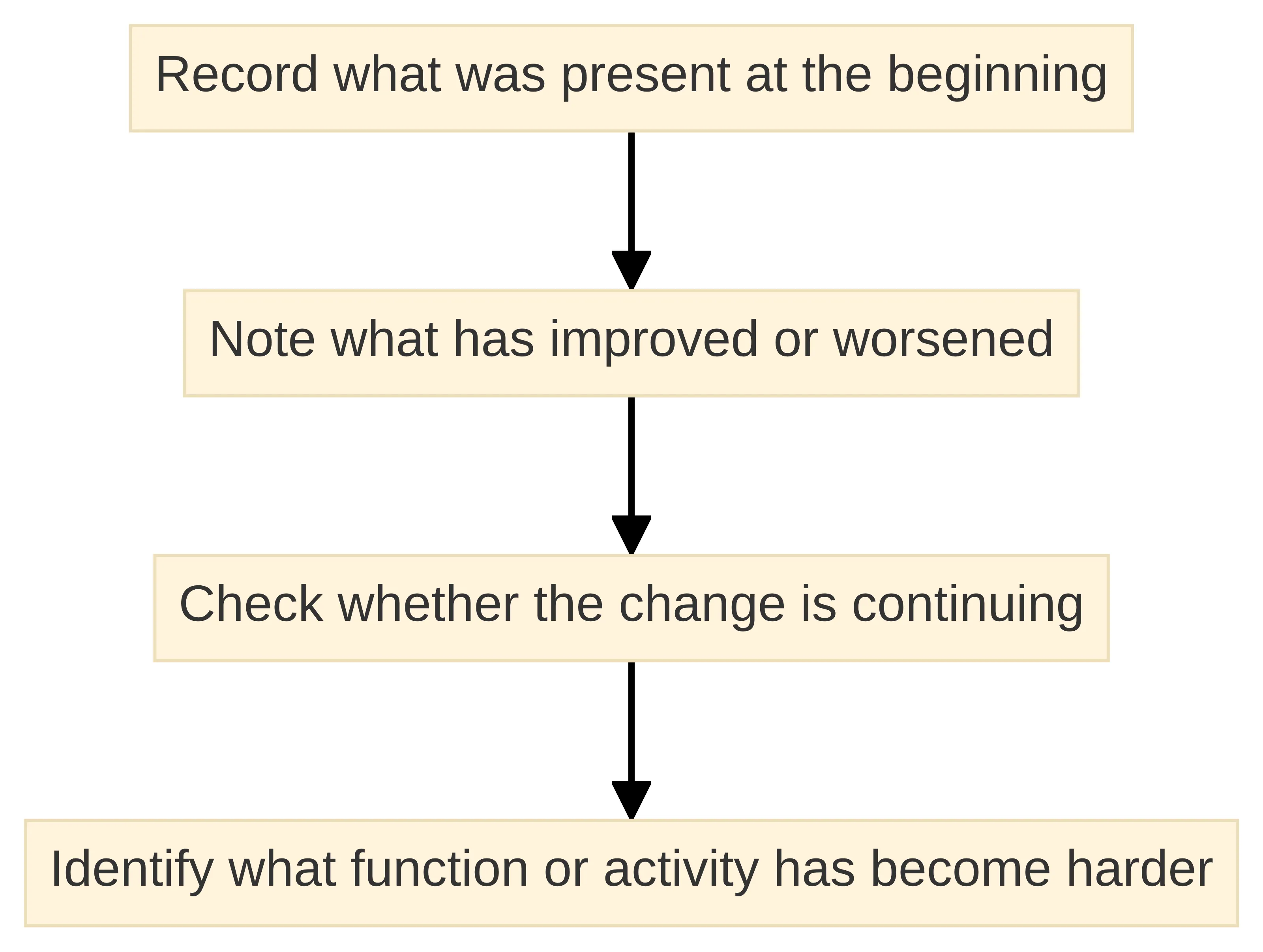
Before an appointment, write down changes in a simple sequence:
- What was present at the beginning.
- What has improved or worsened.
- Whether the change is continuing.
- What function or activity has become harder.
That record does not diagnose the problem. It helps you communicate a change that may affect the timing of professional assessment.
Prompt assessment is a timing decision, not a diagnosis and not an automatic recommendation for surgery. The purpose is to let a qualified clinician examine the change while it may still affect the choice among monitoring, nonsurgical care, intervention, or surgical consultation. If a clinician directs you to a more urgent setting, follow that direction rather than using this article to compare pathways. If the pattern is stable, bring the same record to a planned evaluation and ask what would make the situation no longer appropriate for routine follow-up.
Use conservative care as the usual starting discussion when appropriate
Conservative care is commonly the starting discussion for lumbar disc herniation when the clinical situation does not call for immediate escalation. A 2021 guideline commentary described conservative treatment as first-line because symptoms may improve over time, while also noting that high-level evidence defining its efficacy is limited. A systematic review of lumbar disc-herniation guidelines examined professional guidance covering noninvasive and invasive nonsurgical treatments as well as surgery.
The phrase “conservative care” does not name one universal package. It describes a nonsurgical pathway whose contents, timing, monitoring, and stopping points should be explained for your circumstances. Ask what the proposed plan includes, what response the clinician expects to monitor, when follow-up should occur, and what would lead to a different option. You do not need to treat a nonsurgical label as a promise that symptoms will resolve or that surgery will never be discussed.
It also does not tell you whether your symptoms represent radiculopathy, which is a clinical question for a qualified professional.
A productive starting discussion should cover:
- The working diagnosis and how the symptoms support or challenge it.
- The specific nonsurgical measures being considered.
- The time period for assessing response.
- The findings that would make the plan continue, change, or escalate.
- The alternatives if the first plan does not provide an acceptable result.
Ask how the plan will account for your activity demands. Someone trying to return to hiking in the Palo Alto foothills, a recreational sport, or a physically demanding job may need to describe those demands clearly so that progress is discussed in functional terms. The plan should also identify what you can do if symptoms worsen before the scheduled follow-up.
Conservative care is a pathway to evaluate over time, not a reason to ignore a meaningful change in symptoms.
Let response over time change the next decision
Response over time matters because the next treatment decision depends partly on whether the current pathway is helping and whether the clinical picture remains stable. A 2021 guideline commentary gave about three months as a guide for possible spontaneous resorption of the herniated mass, while noting that evidence defining conservative-treatment efficacy is limited.
Use the follow-up conversation to make the response specific. Ask whether the change is clinically meaningful, whether the diagnosis still fits, and whether the plan should continue or be revised. A lack of improvement is not by itself a command to choose surgery, but it is a reason to revisit the working diagnosis, the treatment plan, and the available alternatives. Progressive neurological symptoms change the urgency and warrant prompt professional assessment.
The evidence also gives you a way to discuss the speed-versus-duration question. Reviews reported that surgery may relieve symptoms faster, while long-term outcomes can be similar to nonsurgical treatment at one and two years in the cited evidence. The timing of relief may matter greatly if pain or loss of function is disrupting your work, sleep, or essential activities. It still has to be weighed against the clinical indications and the alternatives that apply to you.
At each planned review, ask for a clear answer to these questions:
- What has changed since the last assessment?
- Does the response support the original diagnosis and treatment direction?
- What is the next time point for reassessment?
- Which new or worsening finding would change the urgency?
- If the current pathway is not acceptable, what option comes next?
Keep a simple record between visits. Note the activity you attempted, what happened during and afterward, how long the change lasted, and whether function is improving or narrowing. This record is not a medical measurement by itself, but it can make the follow-up conversation more concrete than a general statement that you feel “better” or “worse.”
A time-based plan is useful only when it includes a reason to continue and a clear boundary for reconsideration.
Place nonsurgical interventions in the middle of the pathway
Nonsurgical interventions occupy a middle position between a general conservative plan and an operation, but their place depends on the diagnosis, symptoms, response, and clinician judgment. A 2024 narrative review identified nerve block as an option in cases of more severe pain. A review of professional guidelines described both invasive and noninvasive nonsurgical treatments as categories considered in lumbar disc-herniation guidance.
An intervention is not automatically the next step because it is nonsurgical. Ask what problem it is intended to address, why it fits your findings, what alternatives remain, and what result would lead to another decision. Ask about material risks, expected recovery considerations, and what follow-up is planned. The goal is to understand the decision, not to select a procedure from a menu.
We offer image-guided, nonsurgical options for spinal disc treatment related to back and neck pain. That is an offering to discuss during an evaluation, not a conclusion that an image-guided procedure is appropriate for every herniated disc or symptom pattern. Your suitability still depends on an individualized assessment.
Use this middle-pathway checklist when an intervention is raised:
- Purpose: What symptom or clinical problem is the intervention intended to address?
- Fit: Which examination or imaging findings make it reasonable to discuss?
- Alternatives: What conservative and surgical alternatives should remain on the table?
- Timing: Why is this being considered now rather than earlier or later?
- Follow-up: How will the response be assessed, and what happens if it is not adequate?
Ask whether the proposed intervention is intended as a time-limited step, part of a broader plan, or a response to a specific finding. Ask what would count as an inadequate response and who should be contacted if the symptoms change. These questions keep a targeted clinical option connected to the diagnosis instead of treating the word “nonsurgical” as a guarantee about results, risk, or recovery.
Compare surgery by speed of relief, indications, and trade-offs
Surgery deserves a balanced comparison because the main distinction is not simply “effective” versus “ineffective.” A systematic review and meta-analysis reported better short-term pain and functional outcomes after surgery than after nonsurgical management of lumbar disc prolapse. Other cited evidence indicated that surgery may provide faster symptom relief while longer-term outcomes can be similar to nonsurgical treatment at one and two years. A 2021 guideline commentary described established short-term efficacy for cases that meet surgical indications, while noting mixed evidence about long-term efficacy.
| Decision criterion | Conservative or other nonsurgical pathway | Surgical pathway |
|---|---|---|
| The cited reviews reported faster short-term pain relief and functional recovery after surgery in selected comparisons. | ||
| When the discussion changes | The plan may be reconsidered if management fails or symptoms do not follow the expected course. | Surgery may be considered when conservative management fails or neurological symptoms progress. |
| Longer-term comparison | Cited evidence indicated that long-term outcomes can be similar to surgery at one and two years. | Short-term gains do not establish that long-term outcomes will remain superior in every comparison. |
| What must be individualized | The diagnosis, symptom pattern, response, and personal goals still need clinical interpretation. | The appropriate procedure depends on your condition and other factors. |
The comparison is also harder to interpret than a simple head-to-head table suggests. Observational studies can compare groups with different baseline prognostic factors, creating potential confounding. In cited randomized trials, 26% to 54% of people assigned to conservative care later received surgery shortly after randomization or after an initial conservative period. Those design features mean that research results do not map neatly onto a personal choice between two fixed, isolated paths.
Use the comparison to ask what matters most in your situation: the speed of relief, the persistence of symptoms, neurological changes, the effect on essential activities, or the consequences of waiting. Then ask the clinician to explain which findings make one path more reasonable than another. Avoid choosing based on speed alone or on a promise of avoiding surgery.
You can also ask how the comparison applies to your specific work and activity demands. A faster reduction in symptoms may matter if you cannot perform essential duties, but the reason for the proposed procedure and the expected recovery still need to be clear. A nonsurgical pathway may be reasonable in a stable situation, but the word “nonsurgical” does not remove the need for monitoring. The decision is about fit and timing, not about assigning a permanent label to your care. To compare pathways fairly, keep four questions separate: speed, or how quickly relief is being sought; indication, or what clinical finding supports discussing an option; burden, or what recovery and limitations need to be weighed; and contingency, or what happens if the response is inadequate. This separation prevents faster possible relief from answering the different question of whether surgery is indicated. It also prevents a desire to avoid surgery from answering whether continued monitoring remains reasonable. Bring these four questions to the clinician and ask which are most important in your situation. The resulting discussion should identify the reason for the proposed path, the alternative that remains available, and the finding or response that would cause the plan to change.
Understand what surgical consultation may involve
A surgical consultation is a way to clarify indications, alternatives, and timing; it is not an automatic commitment to an operation. The appropriate procedure depends on your condition and other factors, so the consultation should connect the proposed operation to the findings that support it.
Possible surgical approaches for lumbar disc herniation include microdiscectomy, laminectomy, fusion, and, in selected cases, disc replacement. These names describe different procedures, not interchangeable versions of the same treatment. A clinician should explain why a particular approach is being discussed, what it is intended to address, and what alternatives remain available.
Bring focused questions rather than asking only whether surgery is “necessary.” Ask:
- What clinical finding creates the indication for surgery?
- What is the expected benefit in the short term?
- What is known about the longer-term outcome for this situation?
- Which procedure is being considered, and why does it fit the condition?
- What nonsurgical alternatives remain reasonable?
- What would waiting change, if anything?
- What recovery limitations and follow-up would apply?
- Which symptoms would require more prompt reassessment?
Ask the surgeon to distinguish the goal of the proposed procedure from the reason it is being recommended now. A procedure may be discussed because of persistent symptoms, a neurological change, the effect on function, or a combination of findings. Those reasons are not interchangeable, and the distinction can affect how you weigh timing.
The evidence does not support treating every scan or every pain pattern as a surgical problem. It also does not support treating surgery as a failure of conservative care. Surgery has an established short-term role in cases meeting surgical indications, while the longer-term comparison can be mixed or similar depending on the evidence examined. The useful consultation is the one that makes those conditions explicit.
Bring decision-changing questions to the clinician
Questions for a herniated-disc evaluation should help you understand the diagnosis, the treatment fit, and the boundaries of the plan. Write them down before the appointment so the discussion does not stop at a label on an imaging report.
Questions about diagnosis
- What diagnosis best explains my symptoms and examination findings?
- How does the imaging support that diagnosis?
- What other explanation remains possible or needs to be considered?
- Is there a neurological finding that changes the urgency?
- What does the scan fail to explain about my symptoms?
Questions about treatment suitability
- What makes this option reasonable for my situation?
- What finding would make this option a poor fit?
- What alternatives should I compare before deciding?
- What information is still missing from the assessment?
- Is the proposed plan intended to monitor, relieve symptoms, address a specific finding, or move toward another decision?
Questions about risks and recovery
- What material risks and limitations should I weigh?
- What recovery considerations apply to each option?
- What response would count as meaningful improvement?
- When will the plan be reassessed?
- What activities should I discuss before trying to resume them?
Questions about escalation
- What lack of improvement would prompt a change in management?
- What worsening symptom should lead me to seek prompt professional attention?
- When would a surgical consultation become reasonable?
- If an intervention is discussed, what is the next option if the response is inadequate?
Bring your symptom timeline, prior imaging, prior treatment information, and activity goals to the conversation. Your goal is not to arrive with a predetermined procedure. Your goal is to leave with a working diagnosis, a defined next step, a follow-up point, and a clear boundary for changing course.
If you are comparing appointments, prioritize the questions that would change your decision. A long list is less useful than a short list that asks what the clinician thinks is happening, why a particular pathway fits, what alternatives remain, and what would require a faster reassessment.
Choose an evaluation that can connect the missing pieces
Choose an appointment that gives you enough opportunity to explain what changed and to ask how the findings fit together. The purpose is not to have a treatment selected before the assessment; it is to make the next decision more specific.
Before you arrange the appointment, prepare a short record:
- The date or approximate onset of symptoms.
- The locations and patterns you have noticed.
- Changes in severity or function over time.
- Prior MRI or X-ray reports and images, if available.
- Treatments or consultations already completed.
- The activities you need to resume or protect.
- The questions that would affect your decision.
Ask what the evaluation can clarify in your situation. An evaluation can organize the information and identify options; it cannot guarantee a diagnosis, symptom relief, tissue repair, avoidance of surgery, or a particular recovery timeline before a clinician assesses you.
Take your imaging files, not only a written report, when they are available and practical to bring. Note the name and timing of prior treatments and whether they changed pain, function, or neurological symptoms. Those details can help keep the discussion focused on the pattern over time instead of a single appointment snapshot.
A sensible appointment should leave you able to describe the next step in plain language. You should know whether the discussion is about monitoring, conservative care, an image-guided nonsurgical option, or surgical consultation. You should also know what response or symptom change would cause the clinician to revisit that choice.
If prior records are incomplete, say so when arranging the visit and ask what can be reviewed beforehand and what should be brought later. Do not infer that an unavailable report rules in or rules out a treatment; it simply identifies information the clinician may need to obtain or reassess. The goal of preparation is to improve the quality of the discussion, not to make a clinical decision before the evaluation.
Discuss RegenCore Method’s spinal-disc services in the local context
RegenCore Method offers image-guided, nonsurgical options for spinal disc treatment related to back and neck pain.
Our UCSF-trained interventional spine team provides targeted, image-guided procedures and opioid-sparing techniques where appropriate. These are descriptions of what RegenCore Method offers; they do not establish that a particular procedure is appropriate for your herniated disc, symptom pattern, or stage of care.
Use the local conversation to ask specific questions:
- Will the evaluation address the symptoms, examination findings, and prior imaging together?
- What does the clinician think the disc finding explains?
- Which nonsurgical options are being considered, and why?
- What alternatives remain if the proposed option is not suitable?
- What follow-up will determine whether the plan should continue or change?
- What symptoms would require prompt professional assessment instead of a routine appointment?
Palo Alto and San Francisco are relevant to how you arrange care, not to whether a treatment fits. The same decision standard applies: establish what the symptoms and findings mean together, clarify the available pathways, and keep escalation available when the clinical situation calls for it.
When arranging a local evaluation, treat the first contact as a fit-and-information step. Tell the office that you are seeking discussion of suspected or diagnosed herniated-disc symptoms, ask which Palo Alto or San Francisco setting can address that concern, and confirm what prior imaging or reports should be provided. Ask what the evaluation includes and whether the visit is intended to determine suitability for a nonsurgical option rather than to reserve a specific procedure. You can also ask how follow-up is handled if the clinician recommends monitoring, another nonsurgical discussion, or surgical consultation. These questions do not assume that RegenCore Method will be the right setting or that an offered service will be appropriate. They help you arrive with the right records and a clear understanding of what the appointment can and cannot decide.
Book the next conversation, not a predetermined treatment
The right next step for suspected or diagnosed herniated-disc symptoms is a conversation that makes the decision specific. Gather your symptom timeline, prior imaging, treatment history, and activity goals. Ask how the findings fit together, whether a nonsurgical pathway is reasonable, what response should be monitored, and what would prompt escalation. A qualified clinician must decide individual suitability, urgency, and treatment selection after an assessment.
If you are in Palo Alto or San Francisco and considering this type of care, use the next conversation to clarify what your symptoms and findings mean together before choosing a pathway.
Questions to clarify before a herniated-disc evaluation
What should I expect during a spinal disc evaluation at RegenCore?
During a spinal disc evaluation at RegenCore, you can expect a thorough history review, a hands-on orthopedic examination, diagnostic ultrasound, and a personalized treatment and recovery plan.
What questions should I ask my clinician during a herniated disc evaluation?
You should ask about the diagnosis, how imaging supports it, treatment options, risks and recovery considerations, and what symptoms would require prompt reassessment.
How can I prepare for my appointment regarding herniated disc treatment?
Prepare by gathering your symptom timeline, prior imaging reports, treatment history, and a list of questions you want to ask about your condition and treatment options.
Next step
Have a question for RegenCore?
Concierge regenerative & orthobiologic orthopedics in San Francisco and Palo Alto. Research-backed, non-surgical treatment — PRP, bone marrow concentrate (BMAC), stem cell therapy, shockwave, EMTT and spinal disc care — to help the body heal itself.
Get in touch