
infrapatellar bursitis treatment
Infrapatellar Bursitis Treatment: How to Choose the Right Next Step
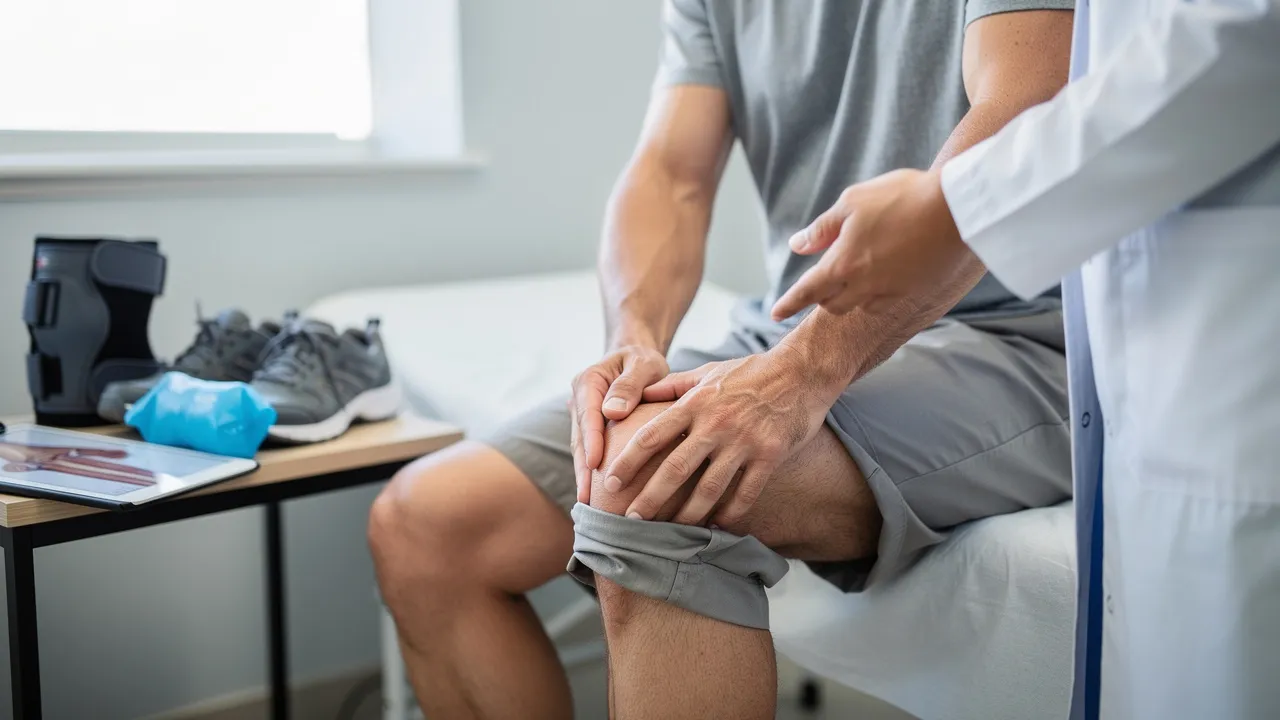
Pain below the kneecap is a starting clue, not a diagnosis
Infrapatellar bursitis is a label for symptoms thought to involve a bursa below the kneecap. The label may fit the location you notice, but location alone cannot establish the cause of pain. Pain below the kneecap can also reflect another nearby structure or a different knee problem, so the first useful decision is not which treatment to choose. It is whether the symptom pattern gives you enough reason to monitor, arrange an assessment, or ask for a more focused discussion.
Knee bursae can cause pain at the front, inside, outside, or back of the knee, and many are under-recognized in practice. That broader distribution matters because pain near the front of your knee does not identify one specific bursa by itself. If your discomfort is below the kneecap, treat the location as a starting clue rather than a diagnosis. Avoid using the word “bursitis” as proof that the source has already been established.
A sensible first step is to describe what you can observe without trying to name the condition. Note where the pain begins and ends, what positions or activities aggravate it, how long it has been present, and whether the pattern is changing. That information can help an assessment distinguish a localized complaint from a broader knee problem. It can also keep you from choosing an injection, shockwave treatment, or regenerative option before the pain source is clear.
The location below the kneecap becomes more useful when you place it beside timing, triggers, function, and change over time. A symptom that appears with pressure may raise different questions from pain that occurs during ordinary movement or continues at rest. Those observations do not diagnose the problem, but they help you choose whether monitoring is reasonable or whether an examination would be more useful.
Use a symptom-and-trigger profile before choosing a path
A symptom-and-trigger profile gives you a more useful starting point than the phrase “pain below my kneecap.” Record the details that can change the next decision rather than trying to score yourself against diagnostic criteria. Your notes can include:
- Exact location: Describe whether the discomfort stays directly below the kneecap or spreads to another part of the knee.
- Quality and intensity: Record whether the sensation is aching, sharp, pressure-related, or simply uncomfortable, using your own words rather than a diagnostic label.
- Triggers: Note the activities, positions, pressure, or repeated movements that increase symptoms.
- Timing: Write down when the problem began, whether the onset followed a clear event, and whether symptoms are constant, intermittent, or recurring.
- Visible or felt changes: Record swelling, warmth, or a change in how the knee moves or feels during ordinary activity.
- Function: Note changes in walking, stairs, exercise, work, or other activities that matter to you.
- Response to self-care: Record what you changed, whether comfort or function shifted, and whether the improvement lasted.
Separate observations from conclusions. “Pain increased after kneeling” is an observation; “the bursa is inflamed” is a conclusion that requires assessment. “Walking felt easier after reducing one activity” describes a change; it does not prove which structure caused the original symptom. Keeping those statements separate makes your notes more useful and reduces the chance that an early assumption will drive treatment.
The profile is information for an assessment, not a home diagnosis. A trigger can show what irritates the symptom without proving which tissue is involved. A quiet period can show that symptoms are settling without proving that the suspected bursa was the source. Recurrence can be a reason to move from observation toward assessment, particularly when the pattern keeps returning after the same activity.
Use the profile to choose the pace of your next step. A mild pattern that is improving and becoming less disruptive may support continued monitoring. A pattern that is difficult to interpret, keeps interfering with function, or returns after temporary improvement deserves a clinical discussion. The purpose of your notes is to make that discussion more precise, not to replace an examination.

Front-of-knee pain can involve more than one structure
Front-of-knee pain can involve more than one structure, and knee bursae can cause pain at the front, inside, outside, or back of the knee. The same general area can therefore support more than one explanation. A pain location may tell you where to begin asking questions, but it cannot tell you which treatment will fit.
A systematic review examined 11 distinct knee bursae, covering their anatomy, clinical presentation, imaging, treatment strategies, and outcomes. That breadth helps explain why a label based only on location can be too narrow. Infrapatellar symptoms need to be considered in relation to the full history, the physical examination, and any other features that change the clinical question.
The practical boundary is simple: do not treat every painful spot below the kneecap as the same problem. Pain that follows a new activity, pain that persists without a clear trigger, and pain that repeatedly limits function may require different questions even when the location sounds similar. You do not need to decide which nearby structure is responsible before seeking an assessment. You do need to avoid letting an assumed diagnosis determine treatment in advance.
Keep treatment selection behind clarification. If the symptom profile is settling, monitoring may be reasonable. If the profile remains unclear or the problem is interfering with ordinary activity, assessment can help determine whether the suspected bursa remains a plausible explanation and what alternatives need consideration.
This distinction matters when you compare advice from different sources. A recommendation aimed at a specific bursa, tendon, joint problem, or injury may not answer the question raised by your symptoms. Before applying it, identify the condition it was intended to address and whether that condition has actually been established in your case.
Begin with conservative care you can monitor
Conservative care is a monitored starting path, not a promise that a particular diagnosis has been confirmed. The immediate purpose is to reduce the exposure that repeatedly aggravates your symptoms and then observe whether comfort, movement, and daily function change. Keep the approach simple enough that you can tell what happened afterward.
A practical monitoring routine can include these steps:
- Identify the aggravating exposure. Note the activity, position, pressure, or repeated movement that reliably increases discomfort.
- Reduce that exposure for a period of observation. Do not use the change as proof that a bursa is involved; use it to see whether the pattern becomes less disruptive.
- Keep track of function. Record whether walking, stairs, work, exercise, or ordinary movement feels easier, unchanged, or more limited.
- Watch the symptom pattern. Note changes in location, swelling, warmth, recurrence, and the amount of activity that brings symptoms on.
- Review the trend. Look for a consistent direction rather than treating one comfortable moment as a complete answer.
Keep the observation narrow and repeatable. If you change several activities and add several treatments at once, you may not know which change affected the pattern. A short note after ordinary activity can be enough: what you did, what you felt, how movement went, and whether the symptom returned. The purpose is not to create a medical score. It is to give you a clearer account of change over time.
Improvement is best judged across several observations: less discomfort with the same activity, fewer interruptions to daily function, easier movement, or fewer recurrences. A single better day does not establish the cause, and a single worse day does not by itself show that conservative care has failed. The useful question is whether the overall pattern is becoming more manageable without repeatedly provoking the same problem.
Avoid turning conservative care into indefinite waiting. If the symptom pattern is not becoming clearer or more manageable, move toward assessment rather than adding treatments based on assumption. Medication choices, injections, and procedures require a separate clinical discussion because the appropriate option depends on what is causing the pain.
Let the response change the next decision
Your response to conservative care should change the next decision, not serve as a pass-or-fail test for infrapatellar bursitis. The same symptom can call for different action depending on whether it is improving, unchanged, worsening, or recurring.
Use these broad branches:
- Symptoms are improving: Continue the same monitoring approach while function becomes easier and the aggravating pattern becomes less disruptive. Do not treat improvement alone as confirmation of the diagnosis.
- Symptoms are unchanged: Arrange a clinical assessment if the problem remains present or continues to limit activity. Persistent symptoms leave the cause unresolved.
- Symptoms are worsening: Shift from observation toward assessment rather than increasing activity or selecting a procedure on your own. Worsening symptoms change the balance of the decision.
- Symptoms are recurring: Seek assessment when the problem settles and then returns, especially if the same trigger repeatedly brings it back. Recurrence can mean that the original change did not address the underlying question.
- Symptoms feel concerning: Obtain clinical assessment instead of relying on a home monitoring plan. You do not need to name the warning sign before asking for help.
A useful reassessment note answers four questions: what changed, what you reduced or resumed, how your function responded, and whether the symptom returned. Include any new swelling or warmth and any shift in where the pain is felt. This record cannot establish the diagnosis, but it can show whether the pattern is stable enough to watch or uncertain enough to examine.
No fixed recovery timetable can tell you when to stop monitoring. The relevant pace depends on the pattern, its effect on function, and whether the symptom is moving in a reassuring direction. A clinical assessment becomes more useful when you can explain what changed, what you reduced, how your function responded, and whether symptoms returned.
The direct action is to match uncertainty with the next step. Continue monitoring only when the pattern is improving enough to observe. Choose assessment when persistence, worsening, recurrence, functional limitation, or concern leaves you without a clear and dependable path.
An evaluation clarifies what symptoms leave uncertain
An in-person evaluation may consider your history, physical examination, competing explanations for pain below the kneecap, and available imaging when imaging can answer a relevant clinical question. A systematic review examined 11 distinct knee bursae across anatomy, clinical presentation, imaging, treatment strategies, and outcomes. That scope reflects why assessment involves more than matching a pain location to a treatment name.
Your history gives the examination a useful starting point. Bring the onset, any clear event, the exact location, aggravating activities or pressure, duration, recurrence, changes in function, and response to self-care. Tell the clinician what has improved, what has stayed the same, and what has become worse. Those details help separate a short-lived irritation from a persistent or recurring problem that needs a different discussion.
A physical examination can add information that a symptom description cannot provide. The clinician may consider the area of tenderness, movement, functional changes, and findings that point toward or away from the suspected bursa. The examination is not a formality before treatment; it is part of deciding whether the working explanation fits the pattern.
Available imaging may be considered when it helps answer a specific question about the structures involved. The systematic review included 76 studies and searched PubMed and Embase for English-language human studies from 2000 through 2024. That review context does not mean every person with pain below the kneecap needs the same imaging. It supports a more limited principle: imaging should have a clinical purpose rather than being treated as an automatic answer.
Before leaving an assessment, make sure you understand the working explanation and its limits. Ask which finding supports the suspected source, which alternatives remain possible, whether available imaging changes the discussion, and what response would prompt reassessment. You can also ask what the goal of any proposed treatment would be and what continued monitoring would involve. These questions keep the next step tied to the unanswered clinical issue.
An evaluation does not obligate you to choose a procedure. It clarifies what the symptoms, examination, and available information do and do not establish. Ask what diagnosis remains plausible, what alternatives need consideration, what the proposed treatment is intended to address, and what uncertainty remains if you decide to monitor instead.

What evidence from other bursae can—and cannot—tell you about treatment
Procedural options belong after the suspected pain source has been examined, not before. The treatment name is not the evidence: identify which bursa the study examined and what outcome it measured before treating the finding as relevant to suspected infrapatellar bursitis.
That wording supports a discussion, not a guarantee. It also means that a treatment studied for one bursa should not automatically be presented as an established treatment for suspected infrapatellar bursitis.
After an evaluation, you can ask how the proposed option relates to the clarified cause:
- Injection-based treatment: Ask what structure the injection is intended to address and what supports using it for that specific problem.
- Shockwave therapy: Ask whether the treatment is being discussed for the identified condition or for a different pain pattern.
- Platelet-rich plasma: Ask what condition the PRP discussion concerns and how closely the available information matches your situation.
- Bone marrow aspirate concentrate: Ask what clinical question BMAC is meant to address, what uncertainty remains, and why it is being considered rather than continued monitoring.
- Other regenerative approaches: Ask which diagnosis and treatment goal support the discussion instead of treating “regenerative” as a diagnosis.
The word “non-surgical” does not remove the need to establish treatment fit. A procedure can still have a defined target, expected trade-offs, and limits that matter to your decision. Ask whether the proposed option is intended to address a confirmed condition, a working diagnosis, or symptoms that remain unexplained. If that distinction is unclear, the treatment conversation is ahead of the assessment.
The review reports several Level I randomized controlled trials on pes anserine and osteoarthritis-related bursitis, plus Level II studies assessing platelet-rich plasma and corticosteroids. Those findings show that some bursal conditions have been studied more directly than others. They do not establish that PRP, BMAC, shockwave therapy, or another procedure will resolve your symptoms, prevent surgery, or suit you without an evaluation.
The supported action is to discuss a procedure only after the cause, purpose, alternatives, and uncertainty have been made clear. If those points remain unanswered, continue the assessment conversation rather than choosing a treatment from the label alone.
Evidence from other bursae provides context, not a direct answer
Evidence from other bursae can show how clinicians have studied procedures without predicting how suspected infrapatellar bursitis will respond. Pes anserine bursitis and greater trochanteric bursitis are different clinical settings from pain involving a bursa below the kneecap. Keep that distinction visible whenever you compare study results with your own symptoms.
A prospective comparative study of pes anserine bursitis assessed patients before injection and at 1 and 8 weeks using WOMAC, VAS, and a tenderness-improvement measure. The study therefore measured defined outcomes in a particular bursitis population at specified follow-up points. It did not study suspected infrapatellar bursitis, and its design cannot turn a pain location into a diagnosis.
At 8 weeks in that pes anserine bursitis study, improvement was reported in 63.3% of injected lower limbs, representing 38 patients, in the local corticosteroid group and in 20% of patients in both the local PRP and extracorporeal shockwave therapy groups. The reported assessment also described no symptoms, complete return of function, and no tenderness. Those figures belong to the studied pes anserine population and its outcome measures; they are not a result for infrapatellar bursitis.
The pes anserine study concluded that PRP injection was as effective as extracorporeal shockwave therapy for the studied pes anserine bursitis population. That conclusion can inform a question about how procedures have been compared in another bursa. It cannot establish that the same comparison applies below your kneecap, because the condition studied and the population studied were different.
A three-patient case series treated clinically diagnosed greater trochanteric bursitis with fluoroscopically guided PRP after conservative options had failed. One patient reported 50% sustained pain relief at three-month follow-up, and another reported 70% sustained pain relief at six-week follow-up after PRP treatment. A case series with three patients can describe those individual experiences, but it cannot establish a general result for another bursa or for you.
Use these studies as context for questions, not as a forecast. Ask whether the proposed treatment has been studied in the condition being considered, whether the study population resembles your clinical situation, what outcome was measured, and how long it was observed. If the answer relies mainly on results from another bursa, keep that limitation beside the treatment discussion.
Keep the evidence boundary part of treatment selection
Before discussing a procedure, ask questions that connect the option to your actual uncertainty:
- What finding makes this suspected bursa more likely than another source of pain?
- What is the proposed treatment intended to change?
- How closely does the supporting information match infrapatellar symptoms?
- What conservative option remains reasonable if you do not proceed?
- What outcome will be monitored, and what would count as an insufficient response?
- Which parts of the expected course are known, and which remain uncertain?
A treatment conversation is more useful when it separates three things: what has been established about your symptoms, what is being proposed, and what is still unknown. That separation protects you from treating a category such as “regenerative” as proof of suitability. It also gives you a clear basis for choosing continued monitoring, further assessment, or a discussion of a procedure.
Keep the boundary visible when you make the next decision. Choose an option because it addresses a clarified clinical question, not because a result from another bursa sounds transferable.
Use location and triggers to frame the treatment discussion
Infrapatellar symptoms call for a decision path, not a quick label. Note whether pressure or particular activities aggravate the pain, how long the pattern has lasted, whether it recurs, and how function has changed; these details help an assessment consider a bursa near the kneecap alongside other front-of-knee structures. Discuss injections, shockwave therapy, PRP, BMAC, or other regenerative options only after the suspected cause and the purpose of treatment are clearer.
The practical choices are straightforward:
- If symptoms are improving and becoming less disruptive, continue monitoring the trend rather than declaring a diagnosis.
- If symptoms remain unclear, persistent, function-limiting, worsening, or recurrent, arrange an in-person assessment.
- If a procedure is proposed, ask how it fits the identified problem, what it is intended to address, and what uncertainty remains.
- If the information comes from another bursa, treat it as context rather than a direct prediction.
Only a qualified clinician can decide whether a diagnosis, procedure, or other treatment is appropriate for your situation. At RegenCore Method, we can discuss your symptom profile, examination questions, and treatment options in Palo Alto without assuming that regenerative treatment is appropriate for everyone. Bring your notes about onset, triggers, duration, function, recurrence, and response to self-care so the discussion starts with the details that still need clarification.
Questions to consider before an infrapatellar bursitis evaluation
Are PRP, BMAC, or shockwave therapy established treatments for infrapatellar bursitis?
They should be discussed only after the suspected pain source has been evaluated. Evidence from other bursae may provide context, but it does not establish that these options will resolve infrapatellar symptoms, prevent surgery, or suit a particular person. Ask what condition the proposed treatment targets, how closely the supporting evidence matches it, and what uncertainty remains.
What should I bring to an evaluation for suspected infrapatellar bursitis?
Bring notes about when the symptoms began, their exact location, aggravating activities or pressure, recurrence, changes in function, swelling or warmth, and your response to self-care. Also note what has improved, stayed the same, or worsened. This information helps the clinician decide whether the working explanation fits and what questions, examination, or selective imaging may be useful.
Next step
Have a question for RegenCore?
Concierge regenerative & orthobiologic orthopedics in San Francisco and Palo Alto. Research-backed, non-surgical treatment — PRP, bone marrow concentrate (BMAC), stem cell therapy, shockwave, EMTT and spinal disc care — to help the body heal itself.
Get in touch