
latest alternatives to knee replacement
Latest Alternatives to Knee Replacement: A Decision Guide for Palo Alto and the Bay Area

When Knee Replacement Alternatives Change the Decision
An alternative to knee replacement is a non-surgical or less-invasive treatment path considered instead of replacing the joint at a particular point in the decision. It may include structured exercise, weight management, symptom-focused care, injections, physical modalities, or other procedures discussed with a qualified clinician. It is not a promise that knee replacement will never be needed, and the word “latest” does not establish suitability, effectiveness, or routine availability.
Knee replacement, delaying a decision, and choosing an alternative are three different decisions. Continuing non-surgical care may be reasonable while you monitor symptoms or work toward a functional goal. Preparing for replacement means accepting that surgery may be the appropriate path if pain and loss of function remain substantial. Choosing a non-surgical or less-invasive option means asking whether it fits the source of your symptoms, your goals, the treatment burden, and the uncertainty around its likely effect.
A 2026 Cochrane review found that, compared with non-surgical treatment alone, knee replacement followed by non-surgical care may provide a small reduction in pain, while functional benefit may be small and the evidence about serious unwanted effects remains very uncertain. That finding does not make replacement right or wrong for you. It shows why the choice should be framed around your symptoms, function, examination findings, and goals rather than around a simple promise to avoid surgery.
Use a replacement-specific checkpoint rather than a general ranking of treatments:
- What symptoms, functional limits, and examination findings are shaping the replacement discussion?
- Which non-surgical or less-invasive options have a relevant purpose, and what does their evidence not establish?
- What treatment burden and uncertainty would come with pursuing an option or postponing replacement?
- What change in pain, function, or daily activity would make it useful to revisit the discussion with a clinician?
This keeps the latest option in context. An emerging or investigational procedure may be worth distinguishing from established care without being treated as effective or routinely available, and a non-surgical option remains an alternative rather than a promise that replacement can be avoided. The same checkpoint can guide a conversation in Palo Alto, elsewhere in the Bay Area, or across locations.
Use the Decision Criteria That Matter More Than “Latest”
The word “latest” does not tell you whether an option fits your knee. A newer procedure may have limited follow-up, uncertain availability, or evidence that applies only to a narrow group. An established treatment may be less dramatic but easier to evaluate and integrate with exercise or symptom management.
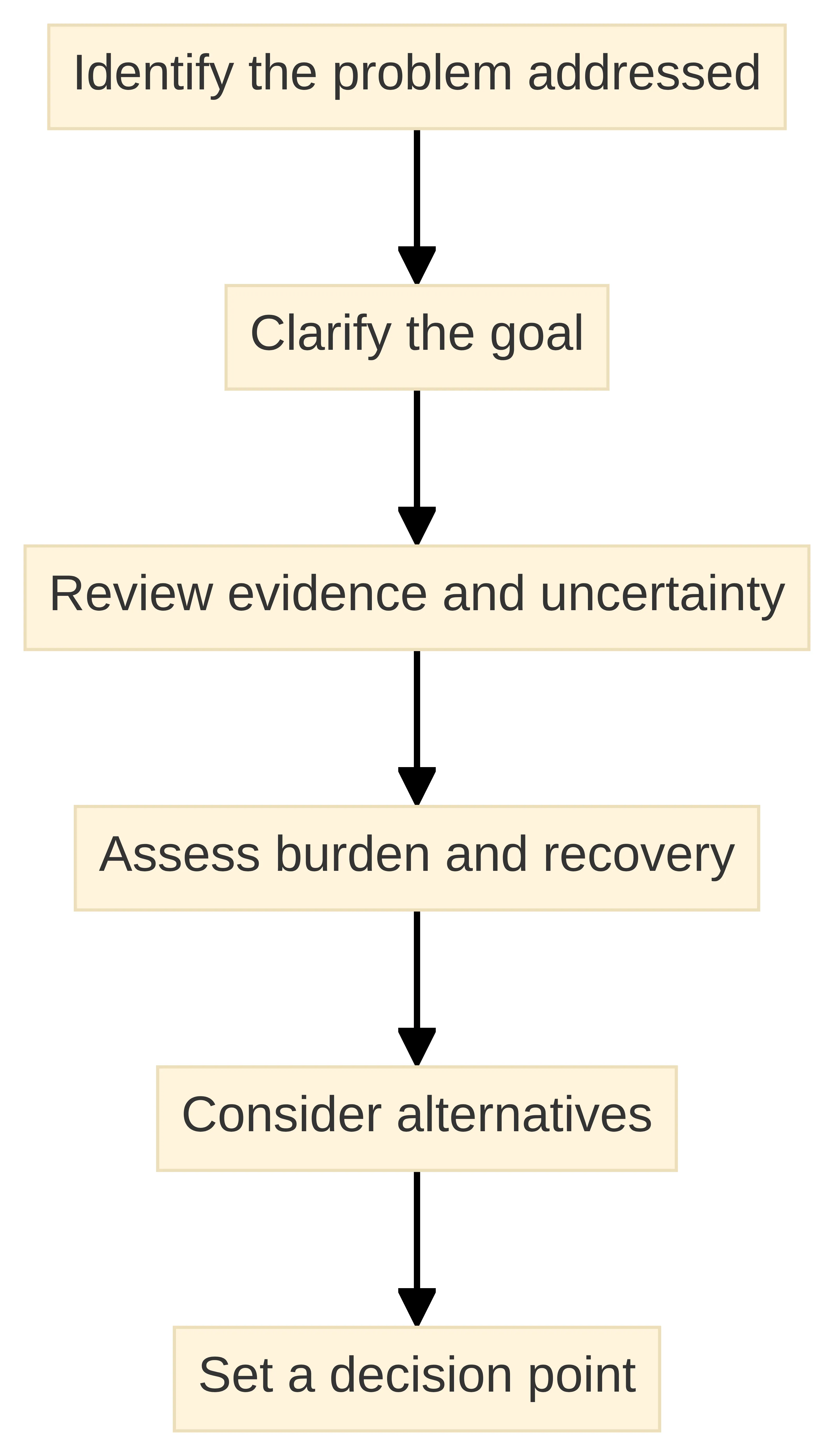
Use these criteria to compare options without turning the decision into a contest between procedures:
- Problem addressed: Is the discussion about osteoarthritis, a cartilage injury, a tendon problem, pain with an unclear source, or loss of function from several factors?
- Goal: Are you trying to walk more comfortably, return to hiking, resume a sport, tolerate stairs, improve exercise participation, or decide whether replacement should be discussed?
- Evidence and uncertainty: What does the available evidence establish for a problem like yours, and what does it leave unanswered?
- Burden and recovery: What does the option involve before, during, and after treatment? What activities may need to change while you recover?
- Alternatives: What non-surgical care, injection, or less-invasive option would be reasonable to discuss instead?
- Decision point: When will you reassess symptoms and function, and what result would lead to continuing, changing, or stopping the plan?
The AAOS guideline addresses non-arthroplasty treatment of knee osteoarthritis. It also identifies gaps in research on corticosteroid, hyaluronic-acid, and PRP injections, including the need to examine differences by osteoarthritis severity. That makes severity and the exact knee problem relevant questions, not details to skip when comparing options.
You can sort the discussion into three practical lanes:
- Continue and refine non-surgical care when the plan is helping function or still has a specific, measurable adjustment to make.
- Discuss a procedure when the problem being treated is sufficiently clear, the expected burden is acceptable, and the clinician can explain what result will be assessed.
- Reconsider the broader pathway when pain or functional loss remains substantial, the diagnosis is uncertain, or the proposed option cannot answer your main goal.
These lanes can change as symptoms and function change. They are decision categories, not predictions about what your knee will require.
A practical rule follows: do not choose an option because it sounds newer, more natural, or more advanced. Choose the next conversation that resolves the largest unanswered question about your knee. If the source of pain is still unclear, evaluation comes before procedure selection.
Start With Exercise, Weight Management, and Symptom-Focused Care
Therapeutic exercise, weight management, information, and support are identified as core treatments for osteoarthritis in a NICE guidance summary. These are general treatment categories to discuss with a qualified clinician, not a personal medication plan.
Exercise is not one uniform intervention. A systematic review and network meta-analysis reported superior combined therapeutic benefits for aerobic exercise among the modalities it evaluated, while also noting limited data and ambiguity about which exercise approaches should be prioritized. Your comparison should therefore cover the type of exercise, the amount, the symptoms it provokes, and how progress will be judged rather than treating “exercise” as a complete prescription.
When you discuss a conservative plan, ask for specifics:
- Which movements or activities should you continue, modify, or pause?
- What change in walking, stairs, strength, or exercise participation would show that the plan is helping?
- How will the plan be adjusted if pain or stiffness remains unchanged?
- When should you stop self-management and arrange an evaluation?
Weight management may be part of an osteoarthritis plan, but the right approach depends on your circumstances and should not be reduced to a number on a scale.
A useful conservative plan has a target and a review point. Write down the activity you want to regain, the movements that currently limit you, and the change you expect to see. That makes it easier to distinguish a plan that is being adjusted thoughtfully from simply postponing a decision without new information.
This lane is not the same as simply waiting. It is an active plan with defined activities, symptom monitoring, support, and a point at which you reassess. If pain or declining function continues despite a reasonable course of care, the next step is a professional evaluation rather than indefinite self-management.
Compare Injection Options Without Treating Them as Interchangeable
Injections are not one category with one expected result. Corticosteroid injections, PRP, and BMAC differ in purpose, evidence, preparation, and uncertainty. A comparison should keep those differences visible.
| Option | How it is generally discussed | What the available guidance or review establishes | What to clarify before deciding |
|---|---|---|---|
| Corticosteroid injection | A possible short-term symptom-relief option or support for exercise in selected circumstances | NICE guidance describes it as an option when other pharmacological treatments are ineffective or unsuitable | What symptom or activity goal is being addressed, how long the plan will be assessed, and what alternatives remain |
| PRP | A non-surgical injection discussed for some knee osteoarthritis and other tendon or joint conditions | A review describes PRP for knee-osteoarthritis pain as experimental, notes that current guidelines do not recommend widespread use, and says safety comparisons with BMAC remain limited | What finding supports the discussion, what evidence applies to your severity, and how uncertainty will affect the decision |
| BMAC | A non-surgical treatment discussed for selected knee and cartilage problems | Reviews report positive clinical results for PRP and BMAC in cartilage and bone injuries but emphasize that the available evidence is limited and more safety research is needed | Why BMAC is being considered instead of another option, what the procedure and recovery involve, and what outcome would be measured |
The table is a starting point for questions, not a treatment ranking.
AAOS identifies evidence gaps across several less-invasive injection options, including corticosteroid, hyaluronic-acid, and PRP, with uncertainty that may vary by osteoarthritis severity. For hyaluronic-acid injections, AAOS highlights evidence gaps rather than establishing a general purpose or expected benefit; a clinician can explain whether the discussion relates to a particular symptom or goal, what evidence applies to the severity of the osteoarthritis, and how the decision would be reassessed. That limitation matters when a recommendation is presented as though the same injection should work across every knee.
The comparison should also include treatment burden. Ask whether the option requires a procedure, how many visits are expected, whether activity must be modified, and when progress will be reviewed. A treatment with an uncertain effect still needs a defined stopping or reassessment point; otherwise you cannot tell whether continuing it serves your goal.
Ask what the injection is meant to change, how the clinician will measure that change, and what happens if the goal is not reached. If those answers are not specific to your symptoms and function, keep the discussion at the evaluation stage.
Keep PRP and BMAC Separate From Their Marketing Claims
PRP and BMAC are different options, and the evidence for each should be considered separately. A review describes PRP for knee-osteoarthritis pain as experimental and says current guidelines do not recommend widespread use. It also reports results for both PRP and BMAC in cartilage and bone injuries, while emphasizing that the available evidence is limited and that more research is needed for a comprehensive safety comparison.
At RegenCore Method, we commonly use PRP for knee osteoarthritis and several tendon and joint-related conditions. Those are our treatment practices; they do not establish that either option is suitable for your knee or superior to the other.
Before you compare these options, ask:
- What examination finding or imaging feature makes this option relevant?
- Is the discussion about symptom management, function, a structural finding, or more than one goal?
- What does the clinician know about this option for the severity and pattern of your knee problem?
- What are the material risks, activity restrictions, and recovery demands?
- What will count as a meaningful response, and when will it be assessed?
- If the response is limited, what other path remains?
A clear answer should describe your decision context, not repeat a broad promise about healing, regeneration, or avoiding replacement.
When two treatments are described with the same broad words, return to the specific question each one is meant to answer. Ask what is being injected or used, what evidence applies to the condition being discussed, and whether the proposed outcome is symptom change, functional change, or a structural claim. Keeping those outcomes separate prevents an early result in one setting from becoming a promise about your knee.
What Current Evidence Can and Cannot Establish About Regenerative Options
Current evidence can help define the boundaries of a discussion. It can show whether a guideline addresses an option, whether a review found limited or mixed support, and whether a treatment has been studied for a particular condition or severity. It cannot, by itself, determine what will happen in your knee.
The AAOS non-arthroplasty guideline is intended to help appropriately trained clinicians manage knee osteoarthritis. It covers nonpharmacologic and pharmacologic interventions and procedures less invasive than knee arthroplasty, while identifying areas where better research is needed. Its scope supports a structured conversation; it does not turn every listed option into a recommendation for you.
For PRP and BMAC, the available review describes limited evidence and ongoing questions about safety comparisons. It also reports positive clinical results for cartilage and bone injuries. These statements can coexist: an early or positive result does not establish a consistent outcome for all knees, and limited evidence does not answer the suitability question for you.
The 2026 Cochrane review also illustrates why comparisons need careful wording. Compared with non-surgical treatment alone, knee replacement followed by non-surgical care may produce a small pain reduction; functional improvement may be small and may not provide a real benefit, while the effect on serious unwanted effects is very uncertain. This is not a direct comparison of every regenerative treatment with replacement, so it should not be used to rank PRP, BMAC, or another option.
You can read the evidence at several levels:
- A guideline describes how a professional body has assessed treatment categories and where its recommendations or research gaps lie.
- A systematic review combines findings across studies but may still report limited data or uncertainty about which approach to prioritize.
- A review of a specific treatment can describe early or positive findings without establishing broad effectiveness or a complete safety comparison.
- Your evaluation connects those general findings with your symptoms, examination, imaging when relevant, goals, and treatment constraints.
Moving from the first three levels to the fourth requires clinical judgment. It is not a conclusion you can make from an advertisement or a single favorable result.
Use evidence to ask narrower questions: Does it apply to your diagnosis? Does it include a similar level of degeneration? Is the outcome you care about pain, function, imaging, or time away from activity? How uncertain is the answer? A clinician can then connect those questions with your examination and goals.
Distinguish Available Services From Investigational Procedures
For context, RegenCore Method provides bone marrow concentrate as a non-surgical treatment. We recommend EMTT for deep or hard-to-reach tendon and joint pain, as an add-on to PRP plans, and for selected chronic conditions or recovery support after orthobiologic treatment. RegenCore Method also offers shockwave therapy as a non-surgical service; for knee osteoarthritis, discuss its intended purpose, evidence, risks, recovery, cost, and insurance coverage with a qualified clinician. These statements describe what we provide and how we describe its use; they do not establish that a particular service is appropriate for your knee.
An option can also be discussed in the context of research without being a routine treatment choice. On January 15, 2025, UChicago Medicine reported that an NIH-funded study was testing an embolization procedure for osteoarthritis knee pain as a possible alternative to knee replacement. That report did not establish effectiveness or routine availability. Treat a procedure described in a study as investigational until a qualified clinician explains its status, access, evidence, and conditions.
Keep three questions separate:
- Is it being studied? This describes an investigational or emerging procedure.
- Can you access it? Availability depends on the setting, clinician, location, and applicable conditions.
- Does it fit your knee? Suitability depends on the cause of symptoms, examination, imaging when relevant, goals, and other circumstances.
An affirmative answer to the first question does not answer the other two.
Ask whether the procedure is part of routine care or a study, what evidence has been reported for knee osteoarthritis, and what conditions govern access. For shockwave therapy, clarify its intended purpose for the knee, how it differs from injections or other options being considered, what evidence and limitations apply, and what treatment burden to expect. Also ask which outcomes are being measured and how long follow-up has lasted. A procedure can be scientifically interesting while still being a poor match for the decision you need to make today.
Do Not Let “Bone-on-Bone” Language Decide the Outcome
“Bone-on-bone” is a phrase that can make the future feel settled before you have discussed what your knee is doing now. A qualitative study found that beliefs about inevitable worsening of “bone-on-bone” knee changes can influence people to reduce loading and seek surgery. The study suggested clearer communication about osteoarthritis, treatment, and recovery.
A NICE guidance summary states that osteoarthritis is diagnosed clinically and usually does not need imaging to confirm diagnosis, and that management is guided by symptoms and physical function. That guidance is from the United Kingdom, so it should not be treated as a universal rule for every clinical setting. Its practical lesson is still useful: an image or phrase should be interpreted alongside your symptoms and function rather than used as the entire decision.
If someone describes your knee as “bone-on-bone,” ask:
- What finding does that phrase refer to?
- Which symptoms and functional limits does it explain?
- What does it not explain?
- What non-surgical options remain reasonable to discuss?
- What would make replacement more appropriate to consider?
You do not need to choose between dismissing the imaging and assuming surgery is inevitable. Ask what the finding changes about the decision.
A focused evaluation can connect your symptom pattern, physical examination, ultrasound or prior imaging, and activity goals. At RegenCore Method, we use those components to develop a personalized treatment and recovery plan rather than treating one phrase as the diagnosis.
Turn the Comparison Into Questions for a Clinician
Start with the clinical question:
- What is the most likely source of my pain and stiffness?
- Which examination findings support that view?
- Is there more than one contributor to the problem?
- Do my prior MRI or X-ray images answer the relevant question, or is another assessment needed?
- What does the imaging show that relates to my symptoms and function?
Then compare the paths:
- What is the purpose of each option being discussed?
- Why would you consider it for my findings rather than another option?
- What evidence applies to a knee with this level and pattern of degeneration or injury?
- What remains uncertain?
- Which burdens, restrictions, or recovery demands could make another option more appropriate?
- What would you do if the expected change does not occur?
Ask about practical conditions before agreeing to a plan:
- What recovery timeline should I plan around, and which activities may need modification?
- What does the treatment cost, and what portion might insurance cover?
- Are there separate charges for evaluation, imaging, procedure, follow-up, or rehabilitation?
- When will progress be reassessed, and what measurement will be used?
- At what point should replacement or another specialist discussion return to the conversation?
Costs, coverage, recovery, and risks are questions to ask directly. Do not assume that a non-surgical label answers any of them.
Prepare a short record before the appointment:
- when the pain or stiffness began and whether it changed suddenly or gradually;
- which activities, positions, or loads bring it on;
- how walking, stairs, sleep, work, hiking, or sport have changed;
- what rest, rehabilitation, medication, or prior procedure you have tried; and
- which reports or images you already have.
This information helps keep the conversation focused on the problem you want to solve. It also gives you a concrete basis for comparing the proposed goal, recovery demands, and reassessment plan.
To make the comparison concrete, put each option in a separate row and record the intended goal, the finding it is meant to address, the evidence relevant to your knee, the treatment burden and activity changes, material risks and unknowns, cost and insurance questions, the reassessment measure and timing, and the fallback plan if the goal is not reached. Use the same headings for non-surgical care, an injection, an investigational procedure, and a replacement discussion so the comparison stays fair. Do not fill an unanswered cell with an assumption. An incomplete row is useful: it shows which question must be clarified before you choose, postpone, or combine a treatment path.
If you discuss care with RegenCore Method, bring any prior reports and images that you have available.
Know When Persistent Knee Symptoms Need Professional Evaluation
Arrange a professional evaluation when:
- pain or stiffness continues after a reasonable course of rest, rehabilitation, or activity modification;
- symptoms are worsening rather than settling;
- walking, stairs, work, hiking, sport, sleep, or ordinary daily tasks are becoming harder;
- you are changing how you move to protect the knee and the change is limiting your activity;
- you are considering an injection, regenerative treatment, or replacement but do not know what problem the treatment would address; or
- a previous plan has not produced the functional change you were expecting.
These signals do not identify a diagnosis or dictate a treatment. They tell you that the decision needs more than trial and error.
If your symptoms continue to limit physical function or are worsening rather than settling, seek clinical advice instead of waiting indefinitely for self-management to resolve the issue. Bring the onset, aggravating activities, limits on function, previous treatments, and any imaging reports to that conversation.
Use an Individualized Knee Evaluation to Narrow the Options
The alternatives to knee replacement are not one treatment and not a guarantee that replacement can be avoided. The informed path is to identify what is driving your symptoms, connect the findings with your functional goals, compare the evidence and treatment burden, and set a clear point for reassessment. Exercise and symptom-focused care may remain central; injections or regenerative options may be discussed; replacement may also need to remain part of the decision.
A qualified clinician must decide individual suitability, explain material risks and uncertainty, and help you determine whether to continue non-surgical care, discuss a specific option, seek another opinion, or prepare for replacement. For persistent knee pain or degeneration in Palo Alto and the Bay Area, use that evaluation to turn a broad search into a specific next question.
Choose the Next Conversation, Not a Guaranteed Outcome
What are the main alternatives to knee replacement?
Alternatives to knee replacement include structured exercise, weight management, symptom-focused care, injections like corticosteroids, Platelet-Rich Plasma (PRP), and Bone Marrow Aspirate Concentrate (BMAC), as well as other non-surgical procedures. Each option addresses knee symptoms or function without immediate joint replacement.
What should I ask my clinician when comparing knee treatment options?
When discussing treatment options, ask about the purpose of each option, the evidence supporting its use for your specific condition, potential risks and recovery demands, and how progress will be measured.
When should I seek professional evaluation for persistent knee symptoms?
You should seek professional evaluation if knee pain or stiffness continues after a reasonable course of self-management, if symptoms worsen, or if daily activities become increasingly difficult.
What is the significance of 'bone-on-bone' in knee osteoarthritis discussions?
The term ‘bone-on-bone’ can influence treatment decisions and perceptions of severity. It is important to clarify what this phrase refers to in your specific case and to consider it alongside your symptoms and functional limitations.
Next step
Have a question for RegenCore?
Concierge regenerative & orthobiologic orthopedics in San Francisco and Palo Alto. Research-backed, non-surgical treatment — PRP, bone marrow concentrate (BMAC), stem cell therapy, shockwave, EMTT and spinal disc care — to help the body heal itself.
Get in touch