
my upper arm hurts when i raise it treatment
My Upper Arm Hurts When I Raise It: How to Choose Your Next Step

What Upper-Arm Pain During Arm Elevation Can—and Cannot—Tell You
Pain during arm elevation can come from the shoulder even when you feel it mainly along the outside of your upper arm. Rotator cuff-related shoulder pain can affect the shoulder and upper arm and worsen when the arm moves away from the body, such as when reaching up.
Pain location alone does not establish which structure is involved. Note whether raising your arm reproduces the pain, whether weakness limits movement, and whether the problem followed an event; an evaluation may include checking shoulder range of motion, nerve and muscle function, and the neck and elbow before any treatment option is considered.
Pain that worsens when you use your arm or shoulder can have several possible causes, including tendonitis, bursitis, or impingement. Shoulder problems can also follow awkward lifting, sport, a trip or fall, or age-related wear and tear.
These categories can help describe the pattern, but they do not label the injury. For an evaluation, note whether the pain began after a particular event, which movement brings it on, and whether it changes what you can do.
First, check for urgency: after a shoulder injury, pain and weakness that leave you unable to lift your arm or a changed shoulder shape warrant urgent medical advice. Seek urgent medical advice if the skin near the painful area is hot and red, or if you have a fever or feel unwell. Seek urgent medical advice if pain is worsening, is not improving despite painkillers and recommended exercises, or is too severe to allow the exercises.. If those signs are absent, take the symptom description to a professional evaluation rather than trying to name the condition yourself.
Start by Checking Whether the Symptoms Need Urgent Attention
Urgency comes before treatment selection when upper-arm or shoulder pain follows an injury or changes quickly. Seek urgent medical advice if pain and weakness after a shoulder injury leave you unable to lift your arm.
Seek urgent medical advice as well if an injury has changed the appearance or shape of your shoulder. A visible change after trauma is not a situation to sort out by choosing exercises or a regenerative treatment on your own.
Upper-arm and shoulder symptoms can be screened with a short warning-sign check:
- Arm-lifting ability: If an injury has left you with pain and weakness and you cannot lift your arm, seek urgent medical advice.
- Shoulder appearance: If an injury has changed the shape or appearance of your shoulder, seek urgent medical advice.
- Speed of change: If the pain is worsening, do not continue treating the situation as routine soreness; seek urgent medical advice.
These findings change the plan because they concern function, visible change, or a worsening course rather than pain during one particular movement.
A lack of one warning sign does not identify the cause of your pain. It only means that this particular urgent branch has not been established from the symptoms described. If any listed warning sign applies, use urgent medical advice rather than moving ahead with self-directed treatment selection.
Pain, Weakness, or a Changed Shoulder Shape After Injury Should Not Wait
Pain and weakness after a shoulder injury deserve a different response when you cannot lift your arm. Seek urgent medical advice in that situation instead of testing the arm repeatedly to see whether it improves.
A changed shoulder shape after an injury also warrants urgent medical advice. The combination of trauma and visible change is a reason to obtain assessment before you try to determine whether the problem involves a tendon, joint, or another structure.
Injury-related weakness that prevents arm elevation is a reason to stop using the symptom pattern as a treatment-selection exercise and seek urgent medical advice. A shoulder that looks different after an injury calls for the same response. Do not let the availability of a non-surgical option substitute for the assessment this branch requires.
The injury branch is different from ordinary activity-related soreness because loss of function and altered shape carry more immediate significance. Pain alone does not tell you which structure is affected, but pain with weakness that prevents lifting or a visible change after trauma should not be managed by repeatedly provoking the motion at home.
Hot, Red, Systemic, or Worsening Symptoms Change the Plan
Hot or red skin near the painful area changes the plan. Seek urgent medical advice if the skin near your shoulder or upper-arm pain is hot and red, or if you have a fever or feel unwell.
Those symptoms should not be folded into an ordinary overuse explanation. The practical boundary is to seek urgent advice rather than continuing to monitor the arm at home.
Worsening or exercise-limiting pain also changes the plan. Seek urgent medical advice if the pain is worsening, is not improving despite painkillers and recommended exercises, or is so severe that you cannot do the exercises.
The action is based on the course and severity of the pain, not on whether you have identified a named condition. If the pain blocks the recommended movement or keeps getting worse, use urgent medical advice.
Hot, red skin, fever, feeling unwell, worsening pain, and pain severe enough to prevent exercises each move you out of cautious monitoring and into urgent medical advice. You do not need to identify tendonitis, bursitis, impingement, or another label before acting on these signs.
If No Warning Signs Are Present, Reduce Aggravation While Preserving Comfortable Movement
Shoulder pain without the urgent warning signs above can be approached initially by reducing the activities that aggravate it. General shoulder-pain guidance advises you to avoid heavy lifting and repetitive tasks, and to address work activities that may be irritating the shoulder.
The purpose of this step is to remove a repeated aggravating demand while you observe the response. It is not a command to keep the arm completely still.
An interim plan for upper-arm or shoulder pain can focus on the movements that reproduce your symptoms:
- Reduce the activity that reliably aggravates your shoulder or upper arm.
- Avoid heavy lifting and repetitive tasks while the symptoms remain active.
- Modify work activities that appear to irritate the shoulder.
Each step has a boundary: a movement or task that aggravates symptoms should be reduced rather than repeatedly tested.
Movement that does not aggravate symptoms can help preserve motion while you monitor the pattern. If movement becomes painful, stop that movement and move toward professional assessment when the symptoms continue, worsen, or interfere with ordinary activity.
Monitoring has a limited purpose: it lets you observe whether reducing the aggravating demand changes the pattern while comfortable movement remains available. Record the motion that brings on pain, the activity you changed, and whether ordinary use is easier, unchanged, or harder. This is useful information for an evaluation, but it does not identify the tendon, bursa, joint, or other structure involved.
To make monitoring informative rather than passive, keep the observation tied to ordinary function instead of repeatedly testing the painful lift. Note the task or work demand, whether pain appears during it, and whether use of the shoulder feels easier, unchanged, or harder afterward. Also record what changed: reduced repetition, avoided heavy lifting, or modified an aggravating work activity. This cannot identify the cause, but it gives a later evaluation a clearer account of the load that provokes symptoms and the effect on function.
Use comfortable movement as the boundary for observation. A movement that remains comfortable can be left available; a movement that reproduces pain should not be repeatedly escalated just to collect more information. The aim is not to prove that one tendon, bursa, or other structure is involved. The aim is to see whether removing an aggravating demand changes ordinary use while preserving a clear record of what happens.
Monitoring also has a decision limit. If the pain worsens, does not improve despite the recommended measures, or becomes too severe to allow the exercises, the urgent branch applies. If those urgent features are absent but normal use remains limited or the pattern continues, the record supports moving toward a professional evaluation. This avoids turning monitoring into indefinite self-treatment or treating a temporary activity change as a diagnosis.
A concise record can compare the activity that was changed with the function that remains difficult. That distinction matters: reducing one provoking task may make symptoms easier without answering whether the underlying issue involves a tendon, bursa, joint, neck, elbow, or another structure. Bring that distinction to an evaluation rather than presenting the response to activity modification as proof of a particular condition. If comfortable movement is no longer possible, ordinary use is declining, or the pain is worsening, shift from observation to professional assessment rather than repeatedly testing the same motion.
Let Everyday Function Show Whether Monitoring Is Still Reasonable
Everyday function gives you a more useful monitoring question than the pain label: can you move the shoulder, or is it becoming harder to use? General guidance supports reducing aggravating activity and seeking urgent medical advice when pain worsens, fails to improve despite recommended measures, or becomes too severe to allow exercises.
You do not need to decide whether the problem is tendonitis, bursitis, impingement, or a rotator cuff injury before noticing that the current plan is not working.
Keep the activity change specific: reduce the lift, repetition, or work demand that provokes symptoms rather than treating every movement as equally problematic.
If movement remains possible, continue observing the pattern without forcing the painful motion. Note whether ordinary tasks become easier, stay unchanged, or become harder.
Persistent limits in normal use, worsening pain, or failure to improve despite the recommended measures are reasons to move from monitoring toward professional assessment. Seek urgent medical advice when the worsening or severity meets the warning criteria described earlier; otherwise, arrange an evaluation to clarify the cause and discuss care.
Function sets the direction, but function alone does not identify the injured structure. An evaluation is the appropriate next step when your observations show that self-management is not resolving the question.
Upper-arm pain during elevation does not provide a fixed recovery date by itself. Let the symptom course and your ability to use the arm determine whether cautious monitoring is still serving you. If the pattern is not improving or is interfering with the activities you need to do, arrange an evaluation rather than repeatedly changing treatments without an examination.
Several Shoulder-Related Problems Can Cause Pain Along the Upper Arm
Pain along the outside of your upper arm can still be shoulder-related. Rotator cuff-related shoulder pain can affect the shoulder and upper arm and become worse when the arm moves away from the body, such as during an overhead reach.
That location-and-motion combination is a clue about where to investigate, not proof of a rotator cuff problem. Your neck, elbow, and nerve or muscle function may also matter during an evaluation.
Several broad categories can produce a similar complaint:
- Tendon irritation: Pain that worsens when you use the arm or shoulder can have possible causes including tendonitis. – Bursa-related pain: Bursitis is another possible cause of shoulder pain that is worse with arm use.
- Impingement-related pain: Impingement is another possible category when shoulder pain increases with use and reaching.
These categories overlap in their movement patterns. A symptom list can help you explain the problem, but it cannot select the category for you.
The way shoulder symptoms began adds context. Shoulder problems can follow awkward lifting, sport, a trip, or a fall, while rotator cuff-related pain can begin gradually or after an activity that demands more from the shoulder than usual.
Record the activity, direction of movement, and change in function without treating that account as a diagnosis. The same account can support several clinical questions.
A painful overhead movement does not establish that you have impingement, and pain along the side of the arm does not establish tendonitis. Impingement may relate to anatomy, overuse, poor posture, abnormal shoulder-blade movement, or a combination of factors. Let an examination sort through those possibilities instead of using one familiar label to decide treatment.
Activity, Anatomy, Posture, and Wear Can Contribute Together
Shoulder pain can arise from more than one influence at the same time. Awkward lifting, sport, a trip or fall, and age-related wear can contribute to shoulder problems, while impingement may also relate to anatomy, overuse, poor posture, abnormal shoulder-blade movement, or a combination of these factors.
This overlap explains why the same symptom can appear after a single demanding event or build gradually during repeated activity. It does not tell you which factor is involved in your case.
The practical consequence is to describe both the demand and the movement. Tell a clinician whether symptoms began after a fall, awkward lift, sport, repeated overhead work, or a change in your usual activity.
Do not assume that changing posture or reducing one task will establish the cause. Use the change as an observation and seek assessment if the pattern persists, worsens, or limits function.
A useful symptom account connects onset, load, posture, and movement without turning any of them into a diagnosis. Note whether the pain followed a single event, accumulated during sport or work, or appeared alongside a change in activity. Include the direction that hurts and what the shoulder can no longer do comfortably.
That information helps an evaluation address the right clinical question. It does not establish whether anatomy, tendon irritation, bursa-related pain, or another factor is responsible.
An Evaluation Clarifies What the Symptom Pattern Cannot
A shoulder evaluation can examine more than the painful lifting motion. The assessment may include checking the shoulder, range of motion, nerve and muscle function, and the neck and elbow.
That broader examination matters because pain felt in the upper arm can be related to shoulder structures while the neck, elbow, or upper-extremity function also needs consideration. The purpose is to narrow the clinical question before a treatment discussion.
A concise account for an evaluation can include:
- Where you feel the pain, such as the outside of the upper arm, front of the shoulder, or another area.
- Which motion brings it on, including whether reaching upward or moving the arm away from your body is difficult.
- Whether the problem followed sport, awkward lifting, a fall, or a gradual increase in activity.
- What the pain prevents you from doing and whether weakness, stiffness, or altered sensation accompanies it.
These details help connect your symptom pattern to the examination. They do not replace the examination.
An evaluation should come before you select among non-surgical options. An examination can establish which movements are limited, whether the shoulder findings fit the complaint, and whether the neck or elbow needs attention. Treatment discussions become more specific after those questions have been addressed.
The value of an evaluation is not limited to naming a shoulder condition. It can also clarify whether the painful motion, range of motion, nerve and muscle function, neck, or elbow needs further attention. That information helps you decide whether to continue conservative care or discuss a non-surgical option.
Imaging Should Support the Clinical Question
Imaging decisions depend on the clinical situation rather than upper-arm pain alone. In the displayed American College of Radiology imaging criteria, shoulder radiography is listed as usually appropriate and shoulder ultrasound as usually not appropriate for the displayed imaging scenario.
The wording matters: the criteria describe an imaging scenario, not a universal rule for every person with pain when raising an arm. Do not infer from the symptom alone that you need a particular scan.
Prior imaging can be useful during an evaluation when you have it, but the clinical question should guide how it is interpreted. A shoulder assessment may examine movement, nerve and muscle function, the neck, and the elbow in addition to the shoulder itself.
Discuss what the examination needs to establish and which imaging, if any, would help answer that question. Imaging should support the evaluation rather than replace it.
Upper-arm pain during elevation is not enough by itself to choose between an X-ray, ultrasound, or another study. The relevant decision is what the examination suggests and what information a study would add. Bring prior MRI or X-ray images if available, then let the clinical findings shape the imaging discussion.
A practical way to approach that discussion is to ask three questions: What clinical question is the study meant to answer? What information would it add beyond the history and examination? How might the result change the next decision? These questions do not determine whether imaging is appropriate for you, but they help keep the study connected to the problem being evaluated.
The same symptom can lead to different clinical questions depending on whether it followed an injury, developed during sport or work, or appeared gradually. It can also matter whether the main issue is pain with a particular movement, reduced range of motion, weakness, or a concern involving nerve and muscle function. The article’s imaging example therefore should not be converted into a universal scan rule.
An imaging report should be considered alongside the symptom history and examination rather than treated as a stand-alone explanation. If a result is discussed, ask how it relates to the movement that hurts and what action it would support. If the result would not change the plan, its role may be limited; if it would clarify an unresolved clinical question, the discussion can be more focused. In either case, imaging supports the evaluation rather than replacing the work of determining what needs attention.
Movement-Based Care Is a General Non-Surgical Starting Point
Movement-based care starts with reducing aggravation while keeping gentle movement available.
This approach is a general starting point, not an individualized exercise prescription. Your symptoms determine which movements are comfortable, and an evaluation is needed when the pattern does not settle or function continues to decline.
One decision is which activity to reduce; the other is whether the remaining movement stays comfortable. If comfortable movement is no longer possible, or if the course continues to worsen or limit ordinary use, an evaluation is the appropriate next step.
Movement-based care can be kept within clear boundaries:
- Identify the lift, repetition, or work activity that aggravates your shoulder.
- Reduce that demand instead of repeatedly provoking the same pain.
-
- Move toward professional assessment if the pain worsens, remains limiting, or prevents the recommended movement.
The sequence gives you a way to manage aggravation while preserving gentle motion. It does not tell you whether a tendon, bursa, joint, or another structure is involved.
Movement-based care should not become a reason to postpone urgent advice. Hot or red skin, fever, feeling unwell, a changed shoulder shape after injury, inability to lift the arm after injury, or worsening and severe exercise-limiting pain each require the urgent branch described earlier.
Work and sport demands can be translated into specific temporary changes that reduce aggravation rather than a blanket instruction to stop all movement. If ordinary use continues to decline, move from general self-management to an evaluation.
PRP, BMAC, Shockwave, and EMTT Are Discussions After Assessment
PRP, BMAC, shockwave, and EMTT should be discussed after the source of your symptoms has been evaluated. Pain during arm elevation does not establish that any one option fits your situation, and service availability does not determine individual suitability.
The useful question is not simply whether a treatment exists. The useful question is whether the examination findings, your functional limits, and the treatment’s intended role belong in the same conversation.
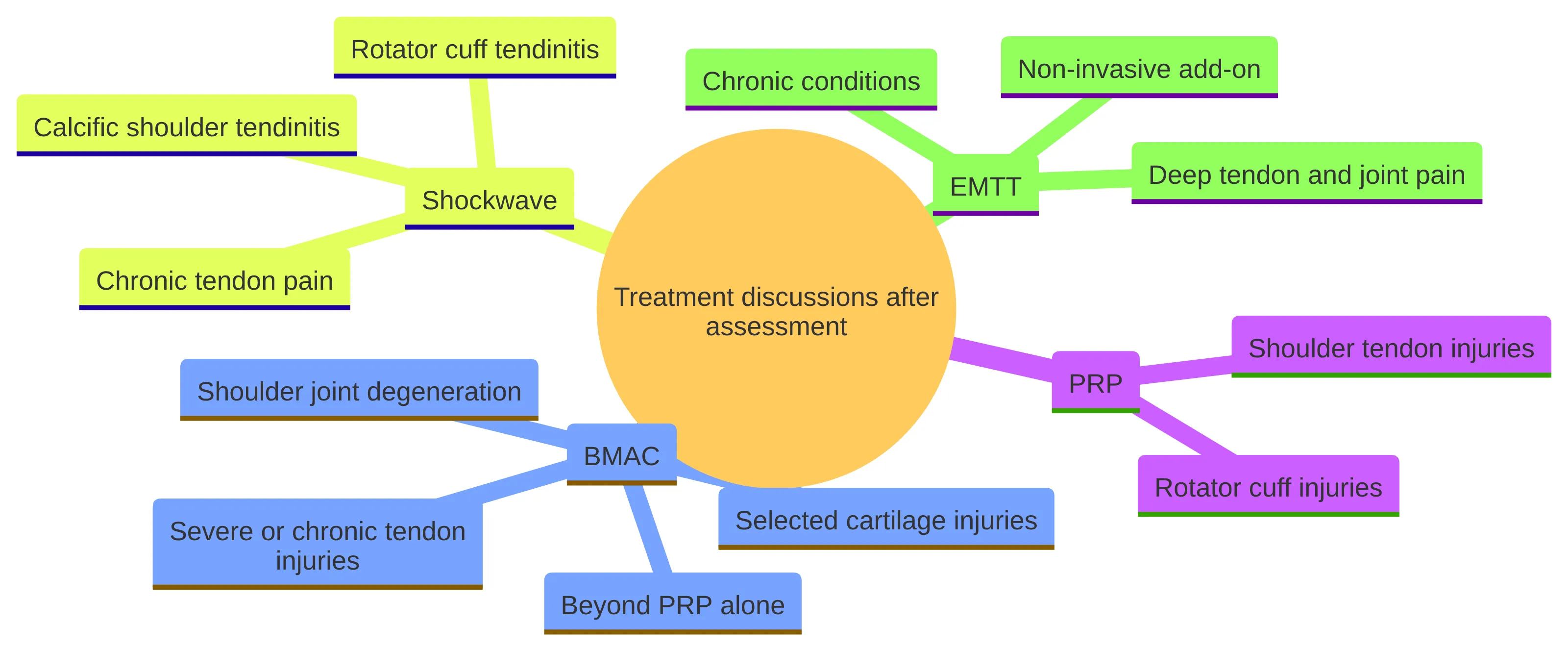
At a broad level, the service descriptions attach different questions to the options: PRP is discussed for some rotator cuff and shoulder tendon injuries; BMAC for selected joint, cartilage, and severe or chronic tendon situations; shockwave for specified shoulder tendinitis and chronic tendon pain; and EMTT for deep or hard-to-reach tendon or joint pain and certain add-on discussions. These descriptions identify topics for review, not a treatment sequence or outcome. The examination still has to establish whether any category fits the actual problem.
At RegenCore Method, we include PRP among our non-surgical options for rotator cuff and shoulder tendon injuries. PRP commonly helps conditions that include those shoulder-related injuries in the treatment information we provide.
That description does not promise pain relief, tissue repair, or a particular result for you. Discuss PRP only after an evaluation has clarified whether the finding and treatment question are relevant.
At RegenCore Method, we discuss BMAC in relation to hip and shoulder joint degeneration, selected cartilage injuries, severe or chronic tendon injuries, and situations beyond what PRP alone can address. Those categories describe the conditions covered in our BMAC information.
A category match is not an eligibility decision. An evaluation must determine whether your findings fit a BMAC discussion, and no outcome can be inferred from the treatment name.
At RegenCore Method, we discuss shockwave therapy for rotator cuff and calcific shoulder tendinitis and for chronic tendon pain that has not responded to physical therapy. Those conditions are included in our shockwave information.
The description gives you a topic for a clinical conversation, not a recommendation for your upper-arm pain. Have the painful movement and underlying condition assessed before deciding whether shockwave belongs in the discussion.
At RegenCore Method, we discuss EMTT for deep or hard-to-reach tendon and joint pain, chronic conditions needing an additional repair stimulus, and patients who prefer a fully non-invasive add-on. Our EMTT information also places it in discussions involving a shockwave or PRP plan.
EMTT is not selected from the symptom phrase alone. Discuss it only after the evaluation establishes what structure and treatment question are being considered.
Keep the decision anchored to the examination. Ask what finding each option is intended to address, what role it would have in the plan, and what uncertainty remains before you decide.
A treatment discussion can be organized by the role each option may have:
- PRP: At RegenCore Method, we discuss PRP for rotator cuff and shoulder tendon injuries among the conditions associated with this option.
- BMAC: We discuss BMAC for shoulder joint degeneration, selected cartilage injuries, severe or chronic tendon injuries, and situations beyond what PRP alone can address.
- Shockwave: We discuss shockwave therapy for rotator cuff or calcific shoulder tendinitis and chronic tendon pain that has not responded to physical therapy.
- EMTT: We discuss EMTT for deep or hard-to-reach tendon and joint pain, chronic conditions needing an additional repair stimulus, and a fully non-invasive add-on preference.
These categories are not interchangeable, and the list is not a ranking. Use the examination findings to determine which questions are relevant.
A useful comparison does not rank these options from best to worst. Instead, it asks what role an option would have for the finding under discussion. You can ask:
- What specific clinical finding or category is this option intended to address?
- Why is it being discussed now rather than continued activity modification, movement-based care, or further assessment?
- Is the proposed role directed at a tendon, a joint, a selected cartilage concern, or another treatment question identified during evaluation?
- What uncertainty remains about suitability, and what information would resolve it?
- What would lead the plan toward a different option or back toward conservative care?
These questions help separate a service description from an individual recommendation. They also make clear why the same symptom phrase should not produce the same treatment conversation for every person. A person whose pain followed an injury with loss of function may need the urgent pathway before any elective treatment discussion. A person without warning signs may still need an examination to clarify whether the relevant issue is movement-related shoulder pain, a tendon category, joint degeneration, or another source that needs consideration.
For readers reviewing RegenCore Method’s options, the service descriptions can be used to prepare questions rather than to self-select a procedure. PRP, BMAC, shockwave, and EMTT are presented for different treatment discussions, and the descriptions do not establish eligibility, expected benefit, or a required sequence. The evaluation is where the symptom history, functional limits, examination findings, and available imaging can be brought together. If those elements do not support a particular discussion, the appropriate conclusion may be continued conservative care, a different clinical question, or no regenerative option.
Before agreeing to a treatment discussion, make sure you can explain what the proposed option is meant to address and what remains uncertain. That level of clarity does not promise an outcome, but it gives you a more useful basis for deciding whether the conversation fits your symptoms and goals.
Non-surgical availability does not remove the need to establish what is causing the movement-related pain. The appropriate discussion may involve conservative care, one treatment category, more than one category, or no regenerative option. An examination is the point at which those possibilities can be separated.
What a RegenCore Method Evaluation Can Help Clarify
The evaluation places your symptom pattern in context without treating the movement label as a diagnosis.
Start with the story of the problem: when it began, which movement brings on the pain, what activity preceded it, what tasks are now difficult, and whether the symptoms are improving, stable, or worsening.
A RegenCore Method evaluation can help you clarify four practical questions:
- What parts of the shoulder, upper extremity, neck, and elbow need to be considered?
- What does the range-of-motion and hands-on examination show?
- Would diagnostic ultrasound or review of prior MRI or X-ray imaging help answer the clinical question?
- Which non-surgical discussions, if any, follow from the findings?
A clear answer to those questions is more useful than choosing a treatment from a symptom search alone.
We use the examination, available imaging, and your history to form a personalized treatment and recovery plan; we do not treat the symptom phrase itself as a predetermined procedure.
A RegenCore Method evaluation may lead to a clearer treatment discussion, continued conservative care, or investigation of a different clinical question. The process narrows the decision; it does not guarantee that PRP, BMAC, shockwave, EMTT, or another non-surgical option will suit you.
Prepare for a RegenCore Method evaluation by bringing prior MRI or X-ray information when available and describing the movement that causes pain. Include the activity or injury that preceded the symptoms, the tasks you have had to change, and whether the problem is improving, stable, or worsening. Those details give the history and examination a clear starting point.
Book a Free Evaluation to Discuss the Next Step
For persistent or activity-limiting symptoms in Palo Alto or the Bay Area, use an evaluation to turn an uncertain movement pattern into a focused clinical discussion. The appropriate next step may remain conservative care, or it may lead to a discussion of non-surgical options after the findings are understood.
What Should You Bring to an Upper-Arm Pain Evaluation?
What are common causes of upper arm pain when raising the arm?
Common causes of upper arm pain during elevation include rotator cuff tendinitis, bursitis, and shoulder impingement. These conditions can cause pain that worsens with arm movement, particularly overhead activities.
When should I seek medical evaluation for shoulder pain?
You should seek medical evaluation if you have persistent pain that does not improve with self-care, if the pain worsens, or if you experience weakness or inability to lift your arm after an injury. Additionally, if you notice any changes in the shape of your shoulder or have systemic symptoms like fever, seek urgent medical advice.
What non-surgical treatment options are available for shoulder pain?
Non-surgical treatment options for shoulder pain may include physical therapy, movement-based care, and regenerative therapies such as PRP (Platelet-Rich Plasma), BMAC (Bone Marrow Aspirate Concentrate), shockwave therapy, and EMTT (Electromagnetic Transduction Therapy). Discuss these options with a healthcare provider after an evaluation.
What should I bring to a shoulder evaluation?
When attending a shoulder evaluation, bring any prior imaging results (like MRIs or X-rays), a list of your symptoms, details about when the pain started, activities that trigger the pain, and any changes in function or sensation.
How does RegenCore Method approach shoulder pain treatment?
RegenCore Method approaches shoulder pain treatment through a comprehensive evaluation that includes a thorough history, hands-on orthopedic examination, and personalized treatment plans. They utilize advanced regenerative therapies tailored to the individual needs of patients.
Next step
Have a question for RegenCore?
Concierge regenerative & orthobiologic orthopedics in San Francisco and Palo Alto. Research-backed, non-surgical treatment — PRP, bone marrow concentrate (BMAC), stem cell therapy, shockwave, EMTT and spinal disc care — to help the body heal itself.
Get in touch