
shoulder impingement treatment
Shoulder Impingement Treatment: How to Choose Your Next Step in Palo Alto and the Bay Area

Validate the impingement label before comparing treatments
Shoulder impingement treatment should begin with the shoulder problem, not with the label alone. The term shoulder impingement does not always mean that something is being physically pinched inside your shoulder.
Shoulder pain can have several causes, including bursitis, cartilage injury, frozen shoulder, infection, nerve problems, impingement, arthritis, rotator cuff tear, and labral tear. Those conditions can require different conversations about activity, rehabilitation, injections, imaging, or other care. A treatment that makes sense for one cause may not answer the question created by another.
That distinction matters if you have spent weeks modifying your workouts, avoiding overhead movements, or trying to work around pain. You may have a useful starting description, but you do not yet have a complete treatment decision. For suspected shoulder impingement, the practical question is whether the current pattern supports a subacromial pain discussion or points toward another shoulder problem.
You can use this guide as a decision map. The key comparison is therefore between the suspected label and the clinical finding, not between treatment names.
That sequencing is useful when the word impingement appears in an old report or in a conversation but the current pattern has changed. The label can organize questions; it cannot by itself settle whether the main issue is a tendon, joint, bursa, stiffness pattern, nerve-related symptom, or another cause. It also cannot tell you whether an injection, rehabilitation plan, shockwave therapy, PRP, BMAC, or imaging is the appropriate next discussion. Those choices depend on what the history and examination show, how long symptoms have lasted, what function has changed, and what care has already been tried. The decision guide below keeps those questions in order: clarify the pattern, decide whether a monitored conservative discussion is reasonable, reassess when function or persistence changes the picture, and then connect any procedure or regenerative option to a specific finding. This is a way to prepare for an individualized discussion, not a way to diagnose yourself.
Use the symptom pattern to decide how much uncertainty remains
Shoulder symptoms help define the next clinical question, but they do not diagnose the cause by themselves. Shoulder problems can involve pain, stiffness, numbness, tingling, swelling, or difficulty moving or rotating the shoulder. The combination matters more than a single sensation.
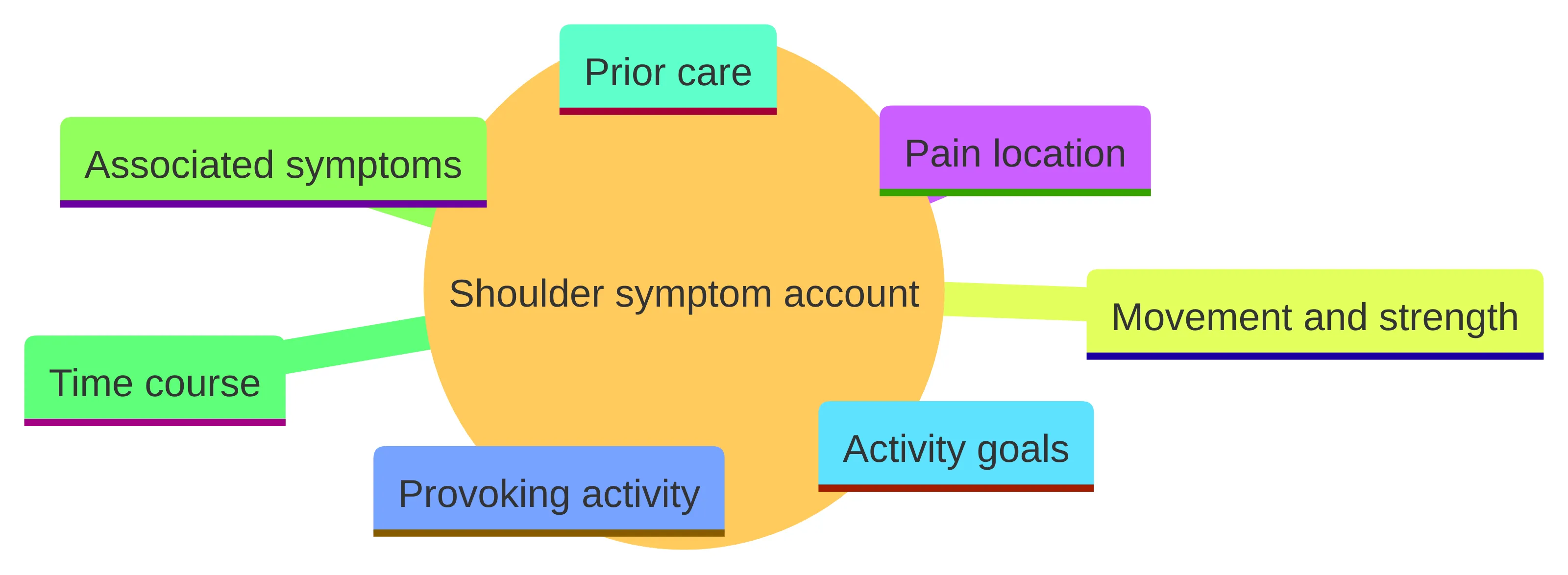
Before choosing a treatment pathway, write down the details that change the decision:
- Pain location: Note whether the pain feels local to the shoulder, extends elsewhere, or appears with a particular movement.
- Provoking activity: Record whether lifting, reaching, throwing, pushing, pulling, sleeping on the shoulder, or ordinary work brings it on.
- Movement and strength: Describe what you can no longer do comfortably, such as reaching a shelf, fastening clothing, carrying equipment, swimming, serving, or working overhead.
- Associated symptoms: Include stiffness, swelling, numbness, tingling, or difficulty moving and rotating the shoulder.
- Time course: Record when the problem began, whether it followed a specific event, and whether it has continued, improved, or returned.
- Prior care: List rest, activity changes, physical therapy, exercises, medication discussions, injections, or other treatments you have already tried.
This account does not replace an examination. It gives the evaluation a clearer starting point. A pattern that is mainly provoked by a specific load may lead to a different discussion from pain accompanied by marked stiffness, neurological symptoms, swelling, or a substantial loss of movement. Persistent symptoms after prior care also deserve a different level of attention than a brief, manageable episode.
Your activity goals belong in the same account. A recreational tennis player, cyclist, swimmer, strength trainee, desk worker, and person whose job requires lifting may describe the same painful arc but face different functional consequences. State the task you need to resume rather than only saying that the shoulder hurts. That description can also help separate a movement complaint from a broader loss of shoulder function. Ask whether the main limitation is pain with a particular load, stiffness that restricts rotation, weakness or inability to complete a task, or symptoms such as numbness or tingling. These categories do not establish a diagnosis, but they change what the clinician needs to examine. They can also keep the word impingement from becoming a shortcut: a movement-related pain pattern may still require consideration of a rotator cuff problem, frozen shoulder, calcific tendinitis, nerve-related symptoms, or another cause of shoulder pain. The useful question is not whether one motion resembles an online description. It is whether the whole pattern, including onset, associated symptoms, and functional change, supports a straightforward rehabilitation discussion or calls for a broader assessment. If the pattern has changed since an earlier label was given, treat that change as information to report rather than as evidence that the old label remains correct.
Know when a short period of conservative care is reasonable
A short period of conservative care may be reasonable to discuss when your symptoms are manageable, no separate warning sign is present, and you can still use the shoulder without a major loss of function. That approach does not mean ignoring the problem. It means reducing the activity that clearly provokes symptoms while using a planned rehabilitation approach rather than waiting passively.
For subacromial pain syndrome, a non-operative plan may include specific, low-intensity, high-frequency exercise therapy tailored to you. Physiotherapy may improve pain and function for some people with shoulder disorders, although the result cannot be assumed for every shoulder condition or every person. The plan should connect the exercise to your movement pattern, strength, work, and sport demands.
A reasonable conservative discussion usually answers four questions:
- Which movement or load should you modify for now?
- Which movements can you continue without repeatedly provoking the shoulder?
- What exercise progression fits the suspected condition and your current function?
- What change would show that the plan needs reassessment?
Strict immobilization is not generally recommended for subacromial pain syndrome; activity should be guided by an individualized clinical plan. That does not mean forcing painful movement or continuing the exact activity that repeatedly aggravates your shoulder. It means separating sensible modification from complete avoidance and giving rehabilitation a defined purpose.
Self-care becomes less suitable as the only plan when symptoms continue, recur as soon as activity resumes, limit work or sport, or remain unclear after prior rehabilitation. At that point, the next step is not automatically a procedure. It is a better assessment of what the shoulder is showing. For an active person in Palo Alto or elsewhere in the Bay Area, this distinction can be practical: temporarily changing a tennis serve, swim stroke, strength exercise, or overhead work task may be different from abandoning all shoulder use. The purpose of modification is to reduce the clearly provoking demand while preserving a plan for reassessment. If the shoulder is not tolerating the modified activity, if function continues to decline, or if symptoms return immediately when ordinary use resumes, the conservative trial has supplied useful information but should not become an indefinite substitute for evaluation. Persistent or recurrent symptoms may mean the working diagnosis, exercise selection, load progression, or underlying condition needs to be reconsidered. The next decision is therefore based on response, not on completing a preset rest period.
Rehabilitation should be specific rather than simply resting the shoulder
Rehabilitation for suspected subacromial pain syndrome may use specific, low-intensity, high-frequency exercise rather than simple rest. The cited guideline describes a tailored approach that may include attention to eccentric training, relaxation, posture, and myofascial trigger points. Those details are a framework for a clinical plan, not a universal home program.
Your rehabilitation should reflect the movement that causes symptoms and the function you need to regain. A plan for a person who cannot sleep on one side may differ from a plan for a baseball player, swimmer, tradesperson, or office worker who repeatedly reaches overhead. The relevant question is not whether an exercise has a shoulder-related name. The question is whether the exercise and its progression fit the suspected problem and your response.
Use these practical checks when discussing rehabilitation:
- Identify the movement or load that repeatedly brings on symptoms.
- Ask how that movement will be modified while you build capacity.
- Clarify which exercises are intended to address mobility, control, strength, or tolerance to load.
- Establish how you will judge whether the plan is helping or needs to change.
Strict immobilization is not generally recommended for subacromial pain syndrome, so complete rest should not automatically become the default. At the same time, a general exercise list cannot determine whether your symptoms reflect subacromial pain, a rotator cuff tear, frozen shoulder, nerve involvement, arthritis, or another cause. If the pattern is unclear or function is falling, use rehabilitation as part of an evaluation-led plan rather than as a substitute for one. This is important when the same overhead discomfort has been described as impingement without a clear explanation of what was examined. A plan aimed at subacromial pain may not answer a question about a rotator cuff tear, frozen shoulder, calcific tendinitis, or nerve-related symptoms. The exercise response is useful information to bring back to the clinician: note which movements were tolerated, which repeatedly provoked symptoms, whether function changed, and whether stiffness, numbness, or tingling developed or persisted. That information does not prove that one condition is present, but it can show why the next step should be a reassessment rather than simply adding more exercises. Rehabilitation is therefore both a treatment pathway and a way to observe whether the working explanation continues to fit the shoulder.
Persistent or function-limiting symptoms change the decision
Persistent or function-limiting shoulder symptoms call for an evaluation rather than repeated trial and error. An evaluation is especially sensible when pain continues despite activity changes or rehabilitation, returns whenever you resume normal use, interferes with work or sport, or is accompanied by stiffness, numbness, tingling, swelling, or difficulty moving the shoulder.
A shoulder evaluation should use a combination of clinical tests rather than relying on one test alone. Shoulder diagnosis is based on your history and a physical examination, because treatment depends on the diagnosis. The purpose is to determine which findings need attention and which options remain reasonable—not to force every symptom into the impingement category.
Your prior treatment changes the next question. If you have already tried rest, physical therapy, or an injection without meaningful improvement, repeating the same approach without reconsidering the diagnosis may leave the main uncertainty unresolved. Bring the name of the treatment, the approximate timing, the response, and the activity you attempted afterward. A lack of improvement can reflect an incomplete rehabilitation plan, an incorrect working diagnosis, a different underlying condition, or a need to reassess the load placed on the shoulder.
A professional assessment also helps separate a symptom that is inconvenient from a symptom pattern that needs a broader workup. You do not need to determine the cause before making the appointment. Describe the pattern accurately and let the examination establish the next clinical question. When a person has been told shoulder impingement, that question should include whether the current pattern remains compatible with subacromial pain syndrome or whether another explanation deserves attention. A marked stiffness pattern can shift the question toward frozen shoulder; concern about tendon integrity can shift it toward a rotator cuff tear; a finding involving calcium can make calcific tendinitis relevant; and numbness or tingling can make nerve-related causes part of the discussion. These are questions for clinical assessment, not conclusions from symptoms alone. They matter because the treatment pathway can change: an exercise progression, injection conversation, shockwave discussion, or regenerative option should be connected to the condition actually being assessed. If no one has explained what finding supports the impingement label, asking that question is a useful reason to seek an evaluation rather than simply trying another treatment.
Assessment comes before choosing imaging or a procedure
A shoulder evaluation should establish the clinical question before you choose imaging or a procedure. The assessment should include your history and a physical examination, and diagnosis should rely on a combination of clinical tests rather than one isolated maneuver. That sequence helps connect your symptoms, movement limits, prior care, and suspected condition.
Imaging decisions should follow a clinical assessment and the relevant specialist pathway rather than being ordered automatically. An image can be useful when it answers a defined question, but obtaining a scan without knowing what question it needs to answer may not clarify the treatment choice. The appropriate study also depends on the suspected tissue or condition and on the findings from the examination.
The cited Dutch guideline recommends diagnostic imaging after six weeks of symptoms and identifies ultrasound as the recommended imaging to help exclude a rotator cuff rupture. Other cited guidance says imaging decisions should follow assessment and the relevant specialist pathway. These recommendations should be treated as context rather than a self-directed rule that applies identically to every shoulder problem.
Bring any prior MRI or X-ray reports and images that you have available. Tell the clinician when they were obtained and whether your symptoms changed afterward. New symptoms, a different level of function, or a new injury can alter the clinical question even when an older image is available.
The assessment should end with a plain explanation of what is suspected, what remains uncertain, and why the proposed next step addresses that question. If the suggested treatment does not connect clearly to the finding, ask what condition it is intended to address and what would lead to a different plan. The same questions apply to imaging. Ask whether the proposed study is meant to clarify a suspected rotator cuff rupture, investigate another structural concern, or answer a different question raised by the examination. A request for a scan should not be treated as proof that the impingement label is correct, and declining to order one automatically does not mean the concern was dismissed. The useful standard is whether the result would change the clinical discussion. If the assessment points toward a different explanation, the imaging question and the treatment comparison should change with it. This keeps the sequence diagnosis-first without making a scan, or the absence of a scan, carry more meaning than the clinical assessment supports.
Compare injections by the question they are meant to answer
Injections belong in the treatment discussion only after the shoulder problem and the purpose of the injection are clear. An injection may be discussed as a way to address a particular symptom pattern or suspected structure, but no injection treats every cause of shoulder pain.
Guidance is not uniform. The cited multidisciplinary guideline says a subacromial corticosteroid injection is indicated for persistent or recurrent symptoms, while the cited evidence summary says it is not known whether subacromial corticosteroid injections are effective. That difference is a reason to discuss the expected purpose, uncertainty, alternatives, and conditions of use rather than treating an injection as an automatic next step.
Use these questions to make an injection discussion specific:
- What diagnosis or suspected structure is the injection intended to address?
- Is the purpose symptom management, diagnostic clarification, or both?
- Why is this option being considered after the care you have already tried?
- What rehabilitation or activity plan would accompany it?
- What uncertainty remains if symptoms improve only temporarily or do not change?
The same discipline applies to other injection approaches. The available information does not support treating every injection category as interchangeable, and a business description of an offering does not determine whether it fits your shoulder. A clinician should connect the intervention to your history, examination, functional limitation, and suspected underlying condition.
If the proposed injection is presented without a clear diagnosis or without an explanation of what happens afterward, pause the comparison. The useful decision is not simply whether an injection is available. It is whether the proposed intervention answers the clinical question raised by your shoulder. If the purpose is symptom management, ask how that purpose fits with rehabilitation and activity modification; if the purpose is diagnostic clarification, ask what the response would and would not establish. A temporary change in symptoms would not, by itself, identify every possible cause of shoulder pain or determine that a regenerative treatment is appropriate. The comparison should also account for the pattern that led to the discussion: persistent or recurrent symptoms may justify a different conversation from a manageable episode, while stiffness, neurological symptoms, swelling, or substantial movement loss may require the underlying condition to be reconsidered first. These distinctions help prevent an injection discussion from becoming a substitute for explaining the diagnosis, the uncertainty, and the next reassessment point.
Keep shockwave, PRP, and BMAC downstream of the finding
Shockwave therapy, PRP, and BMAC should enter the discussion after the evaluation identifies the finding they are meant to address. These options are not interchangeable, and the fact that a treatment is available does not establish that it fits every shoulder problem labeled impingement.
| Option | Finding or situation described in the available information | Boundary for your decision |
|---|---|---|
| Shockwave therapy | Independent evidence cited here says shockwave therapy may improve pain when the shoulder problem involves calcific tendonitis. RegenCore Method also identifies rotator cuff and calcific shoulder tendinitis and chronic tendon pain that has not responded to physical therapy among the conditions it commonly helps with shockwave therapy. | The discussion should establish whether the shoulder finding involves a condition relevant to that description. Do not treat the label impingement alone as the indication. |
| PRP | Our treatment information identifies PRP as commonly helping rotator cuff and shoulder tendon injuries. | A clinician still needs to determine whether your symptoms reflect a shoulder tendon problem and whether PRP is appropriate for your situation. |
| BMAC | Our treatment information identifies BMAC as commonly helping shoulder joint degeneration, cartilage injury in select candidates, and severe or chronic tendon injuries, including cases beyond what PRP alone can address. | The phrase select candidates is a real boundary. Joint degeneration, cartilage injury, and chronic tendon problems are not the same finding as every case called impingement. |
The independent evidence cited for shockwave is specific to calcific tendonitis. The PRP and BMAC descriptions above are RegenCore Method’s treatment information about the conditions it identifies; they are not a guarantee of benefit, a diagnosis, or a determination that you qualify.
Ask what the examination found, which tissue or condition the option is intended to address, and how the proposed treatment relates to your prior care. Ask what uncertainty remains if the finding is not clear. Those questions keep the treatment downstream of the clinical problem instead of allowing a treatment name to determine the problem. Before treating any option in the table as the next step, ask the clinician to make four parts of the comparison explicit: the finding being treated, the reason this option is being considered now, the role of prior rehabilitation or other care, and the sign that would prompt reassessment. This is especially important for a shoulder described only as impingement. The independent evidence cited here gives shockwave a specific connection to calcific tendonitis, while the PRP and BMAC descriptions are RegenCore Method’s statements about conditions it commonly helps and do not establish individual eligibility or shoulder-impingement outcomes. A careful discussion can therefore acknowledge that an option is available without presenting it as necessary, interchangeable with another option, or suitable for every patient. The decision remains tied to the examination, the suspected condition, functional limitations, prior treatment, and the uncertainty that still needs to be resolved.
Do not let an attractive treatment name substitute for diagnosis
A treatment name cannot tell you whether the treatment fits your shoulder. Our treatment information identifies PRP as commonly helping rotator cuff and shoulder tendon injuries, while our BMAC information identifies shoulder joint degeneration, cartilage injury in select candidates, and severe or chronic tendon injuries among the situations it commonly helps. Those descriptions do not establish that PRP or BMAC is appropriate for every case called shoulder impingement.
The distinction is especially important when the label came from a brief conversation, an old report, or a self-assessment based on painful movement. Shoulder impingement does not necessarily mean that tissue is physically being pinched, and shoulder pain can arise from several conditions. Before you compare regenerative options, ask what the current evaluation shows and whether the proposed treatment is directed at that finding.
A careful discussion should separate three decisions:
- What is the likely condition? The history and examination should support the working diagnosis.
- What options are reasonable for that condition? The clinician should explain why rehabilitation, an injection, shockwave therapy, PRP, BMAC, or another pathway is being considered.
- What is known and unknown? You should understand the expected purpose, relevant uncertainty, alternatives, and what would prompt reassessment.
Availability is not eligibility, and eligibility is not a promise of an outcome. Keep those boundaries visible while you decide whether an evaluation is the appropriate next step.
Treat a persistent or enlarging shoulder lump as a separate assessment issue
A persistent or enlarging shoulder lump should not be folded into routine impingement self-care. A persistent or enlarging shoulder lump, especially with restricted movement or pain, warrants prompt medical assessment and may require imaging.
Do not assume that a lump is part of the same process as pain with overhead movement. Note when you first noticed it, whether it has changed, and whether movement or pain changed at the same time. Share those details during the assessment. The clinical question for a lump is different from the question of how to progress an exercise plan, so seek the appropriate medical evaluation rather than treating it as an ordinary training symptom.
Prepare the information that makes a Palo Alto evaluation useful
A useful shoulder evaluation starts with a clear account of what changed, what you tried, and what you need to do. Before an appointment in Palo Alto or elsewhere in the Bay Area, prepare a short symptom brief with these details:
- When the pain or movement problem began and whether an injury preceded it.
- Which movements, positions, work tasks, or sports provoke it.
- Whether you have stiffness, numbness, tingling, swelling, or difficulty moving or rotating the shoulder.
- Which daily, work, or sport activities you have stopped, reduced, or changed.
- What you tried, including activity modification, physical therapy, exercises, medication discussions, or injections.
- How your shoulder responded to each step and whether symptoms returned when activity increased.
- Any prior MRI or X-ray reports and images, with the date and the reason they were obtained.
- Your main goal, such as sleeping comfortably, performing a work task, lifting, swimming, or returning to a particular sport.
An assessment uses your history and examination to frame the next clinical question; imaging decisions follow that assessment and the relevant pathway. Your preparation helps connect those parts of the visit. It does not require you to name the condition in advance.
Bring your symptom brief and available imaging so the visit can address the question that matters most to you: what is limiting the shoulder, and what should happen next?
It can help to separate information that describes the problem from information that describes your preference. The first includes onset, provoking movements, associated symptoms, functional change, prior care, and available reports. The second includes the activity you hope to resume, the amount of time you can devote to rehabilitation, concerns about injections or procedures, and questions about uncertainty. Both belong in the conversation, but neither replaces the examination.
For people in Palo Alto or elsewhere in the Bay Area, the practical next step is to arrange an evaluation when the persistence, functional effect, associated symptoms, or prior treatment history makes self-management alone insufficient. Use the configured booking link to request the evaluation, and bring the information that allows the clinician to connect your goals with the clinical question. The purpose is not to arrive with a treatment selected. It is to make the comparison specific enough that the next step can be discussed on the basis of the finding.
Use a local evaluation to turn the comparison into a plan
Bring the movement map and treatment history described above. Ask what the examination supports, whether imaging is needed to answer a specific question, which non-surgical pathways fit the finding, and what uncertainty remains. A qualified professional must decide individual suitability for any treatment. The purpose of the visit is to make that decision specific to you rather than choosing from a treatment label alone.
Next step
Have a question for RegenCore?
Concierge regenerative & orthobiologic orthopedics in San Francisco and Palo Alto. Research-backed, non-surgical treatment — PRP, bone marrow concentrate (BMAC), stem cell therapy, shockwave, EMTT and spinal disc care — to help the body heal itself.
Get in touch