
regenerative biotherapeutics
What Are Regenerative Biotherapeutics for Knee Pain? Understanding PRP, BMAC, and the Evidence

Translate the label before weighing the treatment
A treatment label can sound more conclusive than the evidence behind it. For a painful knee, the useful question is not whether an option carries a regenerative name; it is what the option is intended to do, which knee problem was studied, how the result was measured, and what remains unknown.
That shift matters if you are dealing with arthritis, an injury, a meniscus problem, or pain that has continued after rest and rehabilitation. A category can help you find information, but it cannot establish a diagnosis or tell you whether a particular injection or cell-based approach fits your knee.
Regenerative medicine is an emerging field that aims to restore the function of tissues or organs affected by severe injury or chronic disease. Stem-cell research has helped lay the foundation for some cell-based therapies. Those statements describe a field and a research pathway, not a guaranteed result for an arthritic or injured knee.
The practical starting point is therefore narrow: identify the condition being discussed, separate the treatment category from the expected outcome, and ask what evidence applies to your specific problem.
What regenerative biotherapeutics means for a painful knee
In this guide, regenerative biotherapeutics is a working label for biological or cell-based approaches discussed in connection with tissue function and repair. It is not the name of one standardized procedure, one ingredient, or one outcome. The label can cover interventions that differ in what they contain, how they are prepared, how they are delivered, and which condition they are meant to address.
For you, that means the label is only the first layer of the question. The next layer is whether the discussion concerns knee osteoarthritis, a ligament or tendon injury, a meniscus tear, or another source of pain.
Orthobiologics are regenerative therapies used for orthopedic conditions. A review describes reviewed orthobiologic approaches as including cell-based, biologic-fluid-based, matrix-based, and molecular-based categories. Regenerative medicine is broader: it concerns restoration of tissue or organ function across severe injury and chronic disease, while orthobiologics apply that conversation to musculoskeletal care.
Stem-cell therapy is therefore not a synonym for every regenerative treatment. Stem-cell research has contributed to some cell-based therapies, but the presence of a regenerative label does not establish that a treatment contains stem cells or that evidence from one cell-based approach applies to every other approach.
PRP and bone marrow aspirate concentrate appear in the knee discussion because a systematic review examined level I studies comparing those injection therapies with hyaluronic acid for knee osteoarthritis. That study question is narrower than the whole field. It does not turn every biological treatment into the same intervention, and it does not answer whether an option suits a knee whose diagnosis has not been established.
Place PRP and BMAC on the treatment map
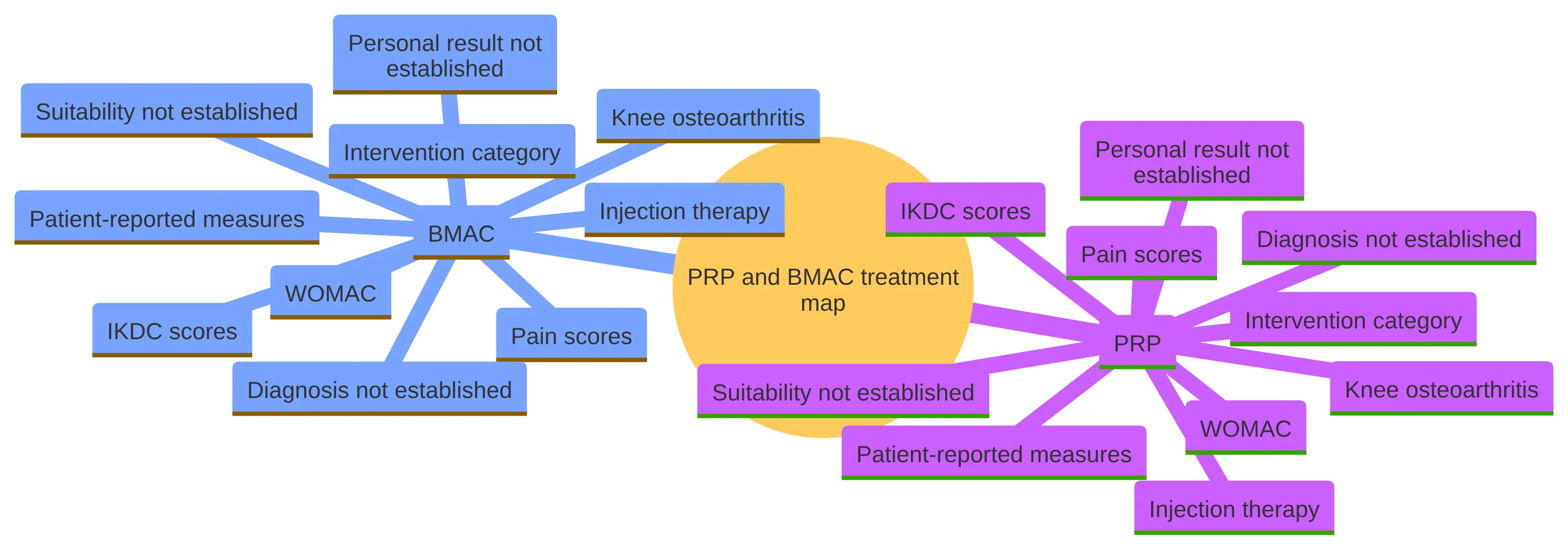
PRP means platelet-rich plasma, and BMAC means bone marrow aspirate concentrate. In a systematic review of knee osteoarthritis studies, both names referred to injection approaches examined in comparative research. The names tell you what intervention the study evaluated; they do not tell you what result you should expect.
A useful comparison keeps the shared study question visible instead of treating the two names as competing promises:
| Decision question | PRP | BMAC |
|---|---|---|
| What was compared in the reviewed knee literature? | An injection therapy included in level I comparative studies for knee osteoarthritis | An injection therapy included in the same type of comparative studies for knee osteoarthritis |
| Which measures appeared in the systematic review? | Patient-reported measures such as WOMAC, pain scores, and IKDC scores | Patient-reported measures such as WOMAC, pain scores, and IKDC scores |
| What does the name establish for you? | The intervention category being discussed | The intervention category being discussed |
| What does the name not establish? | Your diagnosis, suitability, or personal result | Your diagnosis, suitability, or personal result |
ClinicalTrials.gov lists prospective randomized studies comparing bone marrow aspirate concentrate with PRP for knee osteoarthritis, including trials with one- and two-year outcome reports. A trial duration describes how long participants were followed; it does not create a personal timetable for pain relief, activity, or recovery.
Ask which preparation and protocol the clinician is discussing, what condition the evidence concerns, and how progress would be judged. Without those details, comparing the names alone can create a false sense of precision.
Read knee evidence by study question, not headline
A knee evidence question should identify the condition, intervention, comparison, outcome, and follow-up. The systematic review of PRP, BMAC, and hyaluronic acid examined level I studies in knee osteoarthritis and used measures including WOMAC, pain scores, and IKDC scores. That tells you what the researchers set out to compare and how patients were assessed.
The finding becomes less useful when the question changes. Evidence from knee osteoarthritis does not automatically answer whether the same intervention is appropriate for a meniscus tear, an acute injury, pain after surgery, or a knee problem with a different cause.
A treatment claim becomes easier to interpret when you separate four questions:
- Who was studied? Look for the diagnosis, severity, age range, and other features that define the participants.
- What was delivered? Ask about the preparation, dose, number of treatments, and comparison group when those details are relevant to the discussion.
- What changed? Distinguish a pain score, a function score, an imaging finding, and a return-to-activity report. They are not interchangeable outcomes.
- How long were participants followed? A short follow-up can describe short-term results without settling longer-term safety or durability.
This reading method keeps a favorable headline from carrying more meaning than the study question supports.
When a study compares PRP or BMAC with hyaluronic acid, its result answers a specific relative question: how the studied groups fared against that comparator for the measured outcomes and follow-up. It does not automatically answer how either option compares with exercise, weight management, patient education, no injection, or knee replacement. Those choices may belong to different questions and different evidence. Before using a study to guide a conversation, name the alternative you are actually weighing and ask whether the cited research included it. This keeps a comparison result from being mistaken for a complete treatment ranking.
An evidence match also includes timing. A study with one- or two-year follow-up can inform what was observed during that interval, but it cannot answer a longer-term question the study did not measure. If your priority is lasting symptom relief, delaying surgery, or returning to a specific activity, say so explicitly and ask which outcome and follow-up support that expectation. The answer may be uncertain, and that uncertainty is part of the decision rather than a gap to fill with broad promises.
Knee osteoarthritis evidence can help you understand what has been studied in that condition, but it cannot identify the cause of your pain. A systematic review of mesenchymal stromal-cell therapy and a separate review of injection comparisons address defined study populations and interventions. Neither source supplies a universal answer for every painful knee.
The practical boundary is simple: match the evidence to the diagnosis before treating a study result as a reason to pursue a procedure.
Keep promising findings and uncertainty together
Orthobiologic findings need their limitations beside them. A review identifies limited standardization in how some products are prepared and administered as an important limitation. That matters because two interventions with similar names may not be identical in preparation, concentration, delivery, or clinical protocol.
A favorable result from one protocol should therefore be read as a result from that protocol and study population. It should not be widened into a guarantee that every similarly named treatment will produce the same result for you.
A two-column mental check can help when a result sounds promising:
- What the evidence may support: a defined finding in a defined group, measured with a defined outcome over a defined period.
- What the evidence may leave open: whether the finding applies to your diagnosis, whether another protocol would perform similarly, how durable the change is, and what longer-term uncertainties remain.
This is not a way to dismiss research. It is a way to keep the conclusion proportional to the question that was actually studied.
Patient-reported measures such as WOMAC, pain scores, and IKDC scores can describe how participants experienced pain or function in a study. Those measures are useful, but they do not by themselves prove that tissue was restored, that arthritis stopped progressing, or that knee replacement will be avoided.
Ask what the study measured before deciding what its result means. A change in a score and a change in joint structure are different claims.
Use the cell-therapy evidence as a caution point
Mesenchymal stromal-cell therapy provides a useful caution point for interpreting this field. A systematic review reported low- to very-low-quality evidence for mesenchymal stromal-cell therapy in knee osteoarthritis. Because most included trials followed participants for one to two years, the review said long-term safety remained unknown.
The wording matters. Low- or very-low-quality evidence does not prove that an approach has no possible value, but it does limit how confidently you can use the findings to predict benefit, durability, or long-term safety.
The same systematic review recommended caution and said mesenchymal stromal-cell therapy could be considered only for selected patients with persistent significant pain and disability despite extensive first-line treatment, when knee replacement is not feasible, using shared decision-making. That is a review-level recommendation for a narrowly described group, not a general instruction for every adult with knee pain.
The review identified exercise, weight management, and patient education as first-line, non-invasive options for knee osteoarthritis. Your treatment discussion should keep those established parts of care separate from a later conversation about a cell-based intervention.
Mesenchymal stromal-cell findings should not be treated as direct proof about every BMAC preparation or every biological treatment. The intervention, preparation, administration method, participant group, and follow-up all affect what a study can establish. Limited standardization in orthobiologic preparation and administration adds another reason to ask for the exact protocol rather than relying on a category name.
Understand why suitability cannot be inferred from the name
Knee treatment suitability depends first on what is causing the symptoms. A knee-pain evaluation may include your history of pain, injuries, or surgeries, relevant systemic conditions, and family history. Those details can change the clinical question before any treatment is discussed.
The treatment label cannot fill that gap.
A treatment may not be appropriate for you when the working diagnosis does not match the evidence, when the structural problem requires a different form of care, when the expected outcome has not been defined, or when the relevant uncertainty has not been discussed. RegenCore Method will tell you during an evaluation if regenerative treatment is not suitable for advanced structural damage.
Before comparing PRP with BMAC, make the diagnosis and the goal explicit. “I want to avoid surgery” is a meaningful goal, but it is not a diagnosis or proof that a non-surgical option can achieve it.
Relevant imaging can help answer a specific structural question, but an image should be interpreted alongside your history and examination. An evaluation may include review of prior MRI or X-ray imaging. Ask what finding the imaging is meant to clarify and how that finding changes the treatment options being considered.
Make consent an evidence conversation
Informed consent is an important part of clinical treatment, although the process is practiced variably and may not achieve its theoretical ideal. For a regenerative discussion, consent should be more than a signature or a description of a procedure. It should give you room to understand the proposed intervention, its intended outcome, its alternatives, and its uncertainties.
You do not need to accept a confident treatment label in place of an explanation. A clear conversation makes the unresolved parts visible.
Your consent conversation should answer several practical questions:
- What diagnosis is being addressed, and which findings support it?
- What is the treatment intended to change: pain, function, tissue appearance, or another outcome?
- Which studies apply to this diagnosis and this preparation?
- What alternatives remain available, including non-invasive care when relevant?
- What burdens, known risks, uncertain outcomes, and follow-up commitments should you weigh?
- What result would count as meaningful progress, and when would the plan be reassessed?
These questions do not force a treatment decision. They show whether the decision has been defined well enough to make.
Uncertainty should be stated in the same conversation as potential benefit. The knee osteoarthritis review reported low- to very-low-quality evidence for mesenchymal stromal-cell therapy and unknown long-term safety, while the orthobiologics review identified limited standardization in preparation and administration. Those limitations belong beside any discussion of why an option might be considered.
Bring the right knee question to evaluation
A useful knee evaluation starts with a question that can be examined. Instead of arriving with only the treatment name, describe when the pain began, what makes it better or worse, whether swelling or instability occurs, what activities you want to resume, and what care you have already tried.
Bring a concise record of prior diagnoses, procedures, rehabilitation, medication changes, and responses. Bring imaging reports and prior images when you have them. The goal is to help the discussion move from a general category to the specific knee problem.
A knee-pain evaluation may consider your history of prior knee pain, injuries, or surgeries, systemic medical conditions, and relevant family history. You can prepare by writing down those details before the appointment, including dates or approximate sequence when you remember them. A complete history gives the clinician more context for interpreting the examination and imaging.
A concrete functional goal gives the conversation something meaningful to address. You may want to hike around the Bay Area, return to a sport, climb stairs more comfortably, or manage daily walking. A goal does not predict the result, but it gives the clinician an outcome to discuss and measure rather than leaving “better” undefined.
Ask questions that expose the real decision
A treatment conversation becomes more useful when you ask questions that connect the proposed option to your specific knee:
- What is the working diagnosis? Ask which history, examination, or imaging findings support it.
- Which evidence matches this diagnosis? Ask whether the cited research studied knee osteoarthritis, an injury, a meniscus problem, or another condition.
- What is the intended outcome? Ask whether success means less pain, improved function, a measured score change, or something else.
- What has to happen before this option makes sense? For knee osteoarthritis, one systematic review identified exercise, weight management, and patient education as first-line, non-invasive options.
- What exactly is being prepared and administered? Limited standardization in orthobiologic preparation and administration makes the protocol worth clarifying.
- How long were comparable patients followed? Ask whether the evidence addresses the time horizon that matters to you.
- What would make you choose a different path? Ask which findings, symptoms, structural changes, or lack of progress would change the plan.
- How will progress be measured? Agree on functional activities and symptom measures before treating a later change as proof of success.
The purpose of the list is not to create a checklist for self-treatment. It is to make the clinician explain the link between your knee problem, the proposed option, and the evidence.
The AAOS knee osteoarthritis guideline is based on a systematic review of published studies and is intended as a resource for appropriately trained clinicians making treatment decisions. A guideline can organize evidence for clinical judgment; it cannot replace the history, examination, and problem definition needed for your knee.
Interpret the Bay Area option through evaluation, not availability
A Bay Area location can make an evaluation easier to pursue, but local availability does not establish medical suitability. If you live in Palo Alto, Mountain View, Menlo Park, Los Altos, Sunnyvale, San Jose, or elsewhere nearby, use the same standard you would use anywhere: ask whether the evaluation identifies the knee problem, connects the proposed option to applicable evidence, and makes uncertainty clear.
At RegenCore Method, we will tell you honestly during an evaluation if regenerative treatment is not suitable for advanced structural damage. That boundary matters because a practice offering an option should still be able to explain when the option does not fit the clinical situation.
Judge the local conversation by the quality of the explanation, not by the availability of a named treatment.
Choose an informed next action
The useful conclusion is not that PRP, BMAC, or another cell-based approach will solve every knee problem. The useful conclusion is that the treatment name must come after the clinical question. Evidence for knee osteoarthritis may inform a discussion, while low- to very-low-quality evidence, limited standardization, and unknown long-term safety require measured expectations.
A qualified clinician should decide individual suitability after considering your history, examination, relevant imaging, diagnosis, goals, alternatives, and the limits of the applicable evidence. Before that conversation, write down the symptoms and activity limits that matter most to you, gather prior records, and take the questions from this guide with you.
For adults with knee pain or injury in Palo Alto and the wider Bay Area, an evaluation is a sensible next action when you need help defining the problem before weighing a regenerative option.
Questions to ask before discussing regenerative treatment for knee pain
What are regenerative biotherapeutics?
Regenerative biotherapeutics refer to biological or cell-based approaches aimed at restoring tissue function and repair. This term encompasses various interventions that differ in composition, preparation, delivery, and intended conditions, rather than a single standardized procedure.
How do PRP and BMAC relate to knee pain treatment?
Platelet-rich plasma (PRP) and bone marrow aspirate concentrate (BMAC) are injection therapies studied for knee osteoarthritis. They are included in comparative research examining their effectiveness against other treatments, but their names do not guarantee specific outcomes for individual patients.
What should I expect during a knee evaluation?
A knee evaluation typically includes a thorough medical history, a hands-on orthopedic examination, diagnostic imaging review, and a discussion of your symptoms and treatment goals.
What questions should I ask my clinician about regenerative treatments?
You should ask about the working diagnosis, the evidence supporting the proposed treatment, the intended outcomes, and any risks or uncertainties associated with the treatment. Clarifying these points can help ensure that the treatment aligns with your specific knee condition.
What are the limitations of mesenchymal stromal-cell therapy for knee osteoarthritis?
A systematic review indicated low- to very-low-quality evidence for mesenchymal stromal-cell therapy in knee osteoarthritis, with unknown long-term safety.
How can I prepare for a consultation about knee pain treatment?
Before your consultation, gather a detailed history of your knee pain, including previous treatments, imaging results, and specific symptoms. Having this information ready can facilitate a more productive discussion about your treatment options.
Next step
Have a question for RegenCore?
Concierge regenerative & orthobiologic orthopedics in San Francisco and Palo Alto. Research-backed, non-surgical treatment — PRP, bone marrow concentrate (BMAC), stem cell therapy, shockwave, EMTT and spinal disc care — to help the body heal itself.
Get in touch