
Knee Pain Treatment
Knee Pain Treatment: A Decision Guide for Choosing Your Next Step
Separate Acute Injury From Ongoing Knee Pain
Two features change the starting point for a knee-pain discussion: whether symptoms followed a fall or twist and what findings accompany that event. An acute-injury imaging question should not be handled as though it were the same as persistent pain without a recent injury.
Acute injury: use findings to frame imaging
After an acute fall or twist, initial imaging depends on the findings. In people aged five or older who can walk and have no focal tenderness or effusion, the ACR lists knee radiography as potentially appropriate. The ACR separates acute knee injuries with focal tenderness, an effusion, or inability to bear weight from that lower-risk presentation. These categories help frame the initial imaging discussion; they do not diagnose the injury or select a treatment.
Ongoing symptoms: clarify the possible cause
Knee pain can have different causes, including osteoarthritis, rheumatoid arthritis, gout, pseudogout, and septic arthritis. These conditions differ in mechanism: osteoarthritis involves cartilage deterioration, rheumatoid arthritis is autoimmune, gout and pseudogout involve crystals, and septic arthritis is an infection. Identifying the cause requires clinical assessment rather than treating the symptom label alone.
Place rehabilitation and regenerative options in context
When osteoarthritis has been diagnosed, exercise and rehabilitation are pathways to discuss. A 2026 overview found that exercise therapy produced outcomes comparable to many other osteoarthritis treatments; it may be attractive because of its safety, broader health benefits, and lower cost, although access and adherence barriers matter. Knee osteoarthritis rehabilitation is typically individualized, with modifications, time frames, and visits varying with symptoms, comorbidities, goals, demographics, and progress.
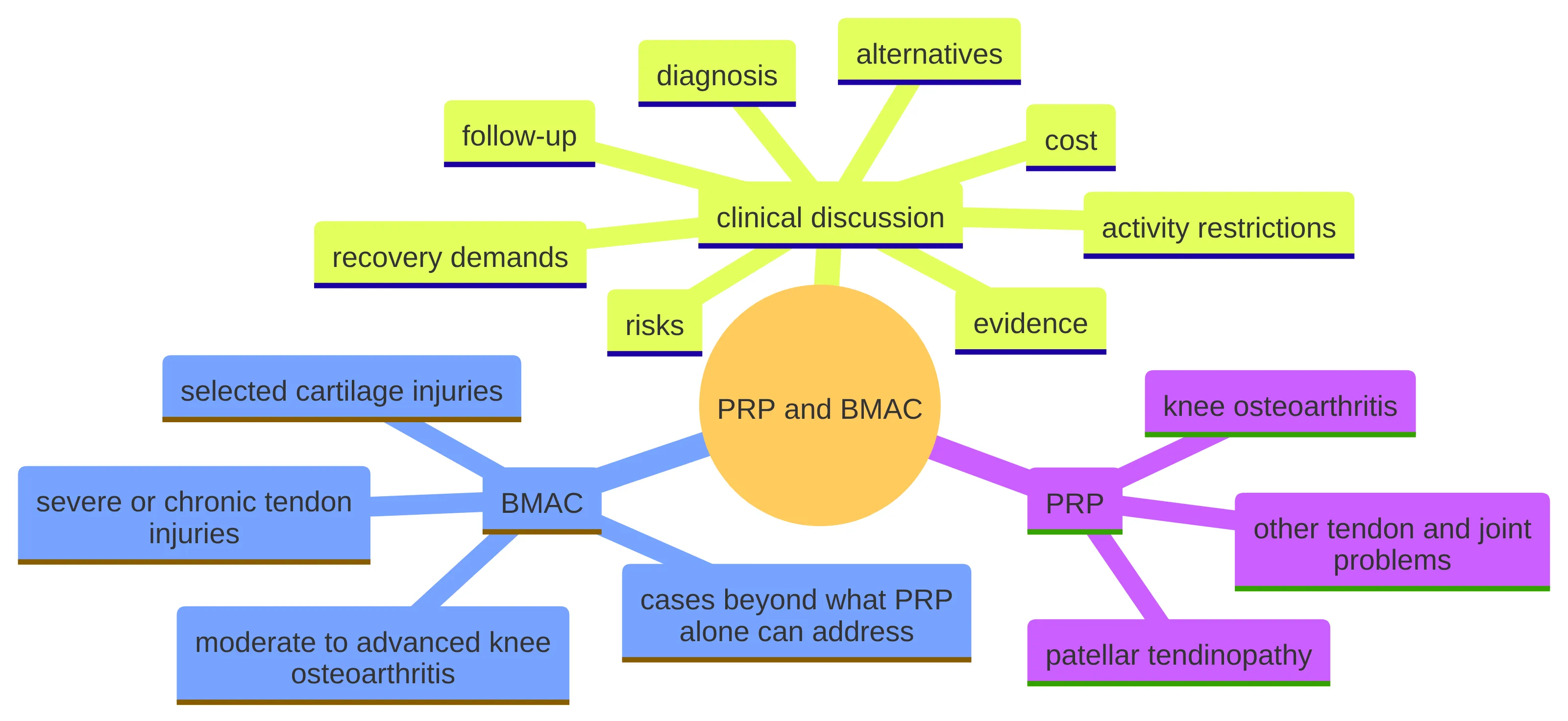
RegenCore Method says PRP commonly helps conditions including knee osteoarthritis and patellar tendinopathy. It also says BMAC commonly helps moderate to advanced knee osteoarthritis, selected cartilage injuries, severe or chronic tendon injuries, and cases beyond what PRP alone can address. Those descriptions identify the conditions discussed by RegenCore Method; they do not establish whether either option is suitable for a particular person.
The resulting sequence is:
- Recent fall or twist: describe the findings that shape the initial imaging question.
- No recent acute event: clarify which possible cause needs clinical assessment.
- Osteoarthritis diagnosis: discuss individualized exercise or rehabilitation and practical barriers to following it.
- Regenerative-treatment discussion: consider the rationale, burden, uncertainty, cost, insurance, and recovery questions for the option under consideration.
General information cannot determine a diagnosis or treatment suitability. Keeping these questions separate helps a clinical discussion address the relevant issue without treating imaging, rehabilitation, and regenerative treatment as interchangeable.
Use Urgency to Set the Scope of the Comparison
Acute and stable knee symptoms create different comparison questions. After a fall or twisting injury, the American College of Radiology separates scenarios according to findings such as focal tenderness, an effusion, and the ability to bear weight. For an adult or child aged five years or older who can walk and has no focal tenderness or effusion, the ACR lists knee radiography as potentially appropriate for initial imaging. Acute injuries with focal tenderness, an effusion, or an inability to bear weight fall into a separate initial-imaging scenario.
Those distinctions do not identify the cause of your pain or tell you which treatment you should receive. They indicate what information should be clarified before comparing treatment pathways. Stable symptoms create a different comparison problem. You may be able to walk, but still have recurring pain on stairs, during a hike, or after sport. In that situation, the useful question is what remains unresolved about the problem, the function you want to regain, and the options being discussed.
Separate the information in your notes:
- Acute change: record the injury mechanism, when it happened, whether you can bear weight, and whether focal tenderness or an effusion appeared.
- Stable or recurring symptoms: record the activities that bring on pain, how long the pattern has continued, what you have already tried, and what function you want to regain.
The distinction keeps an acute injury question from being folded into a longer-term treatment comparison. It also gives a clinician a clearer account of what changed and what still needs explanation.
Use the Symptom Pattern to Define the Clinical Question
The symptom pattern is a starting point for defining the clinical question, not a way to diagnose yourself. Knee pain can arise from osteoarthritis, rheumatoid arthritis, gout, pseudogout, or septic arthritis. Osteoarthritis involves cartilage deterioration associated with use and age; rheumatoid arthritis is autoimmune; gout and pseudogout involve crystals; and septic arthritis is an infection of the joint.
That range changes what you need to ask. A gradual pattern associated with activity raises a different discussion from pain that began after a twist. Recurrent symptoms may require a different assessment from a new, rapidly changing problem. A symptom label such as arthritis does not establish which condition is present, how advanced it is, or whether a particular intervention fits.
Write down the details that can make the discussion more specific:
- when the pain began and whether it followed a fall, twist, or other event;
- which activities bring it on, such as walking, stairs, hiking, or sport;
- whether you can bear weight and whether the knee has focal tenderness or an effusion after an acute injury;
- whether symptoms are stable, recurring, or changing; and
- what you have already tried, for how long, and what changed afterward.
Your activity goal belongs in the same record as your symptoms. Walking around Palo Alto, completing a workday, returning to Bay Area trails, and training for a sport can place different demands on the knee. Stating the demand clearly helps keep the discussion practical without turning your goal into a promise about the outcome.
The record also gives you a way to identify uncertainty. If you cannot explain whether the problem followed an injury, what activities change it, or why a treatment is being proposed, the next step may be clarification rather than a procedure. Clinical assessment is needed to distinguish among possible causes and connect the symptom pattern to an appropriate plan.
Build From Conservative Care and Rehabilitation
Conservative care and rehabilitation give you a foundation for discussing knee symptoms without assuming that an injection or operation is the first answer. Exercise therapy is one established pathway to examine. A 2026 overview of systematic reviews and randomized controlled trials found that exercise therapy for osteoarthritis produced outcomes comparable to many other treatments. The authors noted that exercise may be attractive because of its safety, broader health benefits, and lower cost, while also recognizing that access and adherence barriers matter.
That finding does not mean exercise is suitable for every situation or that it will postpone every later option. The same overview noted that some people face personal or social barriers, and that the expected effect may be small or absent for some individuals. Use the finding to ask a better question: what kind of rehabilitation is realistic for your symptoms, goals, available time, and access to care?
A knee osteoarthritis rehabilitation guideline is intended for rehabilitation after an osteoarthritis diagnosis and is criterion-based. The guideline says that modifications, time frames, and visits can vary with symptoms, comorbidities, demographics, goals, and individual progress. A generic exercise list therefore cannot stand in for a plan that responds to your examination findings.
When discussing rehabilitation, ask about:
- the diagnosis or working problem the program is meant to address;
- the function the program is intended to support;
- how the plan will be adjusted if symptoms change;
- what progress will be assessed and when; and
- what barriers could make the plan difficult to follow.
Rehabilitation also helps clarify what you are comparing. If you have not had a structured opportunity to discuss exercise, adherence, and progression, an injection may be answering a different question from the one you need answered. If you have already made a reasonable effort and symptoms remain limiting, bring that history into an evaluation rather than assuming that the next step must be more of the same.
Conservative care is not a promise of pain relief, and it is not a test of willpower. It is a treatment pathway whose fit depends on the diagnosis, your goals, the plan itself, and your ability to carry it out.
Know When Self-Management Is No Longer Enough
Self-management is no longer enough when the information gap or the change in function matters more than the convenience of waiting. You do not need to identify the cause on your own before seeking an evaluation. You do need to recognize when continuing the same approach leaves an important question unanswered.
Consider moving from self-management to an evaluation when:
- knee pain keeps returning or continues to limit walking, stairs, hiking, work, or sport;
- an acute fall or twist is followed by focal tenderness, an effusion, or an inability to bear weight;
- you are unsure whether the problem is arthritis, an injury, or another condition;
- a previous plan has not addressed the function you need; or
- you are considering PRP, BMAC, shockwave therapy, surgery, or another intervention but do not know what finding would make it relevant.
These are decision signals, not diagnostic criteria. They do not establish that you need an injection, surgery, or any specific regenerative therapy. They indicate that a treatment name alone is unlikely to resolve the uncertainty.
Knee pain also should not automatically be treated as osteoarthritis. The Mayo Clinic overview lists osteoarthritis, rheumatoid arthritis, gout, pseudogout, and septic arthritis among possible causes. Septic arthritis is an infection of the joint, so a concerning or worsening pattern deserves prompt clinical attention rather than an extended experiment with self-management.
A practical boundary is simple: if your symptoms are changing after an injury, your ability to bear weight has changed, or your function is steadily narrowing, shift the focus from trying another general measure to obtaining an assessment. If the pattern is stable and manageable, keep a concise record and use it to decide when a planned evaluation would add useful information.
Treat PRP and BMAC as Questions for Clinical Discussion
PRP and BMAC are distinct options to discuss only after the problem being treated is clear enough to support a meaningful comparison. RegenCore Method states that PRP commonly helps conditions including knee osteoarthritis and patellar tendinopathy, along with other tendon and joint problems. RegenCore Method also states that BMAC commonly helps with moderate to advanced knee osteoarthritis, selected cartilage injuries, severe or chronic tendon injuries, and cases beyond what PRP alone can address.
Those descriptions identify the conditions RegenCore Method lists for each service. They do not determine whether either option is suitable for you, establish that one is preferable, or promise pain relief, tissue repair, return to activity, or avoidance of knee replacement. Suitability still depends on the problem being evaluated and the clinical reasoning behind the recommendation.
Use separate questions for the two options:
- For PRP: What specific diagnosis or tissue problem is being discussed? What evidence applies to that problem? What alternatives would address the same goal? What would the procedure, follow-up, and activity restrictions involve?
- For BMAC: What finding makes BMAC relevant in this situation? Why is it being considered instead of rehabilitation, PRP, or another option? What uncertainty remains about the expected result, recovery demands, risks, and cost?
- For either option: What would change the plan? What outcome will be monitored? What is the next step if the desired function does not improve?
The word regenerative can make an option sound more certain than the decision actually is. Keep the discussion anchored to your diagnosis, the purpose of the intervention, the evidence for that condition, and the practical burden you are prepared to accept. A procedure should answer a defined clinical question, not simply offer a more advanced-sounding label.
Keep Regenerative Options Proportional to the Evidence
Regenerative options need two separate questions: what is being offered, and what does the available evidence establish for your particular condition? RegenCore Method provides non-surgical treatments including PRP, BMAC, stem-cell therapy, shockwave therapy, EMTT, and spinal disc care. That is a description of the services we provide. It is not a general conclusion that every listed option is suitable for every knee problem.
Proportional decision-making means keeping the claim as narrow as the information supports. If a service page lists knee osteoarthritis among the conditions commonly helped by PRP, ask what type of knee problem is being considered, what evidence applies, and how the recommendation relates to your examination. If BMAC is being discussed for moderate to advanced osteoarthritis or a selected cartilage injury, ask what finding places your situation in that category. If shockwave therapy is proposed, ask what structure and clinical question it is intended to address.
Use this evidence check before you agree to any regenerative option:
- Condition: What diagnosis or problem is the option meant to address?
- Rationale: What finding makes the option relevant to you?
- Evidence: What results have been studied for that condition, and how closely does the research match your situation?
- Alternatives: What would rehabilitation, monitoring, another non-surgical option, or a surgical discussion address differently?
- Limits: What cannot be predicted before treatment, and what would count as a reason to change course?
A regenerative discussion should include the procedure’s burden, possible risks, recovery requirements, cost, and the possibility that the clinical question remains unresolved. Keeping those points together helps you compare an option with its uncertainties rather than treating the treatment name as a conclusion.
Compare Burden, Uncertainty, and Cost Before Choosing
A useful comparison places rehabilitation, procedures, and any clinician-raised surgical discussion against the same questions instead of ranking them by novelty. The table below is a question framework, not a declaration that one pathway is right for you.
| Pathway | Main question | Burden to clarify | Uncertainty and evidence question | Cost and coverage question |
|---|---|---|---|---|
| Exercise therapy or rehabilitation | Can an individualized program address the diagnosed problem and the function you need? | How much time, access, home practice, adjustment, and follow-up will it require? | What does the evidence show for your condition, and how will progress be assessed? | What visits, equipment, or access barriers could affect the plan? |
| PRP discussion | Is PRP relevant to the specific condition being evaluated? | What does the procedure involve, and what follow-up or activity changes are expected? | What evidence applies to your diagnosis, and what remains uncertain? | What is the total out-of-pocket amount, and what does your plan say about this treatment? |
| BMAC discussion | What finding makes BMAC relevant, and why is it being considered over other options? | What procedure, recovery demands, follow-up, and practical restrictions should you expect? | How closely does the available evidence match your condition and goals? | What is included in the total cost, and what portion is not covered? |
| Surgical discussion raised during assessment | What finding makes surgery worth discussing in your situation? | What recovery, rehabilitation, and activity demands would the discussion involve? | What problem would surgery address, and what alternatives remain? | What expenses, authorization questions, and time away from normal activity need clarification? |
A 2026 overview found that exercise therapy for osteoarthritis produced outcomes comparable to many other treatments and noted its lower cost as one reason it may be attractive. A rehabilitation guideline also says that visits and time frames vary with symptoms, comorbidities, goals, and progress. Those points support comparing the plan you would actually follow, not an abstract category.
Coverage is plan- and treatment-specific. That discussion does not establish coverage for knee treatment. Ask your plan directly about the particular service, diagnosis, and billing arrangement rather than transferring a coverage assumption from another body area.
Cost should be discussed alongside clinical uncertainty. A lower price does not make an option suitable, and a higher price does not establish greater benefit. Ask what decision the expense is meant to support and what happens if the plan needs to change.
Before choosing a pathway, write down the trade-off you are actually making. You may be weighing time spent in rehabilitation against the cost and uncertainty of a procedure, or comparing a planned evaluation with the inconvenience of continuing to wait. State the function that matters most, the burden you can realistically accept, and the information you still need. That short statement gives the clinical conversation a practical starting point without turning a preference into a treatment recommendation.
Turn Imaging Into a Clinical Question
A clinical evaluation connects your symptom history to examination findings, imaging, and the treatment question. RegenCore Method also says it combines examination, imaging review, and diagnostic procedures to confirm the source of pain.
That process gives you specific points to ask about. Start with the problem being considered, not the procedure you saw advertised. Ask which findings support the working diagnosis, which findings remain uncertain, and how the imaging relates to what you feel during walking, hiking, stairs, or sport.
Use these questions to keep imaging in context:
- What clinical question is the imaging meant to answer?
- Do the examination findings and imaging point to the same source of pain?
- What does prior MRI or X-ray imaging clarify, and what does it leave unresolved?
- If diagnostic ultrasound or another diagnostic procedure is used, what decision will it inform?
- What would make the proposed plan change?
An imaging report can be useful evidence in a discussion, but a report alone does not tell you which treatment to choose. The ACR’s acute-trauma guidance illustrates why context matters: initial imaging considerations change according to findings such as the ability to walk, focal tenderness, and an effusion. The same principle applies to treatment planning. Your symptoms, examination, imaging, goals, and constraints need to be interpreted together.
If you cannot explain how the proposed treatment follows from the clinical question, pause the comparison and ask for that connection. Clear reasoning is more useful than a longer list of options.
Ask Why the Option Fits Your Situation
Questions for a clinician should test fit, evidence, burden, and value rather than invite a simple yes-or-no recommendation. A treatment can be listed for a condition without being suitable for every presentation of that condition.
Bring a written list so the conversation covers the points that are easiest to skip:
- Diagnosis: What problem is being treated, and what findings support that conclusion?
- Purpose: Is the goal symptom management, improved function, rehabilitation, diagnosis, or something else?
- Rationale: Why does this option fit my findings and activity goals?
- Evidence: What research applies to this condition, and how closely does it match my situation?
- Alternatives: What would continued rehabilitation, monitoring, another non-surgical option, or a surgical discussion address differently?
- Risks and limits: What material risks, contraindications, or uncertainties should I understand before deciding?
- Recovery: What would the procedure or plan require from my schedule, walking, hiking, work, or sport?
- Measurement: What will be monitored, and when will we decide whether the plan is helping?
- Cost: What is the total expected out-of-pocket amount, including follow-up or related services?
- Insurance: What should I ask my plan about coverage, authorization, exclusions, and the specific diagnosis or service?
- Contingency: What is the next discussion if the plan does not produce the expected change?
The insurance question deserves precise wording. A RegenCore Method discussion published on July 2, 2026, addressed stem-cell therapy for back pain and said coverage can vary widely because insurers often classify such treatments as experimental. That statement is specific to the discussion’s back-pain context; it does not answer how your knee treatment will be covered.
The goal of these questions is not to force a treatment choice. It is to make the recommendation understandable enough for you to weigh against your priorities and constraints.
Use an Evaluation to Turn Uncertainty Into a Discussion
Prepare information that helps those parts of the evaluation connect:
- a short timeline of when the pain began and whether it followed a fall or twist;
- the activities that bring on symptoms, including walking, stairs, hiking, work, or sport;
- whether you can bear weight and whether focal tenderness or an effusion appeared after an acute injury;
- the rehabilitation or other care you have already tried and what happened afterward;
- copies or details of prior MRI or X-ray imaging; and
- your most important function, such as walking without constant interruption or returning to a particular activity.
A simple one-page record can make this preparation easier. Put the date or approximate period symptoms began at the top, then list the activity that brings them on, the change you noticed, the care you tried, and the question you want answered. Add any known imaging dates and the function you most want to discuss. This keeps the appointment focused without requiring you to interpret the symptoms yourself.
For an active adult in Palo Alto or elsewhere in the Bay Area, the practical goal may be to understand how the knee affects a workday, a trail, or a training schedule. State that goal plainly. It gives the discussion a measurable direction without turning it into a promised outcome.
An evaluation can help organize the next conversation, but it does not guarantee that a regenerative option, continued rehabilitation, or surgery will be recommended. It also does not establish an outcome before the findings are considered. Use the appointment to ask what is known, what remains uncertain, and which choice would address the question most directly.
If you leave with a proposed plan, repeat it in your own words: the problem being addressed, the reason for the option, the expected burden, the cost questions still open, and the point at which the plan will be reassessed. That summary makes the next decision easier to evaluate.
Complete the Treatment-Comparison Brief Before You Choose
The Treatment-Comparison Brief is a one-page record for comparing a knee-pain pathway with the question it is meant to answer. It keeps four parts together: the clinical question, the evidence and uncertainty, the burden of the option, and the value of the function you want to protect or regain. It does not diagnose the cause or establish whether a treatment is suitable.
The brief is most useful when it preserves distinctions rather than forcing a conclusion. An unresolved field is not a reason to infer an answer; it identifies a question for the clinical conversation. An imaging result can be recorded as information to interpret with symptoms rather than as a treatment decision. A service description can be recorded as what is offered while evidence, risks, burden, and fit remain separate questions. This keeps the record useful when the available information is incomplete.
Read each pathway as a chain: the problem or symptom pattern leads to a clinical question, the question determines what evidence is relevant, the evidence is weighed with the burden of the option, and the comparison is measured against the function that matters to you. If one link is missing, the comparison is unfinished. For example, knowing that PRP or BMAC is discussed for certain knee conditions does not answer whether the condition in question has been established, why the option is being considered, or what alternatives address the same purpose.
The pathways also do not have identical purposes. Symptom management may concern the day-to-day burden. Rehabilitation may concern an individualized plan for a diagnosed problem and a desired function. A procedure discussion may concern rationale, evidence, risks, recovery demands, and cost. A surgical discussion may concern the finding that makes surgery relevant and what other options would address differently. Keeping those purposes visible prevents a treatment category from being treated as though it answers every question.
Missing information should remain visible in the record. If the diagnosis is uncertain, say so. If the evidence does not closely match the condition being discussed, note that limitation. If the total cost, insurance treatment, recovery requirements, or follow-up plan has not been explained, leave that point open rather than estimating it. The discussion can then focus on the gaps that affect the decision instead of creating confidence from incomplete information.
A completed brief should therefore show not only which options were mentioned, but also why each option entered the discussion, what remains unknown, and what practical burden would accompany it. It can preserve competing considerations without ranking them in advance. The result is a record that supports a focused clinical conversation while leaving diagnosis, suitability, and treatment selection to the appropriate examination and discussion.
State the clinical question. Record when the pain began or changed, whether it followed a fall or twist, what activities trigger it, and what you have already tried. Note whether you can bear weight and whether focal tenderness or an effusion appeared after an acute injury. This gives the discussion a pattern to examine without turning the record into a self-diagnosis.
Identify what each pathway is meant to answer. Symptom management may focus on day-to-day burden. Rehabilitation may address an individualized plan for a diagnosed problem and a desired function. An injection or regenerative therapy discussion should identify the condition, rationale, evidence, risks, recovery demands, and alternatives. A surgical discussion should identify the finding that makes surgery relevant and what other options address differently.
Compare burden with value. Note the time, follow-up, activity changes, recovery demands, and practical restrictions associated with each proposed path. Add the function that matters most, such as walking through a workday, hiking, or returning to sport. Record the total cost and the insurance questions that remain open. Leave insurance questions open until the plan addresses the specific service.
Mark what would change the discussion. After an acute fall or twist, initial imaging depends on the findings. In patients aged five or older who can walk and have no focal tenderness or effusion, the ACR lists knee radiography as potentially appropriate. The ACR separates acute injuries with focal tenderness, an effusion, or inability to bear weight from that presentation. If symptoms worsen or function narrows, record the change rather than assuming that the original comparison still applies.
A completed brief should leave you with specific questions: What diagnosis or clinical question is being considered? What is the purpose of each option? What evidence applies to this situation? What are the risks, recovery demands, costs, and insurance limits? What information would change the discussion? Prior imaging and a symptom record can make those questions more specific, but neither can replace an examination. The brief supports a clinical discussion; it does not select a treatment or establish eligibility.
Bring the Brief to the Treatment Discussion
Before choosing a treatment, identify the question that remains unanswered—whether the problem is changing, what findings need explanation, or which trade-off matters most to you. If symptoms are concerning or worsening, get clinical guidance rather than choosing from a treatment list.
Bring your symptom timeline, activity goals, prior imaging, rehabilitation history, and questions about diagnosis, evidence, risks, recovery, cost, and insurance. Individual suitability can be decided only through an examination and clinical discussion. Use that discussion to understand which path fits the findings and which limits still matter.
Next step
Have a question for RegenCore?
Concierge regenerative & orthobiologic orthopedics in San Francisco and Palo Alto. Research-backed, non-surgical treatment — PRP, bone marrow concentrate (BMAC), stem cell therapy, shockwave, EMTT and spinal disc care — to help the body heal itself.
Get in touch