
treatment shoulder pain
Shoulder Pain Treatment: A Decision Guide for Choosing Your Next Step

Start with the decision, not a procedure
Shoulder pain treatment is a diagnosis-first decision, not a choice between procedures made in isolation. Your first step is to decide how quickly the shoulder needs assessment, then clarify what may be contributing to the pain, and only afterward compare conservative care with non-surgical clinical options.
That order matters because shoulder pain can involve different tissues and problems. Most shoulder problems involve muscles, ligaments, and tendons rather than bones, although fractures can also occur. Pain that worsens when you use your arm can occur with tendonitis, bursitis, or impingement, while persistent pain and stiffness can occur with frozen shoulder or arthritis. These patterns can help you describe the problem, but they do not establish a diagnosis.
Use this sequence to organize your next step:
-
- Describe the pattern. Record when the pain began, what movements affect it, whether stiffness is persistent, and how the problem affects your ordinary activities.
- Begin with the least assumptive appropriate category. For chronic shoulder disorders, initial management may combine activity modification, physical therapy, medication, and—when necessary—corticosteroid injections.
- Use evaluation findings to compare options. PRP, BMAC, shockwave, and EMTT should be discussed in relation to the working diagnosis, the evidence for that problem, and the practical burden of the proposed plan.
This approach keeps a treatment name from becoming a substitute for an assessment. If you want individualized guidance in the Palo Alto or Bay Area region, an evaluation can turn a broad treatment search into a more specific clinical discussion.
Identify patterns that should change the pace
Shoulder-pain patterns should determine whether you monitor the problem, arrange a routine evaluation, or seek prompt assessment. The symptom pattern cannot tell you the exact cause by itself, but it can change how long you should remain in an informal wait-and-see phase.
Do not treat that pattern as a routine question about which elective treatment to choose.
Arrange an evaluation when the problem persists. Pain and stiffness that continue over months or years can occur with frozen shoulder or arthritis. Persistence does not identify either condition, but it does give you a reason to stop treating the symptom as a short-lived irritation and ask what should be assessed.
Pay attention to pain linked to arm use. Shoulder pain that becomes worse while using the arm or shoulder can occur with tendonitis, bursitis, or impingement. That pattern can help you describe the activity that brings on symptoms, which is useful during an examination, but it does not tell you whether a tendon, bursa, joint, or another structure is responsible.
Bring the pace back to function. Note whether you can move the arm through your usual range, whether a particular task repeatedly provokes symptoms, and whether the overall pattern is changing. Your account should help a clinician decide what needs examination and whether imaging may answer a specific question.
The practical boundary is simple: a sudden severe injury pattern with loss of movement or a change in shape should not wait for a routine treatment comparison. A persistent or activity-related pattern can support a planned evaluation, particularly when it continues despite an appropriate conservative approach.
Use conservative care as an initial treatment category when appropriate
Conservative care is an initial treatment category for many chronic shoulder disorders, not a dismissal of your pain. An AAFP review describes initial management as potentially combining activity modification, physical therapy, medication, and—when necessary—corticosteroid injections. The appropriate combination depends on the problem being assessed and your clinical circumstances.
Think of conservative care as a structured plan rather than a vague instruction to “take it easy.” A useful discussion can clarify:
- Which activities should be modified temporarily, and which movements remain reasonable?
- Is physical therapy being used to address motion, strength, or another finding from the examination?
- What medication options are being considered, and what conditions or other medicines affect that discussion?
- If an injection is proposed, what problem is it intended to address, and what is the alternative?
- What finding will determine whether the plan is continued, changed, or reassessed?
This category can be appropriate while the cause is being clarified, but it should still have a purpose and a review point. If the plan does not explain what you are monitoring, you may not know whether a lack of improvement represents a need for more time, a need for a different conservative approach, or a reason to arrange further evaluation.
Conservative treatment also does not mean that every shoulder problem should be managed indefinitely without assessment. A persistent problem, a marked restriction in movement, or a failure to respond to an appropriate nonoperative course changes the question. The aim is to connect the initial plan to an examination and a clear next decision rather than to promise that any single measure will resolve the pain.
To make conservative care reviewable, separate the plan into three parts: the action, the finding it is meant to address, and the point at which it will be reviewed. For example, activity modification and physical therapy can be discussed in relation to the movements or examination findings that matter, while medication or an injection should have a stated purpose and alternative. This does not tell you which measure to choose. It gives you a way to tell whether the plan has a clinical question behind it and whether you will know what to do if the shoulder remains limited. A plan with no review point can turn monitoring into indefinite delay; a plan with a defined question makes the next consultation more useful.
Set a boundary for waiting and monitoring
Waiting and monitoring need a boundary that is tied to the shoulder’s pattern and response, not an open-ended hope that the pain will settle. That gives you a practical reason to define what you are trying and how you will decide whether it has helped.
A monitoring plan should answer four questions:
- What are you changing? Identify the activity modification, physical therapy plan, or other conservative measure being discussed.
- What are you observing? Track movement, task-related pain, stiffness, and the activities that remain limited. Keep the record descriptive rather than diagnostic.
- What would change the plan? Persistent symptoms despite an appropriate course, worsening function, or a new sudden severe pattern should move you toward assessment rather than indefinite monitoring.
- When will you reassess? Use the review point agreed with a qualified professional instead of choosing a treatment timeline from a general article.
Monitoring is a reasonable category only when the pattern does not call for prompt assessment and you have a clear way to revisit the decision. It is not a commitment to continue the same approach regardless of what happens.
If you already completed an appropriate nonoperative course without meaningful progress, the next question is not whether you should try to tolerate the pain longer. The next question is what a specialist evaluation needs to establish before another treatment category is considered.
Make the working diagnosis the treatment-selection checkpoint
The working diagnosis is the checkpoint between describing shoulder pain and choosing treatment. Your symptoms can point toward questions about tendons, ligaments, muscles, bones, the joint, or referred pain, but they cannot establish which structure is responsible without an appropriate assessment.
The distinction matters because similar words can describe different problems. Pain that worsens with arm use can occur with tendonitis, bursitis, or impingement. Persistent pain and stiffness can occur with frozen shoulder or arthritis. Most shoulder problems involve muscles, ligaments, and tendons rather than bones, yet fractures can also occur. These are possible associations, not conclusions about your shoulder.
A useful history should make the pattern more precise:
- When did the pain begin, and did it follow an injury or develop gradually?
- Which movement or task brings it on?
- Is the main limitation pain, stiffness, weakness, or difficulty moving?
- Can you move the arm yourself, and does assisted movement differ?
- Has the pattern improved, stayed the same, or worsened during conservative care?
The examination then tests the questions raised by that history. A clinician may assess tenderness, active and passive motion, strength, the shoulder joint, and the neck, including possible nerve-related or referred causes. That process helps keep the treatment discussion connected to a physical finding rather than to a procedure that happens to sound relevant.
Your goal before comparing PRP, BMAC, shockwave, or EMTT is not to name the condition yourself. Your goal is to obtain a sufficiently clear clinical question: what may be involved, what needs to be ruled out, and what type of care is being considered for that question.
Your description of function can also help define the question that needs answering, without turning your notes into a diagnosis. Record whether you can move the arm on your own, whether someone else moving it feels different, and whether weakness or stiffness is more prominent than pain. These observations do not identify the cause, but they give the clinician a clearer starting point for the active and passive motion and strength portions of the examination. They also help explain why a treatment discussion should follow the evaluation: the same word—such as weakness or stiffness—can require different questions about the shoulder, joint, or neck.
Know what a useful evaluation may include
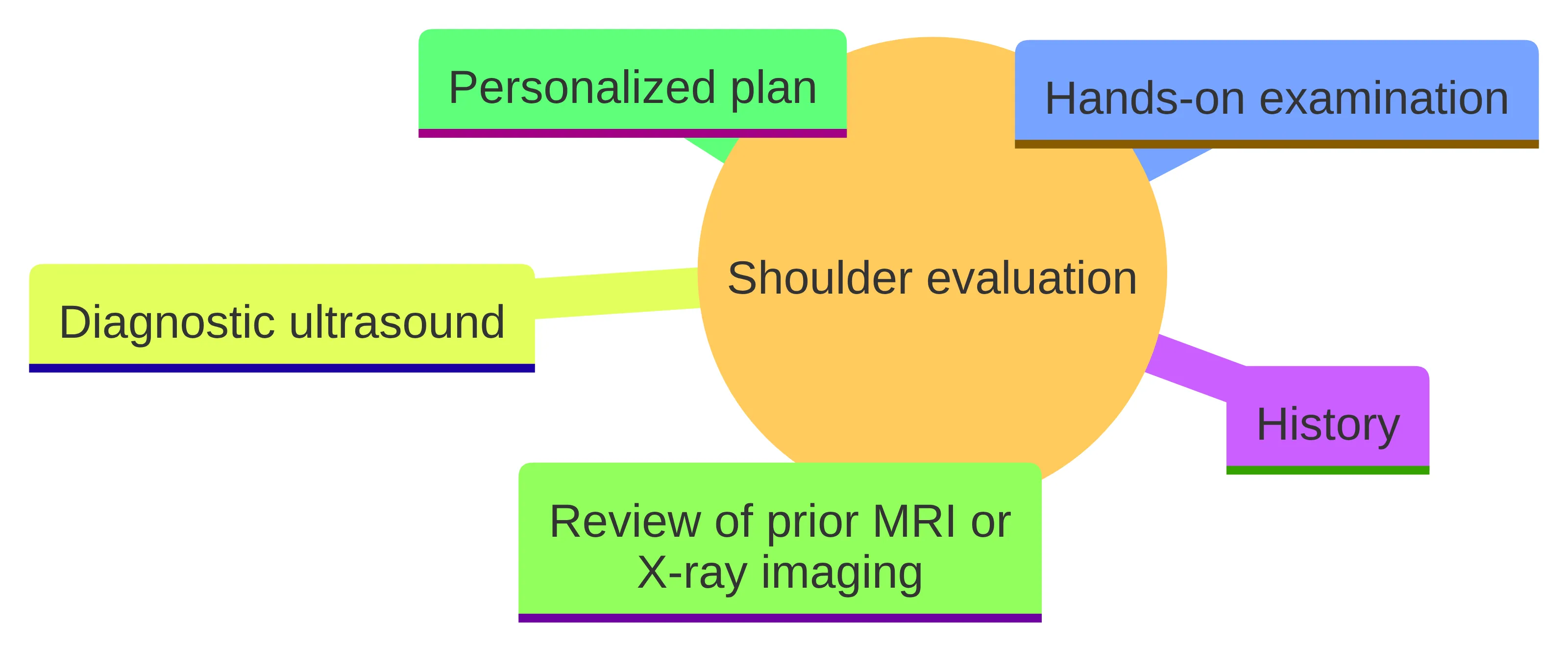
A useful shoulder evaluation connects what you report with physical findings and available imaging before a treatment plan is selected. The clinician may check movement, strength, tender areas, and the neck while considering other shoulder findings. Diagnostic ultrasound or prior MRI and X-ray reports can add context to that discussion when they are relevant and available.
Together, these steps give you a structure for discussing what the shoulder problem may involve and which questions remain unresolved. That context can help frame the treatment category under consideration and the recovery questions that remain.
An evaluation is not a promise that a particular procedure will be recommended. It is the point at which a general option such as PRP or BMAC can be considered alongside the findings that may support, limit, or redirect the discussion. It can also keep conservative care in the plan when that remains the appropriate category.
Bring prior reports and images if you have them, along with a short account of what changed, what you tried, and which activities are limited. That information makes the clinical conversation more specific without requiring you to diagnose the shoulder before you arrive.
Use imaging to answer a specific question
Shoulder imaging is most useful when it answers a question raised by your history and examination. An X-ray assesses the bones of the shoulder. MRI and ultrasound provide more detailed views of soft tissues than X-rays, and MRI may help identify injuries involving the ligaments and tendons around the shoulder.
That distinction explains why one scan does not automatically settle every shoulder-pain question. If the concern relates primarily to bone, an X-ray may address a different question than an MRI or ultrasound. If the concern relates to a tendon or ligament, the clinician may need to decide whether soft-tissue imaging adds information that changes the plan. The choice belongs beside the examination, not before it.
Use these questions to make an imaging discussion practical:
- What specific finding are you trying to confirm or exclude?
- Which structure or tissue does the proposed study show most clearly?
- Would the result change the treatment category under consideration?
- How should prior imaging be interpreted alongside the current symptoms and examination?
- If the scan does not explain the pain, what is the next clinical question?
At RegenCore Method, our evaluations include review of prior MRI or X-ray imaging and diagnostic ultrasound. That process can help place imaging findings within the broader assessment rather than treating a scan as an independent treatment recommendation.
Imaging can clarify anatomy, but it does not by itself determine whether PRP, BMAC, shockwave, EMTT, physical therapy, medication, or another approach is suitable for you. The treatment-selection question remains linked to the working diagnosis, the clinical findings, and the limitations of the evidence for that problem.
Compare non-surgical options without treating them as interchangeable
Non-surgical shoulder options differ in what they are intended to address, how they are delivered, and how much uncertainty remains for your specific problem. The following comparison describes the options RegenCore Method discusses; it does not determine which option fits you.
| Option | How RegenCore Method describes it | Question to resolve before choosing |
|---|---|---|
| PRP | We offer PRP for conditions including rotator cuff and shoulder tendon injuries. | What is the working diagnosis, and what evidence applies to that diagnosis rather than to shoulder pain in general? |
| BMAC | We offer BMAC for shoulder joint degeneration and severe or chronic tendon injuries. We describe some cartilage-injury cases as appropriate only for select candidates. | What examination or imaging finding makes this option relevant, and what alternatives should be considered first? |
| Shockwave | During our shockwave treatment, a handpiece delivers focused acoustic pulses to the injury, and most patients feel a tolerable tapping sensation. | What is the intended target, and how does this treatment fit the conservative or clinical plan? |
| EMTT | We describe EMTT as an option for deep or hard-to-reach tendon and joint pain, chronic conditions, fully non-invasive add-on use, large-joint conditions, and recovery support after orthobiologic treatment. | Is it being discussed as an add-on or another part of the plan, and what specific problem is it meant to address? |
The table separates a practice’s stated treatment scope from the decision you still need to make. A practice offering an option does not establish that the option is appropriate for your diagnosis, and a description of a treatment does not guarantee pain relief, healing, or a return to work or sport.
The options also should not be treated as interchangeable labels for “regenerative treatment.” PRP and BMAC are discussed in relation to different clinical situations. Shockwave and EMTT are delivered differently, and EMTT is described as fully non-invasive. Your evaluation should explain why an option is being raised, what it is expected to address, and what would lead you to choose conservative care or another path instead.
A fair comparison also keeps the decision at the same level for every option. For each proposed treatment, write down: the finding it is meant to address; whether it is a procedure, a non-invasive treatment, or an add-on as described; what evidence is being applied; what other category remains available; and what result would lead to reassessment. This prevents a delivery feature from being mistaken for evidence of effectiveness. It also prevents a practice’s list of available services from becoming a personalized recommendation. If the explanation cannot connect the option to a working diagnosis or explain the alternative, pause the comparison and return to the evaluation question.
Put evidence uncertainty beside the treatment discussion
Evidence uncertainty belongs beside the treatment discussion, especially when you are considering PRP for shoulder pain. A systematic review of PRP for rotator cuff tendinopathy examined eight randomized controlled trials, but concluded that the best treatment remained inconclusive; the PRP preparation and injection techniques varied across the studies.
An older AAFP evidence table classified PRP injections as having unknown effectiveness for shoulder pain. That older classification should not be treated as the final word on every current PRP question, but it does reinforce the need to avoid broad promises. The systematic review also does not answer every shoulder condition, every preparation method, or every injection approach.
The practical interpretation is narrower than “PRP works” or “PRP does not work.” Before you consider PRP, ask:
- Is the evidence being discussed about rotator cuff tendinopathy or about a different shoulder problem?
- Does the proposed preparation and treatment method resemble the methods studied?
- What outcome is being measured: pain, function, movement, or another result?
- What conservative options remain available?
- What would count as insufficient benefit, and what would happen next?
Evidence limitations apply to the decision process, not only to the procedure name. The same discipline is useful when discussing BMAC, shockwave, or EMTT: identify the problem being treated, ask what support applies to that problem, and keep the proposed benefit separate from a guarantee.
RegenCore Method offers PRP for rotator cuff and shoulder tendon injuries, but that business fact does not determine your diagnosis or establish an outcome for you. The purpose of evaluation is to connect an offered option to your findings while keeping uncertainty visible.
Evidence applicability has more than one layer. First ask whether the study concerns the same shoulder problem being discussed. Then ask whether the preparation, injection technique, comparison treatment, and outcome resemble the proposed plan. Finally ask how the result will affect your decision if the evidence is mixed or incomplete. The review’s variation in PRP preparation and injection techniques is important for this reason: a conclusion about a group of studies cannot automatically settle a question about every formulation or technique. This is not a reason to reject an option or to accept it. It is a reason to ask for a diagnosis-specific explanation and to keep a conservative alternative and a reassessment point visible.
Weigh burden, uncertainty, and unanswered questions
Treatment choice involves more than whether an option sounds promising. You also need to weigh the practical burden, the uncertainty in the evidence, and the questions that remain unanswered about your shoulder.
Start with the burden of the plan. Ask whether the option involves a procedure, an appointment sequence, additional imaging, activity changes, or follow-up. EMTT is described by RegenCore Method as fully non-invasive in add-on use, while shockwave treatment uses a handpiece to deliver focused acoustic pulses and is described as producing a tolerable tapping sensation for most patients. Those details describe delivery; they do not establish which option is appropriate or what result you will have.
Next, weigh uncertainty. Evidence for or against many common treatments for chronic shoulder disorders has been limited by a lack of well-designed clinical trials. PRP research for rotator cuff tendinopathy has also used varying preparation and injection techniques, with the best treatment remaining inconclusive. A reasonable consultation should explain what is known for the specific problem under discussion and where the conclusion is less certain.
Then identify the unanswered questions:
- What is the working diagnosis?
- What finding supports the proposed treatment?
- What conservative approach is available, and why is it being continued or changed?
- What are the practical steps, including appointments and activity restrictions?
- What alternatives should you compare?
- How will you decide whether the plan is helping?
- What is the next step if the expected change does not occur?
You can also ask about financial responsibility and time demands before agreeing to a plan. The appropriate comparison depends on your circumstances, and general information cannot determine individual suitability. A clear explanation of burden and uncertainty is more useful than a confident treatment label detached from the diagnosis.
One practical way to prepare is to make a one-page decision record before the visit. Write the symptom pattern and functional limits in one column; list what you have tried and how the shoulder changed in another; then leave space for the working diagnosis, proposed target, alternatives, burden, evidence limitations, and review point. The record is not a substitute for an examination. It is a safeguard against leaving with only a procedure name and no explanation of why it was raised. If more than one option is discussed, use the same headings for each so that differences in delivery, uncertainty, and follow-up are visible.
Ask questions that make the consultation useful
Consultation questions should help you move from a symptom description to a defensible next step. Bring these questions with your symptom history, prior imaging, and list of treatments you have already tried.
- What is the working diagnosis, and which findings support it? Ask which part of the history or examination is carrying the most weight.
- What needs to be ruled out before treatment is selected? This keeps the discussion focused on the conditions that would change the plan.
- What did the movement and strength examination show? A shoulder evaluation may include active and passive motion, strength, tenderness, the shoulder joint, and the neck.
- What question would an X-ray, MRI, or ultrasound answer? X-rays assess bones, while MRI and ultrasound provide more detailed views of soft tissues; the useful choice depends on the clinical question.
- What is the purpose of the proposed treatment? Ask whether it is intended to address a specific tendon, joint, or other finding.
- What evidence applies to my diagnosis? For PRP, ask whether the discussion reflects evidence for rotator cuff tendinopathy or a different shoulder problem, and whether the studied techniques resemble the proposed approach.
- What conservative option remains available? Ask what activity modification, physical therapy, medication, or other nonoperative measure is being considered and how it will be reviewed.
- What burden should I plan for? Clarify appointments, procedures, follow-up, activity changes, cost, and the time needed for the plan.
- What would make you change the plan? Ask what lack of improvement or new symptom would prompt reassessment.
- What is the next step if this option is not suitable or does not help? A plan should include a boundary rather than leaving you with a single treatment choice.
These questions do not require you to arrive with a preferred procedure. They help you understand why a treatment is being discussed, what uncertainty remains, and how the proposed plan fits the examination.
At the end of the consultation, try to summarize the decision in your own words: the working diagnosis or unresolved question, the reason for the proposed next step, the alternatives that remain open, and the event that would prompt reassessment. If you cannot state those four points, ask the clinician to clarify them before deciding. This is especially important when an option is described using broad terms such as regenerative or non-surgical; those labels describe a category, not a diagnosis-specific recommendation. A useful consultation should leave you with a question to answer and a way to revisit the decision, whether the next step is conservative care, further evaluation, or discussion of a clinical treatment.
Use a Bay Area evaluation to resolve the remaining uncertainty
At RegenCore Method, we offer PRP for rotator cuff and shoulder tendon injuries and BMAC for shoulder joint degeneration and severe or chronic tendon injuries; suitability is determined through individual assessment.
Use the evaluation to clarify the pace of care, the working diagnosis, the role of imaging, the place of conservative management, and the uncertainty attached to any non-surgical option. A qualified clinician must determine whether a treatment is suitable for your circumstances. If you want individualized guidance for shoulder pain in Palo Alto or the surrounding Bay Area, the next step is to arrange that conversation.
Questions to consider before booking a shoulder-pain evaluation
What are the common treatment options for shoulder pain?
Common treatment options for shoulder pain include conservative care such as activity modification, physical therapy, and medications. Non-surgical options may also include Platelet-Rich Plasma (PRP) injections, Bone Marrow Aspirate Concentrate (BMAC), shockwave therapy, and Electromagnetic Transduction Therapy (EMTT). Each option should be discussed in relation to a working diagnosis.
When should I seek immediate evaluation for shoulder pain?
You should seek immediate evaluation for shoulder pain if you experience sudden, severe pain with difficulty moving your arm, or if there is a visible change in the shape of your shoulder. These symptoms may indicate a dislocation, fracture, or torn tendon.
What factors should I consider when deciding between self-care and professional evaluation for shoulder pain?
Consider the persistence of your symptoms, the impact on your daily activities, and whether conservative measures have been effective. If pain and stiffness last for months or worsen with activity, it may be time to seek a professional evaluation.
What does a shoulder evaluation typically involve?
A shoulder evaluation typically includes a thorough history of your symptoms, a hands-on orthopedic examination to assess tenderness and range of motion, and possibly imaging tests like X-rays or MRIs to identify any underlying issues.
What questions should I ask my clinician during a shoulder pain consultation?
You should ask about the working diagnosis, what findings support it, what imaging may be needed, the purpose of any proposed treatment, and what alternatives are available. Additionally, inquire about the expected outcomes and what would prompt a change in the treatment plan.
Next step
Have a question for RegenCore?
Concierge regenerative & orthobiologic orthopedics in San Francisco and Palo Alto. Research-backed, non-surgical treatment — PRP, bone marrow concentrate (BMAC), stem cell therapy, shockwave, EMTT and spinal disc care — to help the body heal itself.
Get in touch