
kneeling pain
Knee Pain When Kneeling: How to Choose Your Next Step

Use the kneeling trigger as a starting clue, not an answer
Kneeling pain is a decision signal, not a diagnosis. The fact that your knee hurts in one position tells you when the symptom appears, but pain location and position alone do not establish the underlying condition. Use the trigger to organize what you notice next: where the pain sits, how it began, what else happens with it, and whether it changes your daily activities.
That approach keeps you from making two common mistakes. You do not have to assume that pain during kneeling means arthritis, and you do not have to dismiss recurring pain simply because it appears only in one position. A careful description gives a clinician a more useful starting point and helps you choose between cautious monitoring, activity modification, and an evaluation.
The immediate question is not What is the diagnosis? The immediate question is What does the pattern justify doing next?
- If the symptom is mild, occurs only with a specific pressure or position, and settles when you stop that activity, you may begin with a cautious reduction in the provoking activity while you observe the pattern.
- If the symptom keeps returning, lasts beyond the activity that triggered it, or interferes with walking, work, hiking, exercise, or sport, arrange a clinical evaluation.
- If the knee is hot, swollen, and painful, especially with fever or no clear injury, seek prompt medical attention rather than relying on self-monitoring.
These branches are starting points, not a way to identify your condition. The sections below show what information should move you from one branch to another.
For an active routine in Palo Alto or elsewhere in the Bay Area, the practical impact may show up during gardening, floor-level household tasks, yoga, hiking preparation, training, or work that repeatedly brings you down to the ground. You do not need to stop every activity at the first twinge, but you should pay attention when a position repeatedly produces the same symptom or begins changing what you choose to do.
Describe the pattern before trying to explain it
The pattern of your knee pain is more useful than the kneeling trigger by itself. Before searching for a cause, write down a short account of what you feel and when it happens. A clinical assessment commonly considers when the pain began, how long it has lasted, what worsens or relieves it, whether swelling is present, and whether an injury occurred. Where the pain sits can provide clues, but location alone does not establish a diagnosis.
Record these details:
- Location: Note whether the discomfort is at the front, inside, outside, or back of the knee. Use your own description rather than assigning a condition to that location.
- Onset: Write down whether the symptom appeared suddenly after a fall, twist, impact, or change in activity, or whether it built gradually.
- Trigger: Note whether kneeling is the only trigger or whether stairs, squatting, walking, running, sitting, or another activity also brings it on.
- Timing: Record whether the pain ends when you stand up, lingers afterward, returns later the same day, or appears even when you are not kneeling.
- Visible or felt changes: Note swelling, warmth, redness, tenderness, catching, locking, or a feeling that the knee gives way.
- Effect on function: Describe what you have stopped doing or what you can no longer do comfortably, such as gardening, prayer, household tasks, hiking, training, or getting up from the floor.
A symptom record should support a conversation, not replace an examination. A clinician may use your history together with inspection, palpation, and an assessment of movement. That combination is more informative than trying to match one symptom to a condition online.
You can make the record concise. For example: pain at the front of the right knee began gradually, appears when kneeling for more than a few minutes, improves after standing, and has not caused swelling. A different account, such as sudden pain after a twist followed by swelling and difficulty moving, would warrant a different level of attention. The point is not to label either pattern yourself. The point is to make the difference visible.
Two details deserve special attention because they change the next question. Second, note whether the same discomfort appears during walking, stairs, squatting, running, or rest. A symptom that stays tied to one position presents a different monitoring question from pain that begins affecting ordinary movement.
Sort possible contributors into broad categories
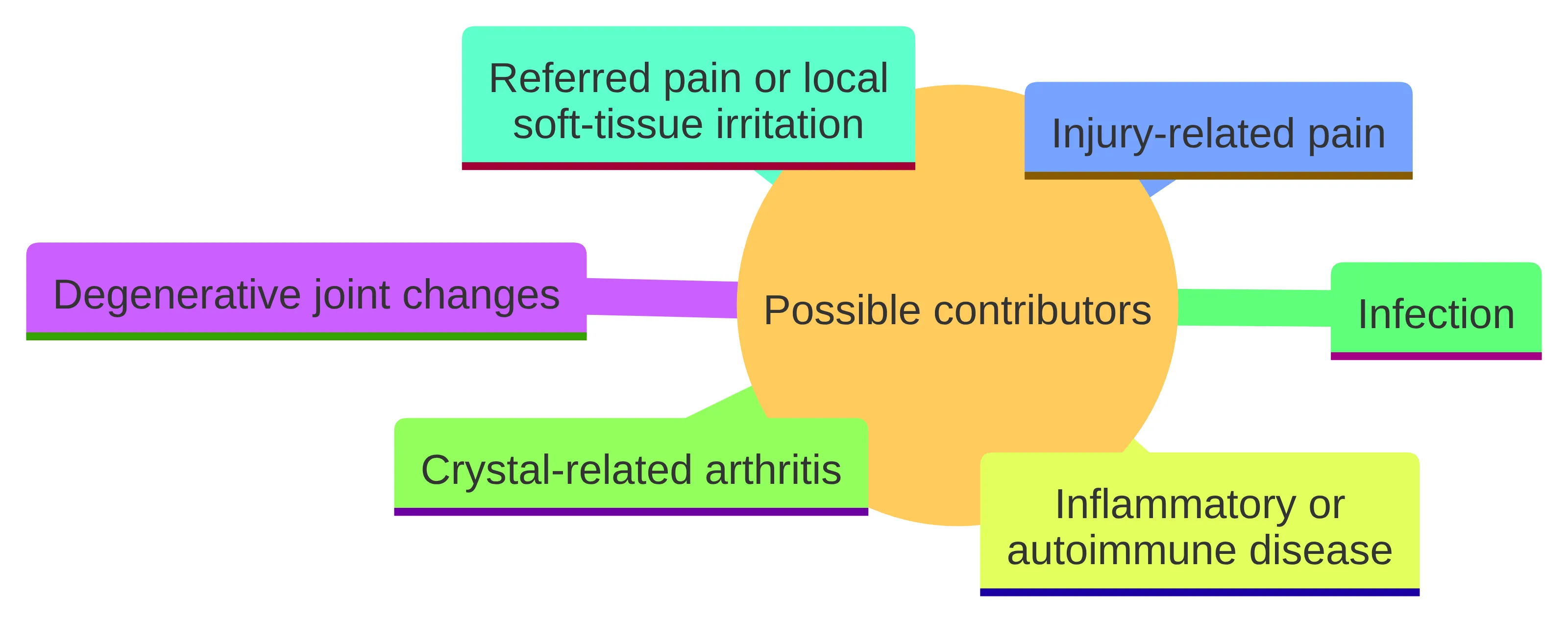
Knee pain can have many possible contributors, including arthritis, injury, inflammation, infection, bursitis, or pain referred from the hip or lower back. A kneeling trigger can occur within more than one category, so it should not be used to select a diagnosis on its own.
Broad categories include:
- Degenerative joint changes: Osteoarthritis is a degenerative condition in which knee cartilage can deteriorate over time with use and age. – Injury-related pain: Strains, ligament injuries, fractures, and other soft-tissue or bone injuries may follow a fall, twist, impact, or sudden change in demand. – Inflammatory or autoimmune disease: Rheumatoid arthritis is an autoimmune disease that can affect the knees and may fluctuate in severity. Other inflammatory patterns can also cause knee symptoms.
- Crystal-related arthritis: Gout involves uric acid crystals, while pseudogout involves calcium-containing crystals in joint fluid. Either can affect the knee.
- Infection: A hot, swollen, painful knee, particularly with fever and no clear injury, can be a sign of infection and needs prompt medical attention.
- Pain referred from elsewhere or local soft-tissue irritation: Pain may be referred from the hip or lumbosacral spine, and bursitis is another possible contributor. Your knee may not be the only area a clinician considers.
Several circumstances are associated with knee pain, including increasing age, excess weight, knee-straining work, and sports participation. These are context clues, not explanations and not judgments about your choices. Your activity history matters because repeated kneeling, pivoting, impact, or training changes may help a clinician understand when symptoms began and what aggravates them.
The useful conclusion is modest: keep the possible contributors broad until an assessment narrows the question. Do not treat a familiar label such as arthritis, meniscus injury, or bursitis as established merely because the symptom appears while kneeling.
The categories also explain why internet symptom matching can mislead you. The same location may occur with different conditions, and the same condition may produce symptoms in more than one part of the knee. Use location, onset, swelling, movement, and activity impact together as information to bring to an evaluation. Keep the label provisional until a qualified clinician connects the history with examination findings and any appropriate testing.
Let the onset change the level of concern
The onset of knee pain changes what needs to be considered first. Pain that began after a fall, twist, impact, or other acute event deserves an injury-focused history and examination. After knee trauma, evaluation may need to check for fractures, tendon or ligament injuries, and neurovascular problems.
Acute trauma does not automatically mean that you need advanced imaging. Under the ACR criteria, an X-ray may be an appropriate initial imaging test in some situations, including acute trauma with focal kneecap tenderness, swelling within the joint, and the ability to walk. The clinician decides whether those conditions apply and whether another test is appropriate.
Gradual or recurring pain calls for a different set of questions. You may notice it during kneeling before you notice it during other activities, or you may find that it returns after work, training, or a long day. That pattern can justify reviewing activity demands, swelling, range of motion, and other symptoms without identifying a specific condition.
Use the onset as a sorting tool:
- Sudden after trauma: stop treating the symptom as routine and arrange an assessment, especially if swelling, marked tenderness, reduced movement, or other concerning changes follow.
- Gradual or recurring: reduce the provoking demand, track whether the symptom persists or spreads to other activities, and arrange an evaluation if the pattern continues or affects function.
- Sudden without a clear injury: pay attention to warmth, swelling, redness, fever, and general illness, because those features change the need for prompt care.
A timeline is more useful than a single severity rating. Write down the first noticeable episode, any change in training or workload around that time, whether the symptom recurred, and what happened after you stopped kneeling. Include whether your walking, stairs, work, hiking, or sport changed. This sequence helps a clinician decide whether the next step should focus on an acute injury, a persistent symptom, or another category of concern.
Move urgent patterns out of self-monitoring
A hot, swollen, painful knee is not a pattern to watch casually, especially when fever is present or no injury explains the onset. That combination can signal infection and warrants prompt medical attention. Do not wait for a kneeling experiment to clarify it.
Other warning categories include inflammatory arthritis, tumors, and major bone or soft-tissue injury such as a fracture. You do not need to determine which category applies. A new, substantial change after trauma, rapidly worsening symptoms, or a knee that becomes visibly hot and swollen should move the decision from self-monitoring to professional assessment.
Use a simple boundary: warning signs call for prompt evaluation; uncertainty without warning signs calls for a planned assessment if the symptom persists, recurs, or limits your activities. Initial evaluation focuses on ruling out urgent problems and deciding whether referral is needed. Imaging or laboratory tests may be used when clinically appropriate.
If you have a hot, swollen, painful knee with fever, or a comparable urgent pattern, seek prompt medical attention. If the issue is a recurring kneeling symptom without those warning signs, continue to the lower-pressure steps and monitoring boundary below while arranging care when needed.
Before choosing to monitor, pause and check for changes that should alter your plan:
- Is the knee newly hot, red, or visibly swollen?
- Do you have fever or feel generally unwell?
- Did the symptom follow a fall, twist, impact, or other significant event?
- Has the knee become difficult to move or bear weight on?
- Are symptoms worsening rather than settling when you stop the provoking activity?
A positive answer does not tell you the diagnosis, but it does give you a reason to seek professional assessment instead of repeatedly testing the position.
Try a low-pressure response when warning signs are absent
A low-pressure response gives your knee less exposure to the position that provokes symptoms while you learn whether the pattern settles. General joint-protection guidance includes reducing activities with repetitive pounding or high injury risk and resting temporarily if joint pain occurs. Applied cautiously to kneeling, that means you can pause or shorten the activity that brings on pain instead of repeatedly testing it.
Try these practical adjustments:
- Reduce the amount of time you spend kneeling and take a break when pain begins.
- Use a different position for tasks that do not require kneeling, rather than forcing the painful position.
- Temporarily reduce other activities that clearly reproduce the same knee pain, particularly repetitive pounding, pivoting, or contact activities with a meaningful injury risk.
- Keep a short record of what changed, whether swelling appeared, and whether the pain returned during ordinary activity.
This is a monitoring strategy, not a treatment prescription. It does not tell you why the knee hurts or establish that the problem is minor.
Avoid turning temporary comfort into reassurance. If reducing kneeling makes the symptom quieter but the pain returns as soon as you resume normal demands, that recurrence is useful information for an evaluation. If pain begins occurring at rest, spreads to other activities, or comes with swelling, warmth, redness, or fever, stop relying on activity modification and seek professional guidance.
Do not add a new exercise routine, medication plan, or injection based only on this symptom pattern. A general measure can help you observe the problem while preserving the information a clinician needs to assess it.
Make the observation period specific enough to produce useful information. Each time the symptom appears, record the activity, position, duration, pain location, and what happened after you stopped. Note any swelling, warmth, redness, reduced movement, or change in walking. Then use the record to decide whether the symptom is settling with less pressure or whether recurrence is becoming the reason to arrange an evaluation.
Use persistence and function as the monitoring boundary
Persistence and function determine when observation has stopped being enough. If knee pain continues, keeps returning, or remains unexplained, a clinician may refer you to a musculoskeletal service, physical therapist, or orthopedic surgeon. The same applies when the symptom changes how you walk, work, exercise, hike, play sport, garden, or manage ordinary tasks.
You do not need to wait for the symptom to become constant before arranging an evaluation. A recurring problem that repeatedly changes your choices can be enough reason to discuss it. Conversely, a symptom that settles after you reduce the provoking position can be monitored cautiously when warning signs are absent, provided you respond to recurrence or worsening rather than treating improvement as a diagnosis.
Function gives the decision practical meaning. You may be able to tolerate a brief symptom during an occasional household task but still need an evaluation if it prevents you from hiking, training, working, getting up from the floor, or completing another activity that matters to you. Describe the change in concrete terms: what you can no longer do, what takes longer, and what you now avoid. That information helps keep the clinical discussion connected to your goals.
Know what a useful evaluation is meant to establish
A useful knee evaluation is meant to connect your symptom pattern with examination findings and decide what question needs answering next. A clinician may ask when the pain began, whether there was trauma, what worsens or relieves it, whether swelling is present, and how the knee functions. The physical assessment may include inspection, palpation, and evaluation of movement.
The first decision is often whether an urgent problem needs attention. The next may be whether the pattern fits a clinical concern that can be managed through observation and rehabilitation, or whether imaging, laboratory testing, or referral would add useful information. Imaging is not an automatic answer; it is used when clinically appropriate to confirm or establish a diagnosis.
Trauma changes the evaluation question. After a fall or twisting event, the clinician may consider fracture, tendon or ligament injury, and neurovascular problems. The ACR criteria identify radiography as usually appropriate in some acute-trauma situations, while MRI or CT may be considered in particular circumstances after an initial finding. The appropriate study depends on the examination and the trauma pattern.
An evaluation also does not create a fixed treatment pathway. The AAOS osteoarthritis guideline is evidence-based but is not a fixed protocol; care should reflect your circumstances and the clinician’s judgment. That principle matters when you are hoping to avoid or delay knee replacement: the goal is to identify what your knee needs discussed, not to force every symptom into a nonsurgical or regenerative category.
Our evaluations include a thorough history, hands-on orthopedic exam, diagnostic ultrasound, review of prior MRI or X-ray imaging, and a personalized treatment and recovery plan. Bring prior reports or images when available, along with your symptom record and a clear account of what you want to return to doing. Those details help keep the conversation focused on your actual function rather than on the kneeling trigger alone.
Before an appointment, organize the information that can change the discussion:
- the first date or period when you noticed the symptom;
- any fall, twist, impact, or change in activity;
- the precise location and provoking positions;
- swelling, warmth, redness, locking, giving way, or reduced movement;
- the effect on walking, work, hiking, training, or household tasks; and
- what happened after you reduced the activity.
This preparation does not identify the cause. It makes the history easier to assess and helps the clinician decide whether examination, imaging, laboratory testing, referral, or monitoring is the appropriate next step.
Keep established care and regenerative options in separate lanes
Established care discussions depend on what an evaluation shows. For knee osteoarthritis, guidelines cited in a 2025 systematic review identify education, structured exercise, and weight loss as primary treatment approaches. The same review found that aerobic exercise provided superior combined therapeutic benefits among the exercise approaches it assessed. That finding does not prescribe a particular routine for you or establish that osteoarthritis is causing your pain.
The evidence also needs to stay in context. The review described uncertainty about which exercise interventions should be prioritized, and the AAOS guideline states that care should be individualized rather than applied as a fixed protocol. Ask what the proposed treatment is intended to address, what participation it requires, and what would change the plan if your symptoms do not improve.
Regenerative options belong after the source of pain and the relevant clinical question have been assessed. A treatment label does not establish suitability, expected benefit, or a reason to delay other care. PRP, bone marrow concentrate, shockwave therapy, and other options should be discussed in relation to your examination, imaging when appropriate, goals, alternatives, and the uncertainty that remains.
We provide non-surgical treatments including PRP, bone marrow concentrate, stem cell therapy, shockwave, EMTT, and spinal disc care. That is a description of what RegenCore Method provides, not a promise that any option will relieve your pain or prevent surgery. We guide you across the full spectrum of care and reserve surgery for when it is the right answer.
The practical separation is straightforward:
- Before treatment selection: establish the symptom pattern, assess the knee, review relevant imaging, and identify whether an urgent or structural problem needs attention.
- For established approaches: discuss education, rehabilitation, activity changes, and other care that fits the findings and your goals.
- For regenerative options: ask what problem the option is meant to address, what evidence applies to that problem, what alternatives exist, and what individual factors affect suitability.
- For surgery: treat it as a separate discussion about indications, timing, expected trade-offs, and whether it is appropriate for your circumstances.
Keeping these lanes separate protects the decision from being driven by a treatment name before the clinical question is clear.
If osteoarthritis becomes part of the discussion, ask how education, structured exercise, weight-related factors, and activity changes relate to your findings and goals. If an option is described as regenerative, ask which diagnosed or suspected problem it is intended to address and how it compares with established approaches. These are different questions from asking whether a treatment sounds promising. They keep the conversation tied to your situation and to the uncertainty that remains.
Turn the symptom story into questions for a clinician
A focused question list can make your evaluation more useful. Bring the location, onset, triggers, swelling or warmth, associated sensations, activity limits, and changes you have already tried. Then ask:
- What findings could explain pain that appears during kneeling, and what findings would point elsewhere?
- Does my history suggest that trauma, arthritis, inflammation, infection, referred pain, or a local soft-tissue problem needs consideration?
- What does the examination show about movement, tenderness, swelling, and function?
- Do I need imaging or laboratory testing, and what specific question would each test answer?
- If an injury occurred, do we need to assess for fracture, tendon or ligament injury, or a neurovascular problem?
- If osteoarthritis is part of the discussion, which education, activity, exercise, or weight-related factors are relevant to my circumstances?
- What would make monitoring reasonable, and what change should prompt follow-up?
- If an injection or regenerative option is proposed, what problem is it intended to address, what alternatives should I compare, and what uncertainty remains?
- How would the plan change if I want to return to hiking, sport, work on my knees, or another specific activity?
The goal of these questions is not to request a predetermined treatment. The goal is to connect your symptom story to an examination, relevant testing, and a plan that reflects what you want to do. A personalized treatment and recovery plan is more meaningful when it responds to the source of pain and your function rather than to the word kneeling alone.
If time is limited, start with the questions that change urgency and direction:
- What needs to be ruled out first?
- What findings would make monitoring reasonable, and what findings would require follow-up?
- Would imaging or laboratory testing answer a specific unresolved question?
- What activity changes are reasonable while the cause is being clarified?
- Which treatment discussions belong now, and which depend on additional findings?
Writing the answers down can prevent a treatment conversation from moving ahead of the basic assessment.
Choose an evaluation when the decision remains unclear
Your next step should match the pattern you can describe. If pain appears only in a specific position, improves when you reduce that position, and has no warning signs, cautious observation may be reasonable. If the symptom persists, recurs, limits your activities, or remains difficult to explain, arrange an evaluation. A hot, swollen, painful knee, especially with fever or no clear injury, warrants prompt medical attention.
An evaluation can move the discussion from a single trigger to the questions that matter: what needs to be ruled out, whether imaging or laboratory testing is appropriate, what care fits the findings, and whether any non-surgical or regenerative option belongs in the conversation.
A qualified clinician must decide whether any individual treatment is suitable for you. If your knee pain when kneeling is persistent, recurring, activity-limiting, or uncertain, use the next conversation to clarify the decision rather than choosing a treatment from the symptom alone.
Questions to consider before requesting knee-pain guidance
What are common causes of knee pain when kneeling?
Knee pain during kneeling can arise from various factors, including osteoarthritis, injuries, inflammation, infections, bursitis, or referred pain from the hip or lower back.
When should I seek medical evaluation for knee pain?
You should seek medical evaluation if your knee pain is persistent, recurs, limits your activities, or is accompanied by warning signs such as swelling, warmth, redness, fever, or if it follows a significant injury.
What warning signs indicate that knee pain may require urgent attention?
Warning signs that may require urgent attention include a hot, swollen knee, fever, significant pain following an injury, or symptoms that worsen rather than improve.
How can I prepare for a clinical evaluation of my knee pain?
Prepare for a clinical evaluation by documenting the location, onset, triggers, and any changes in your knee pain, as well as any relevant medical history and prior imaging.
What types of treatments are available for knee pain?
Treatment options for knee pain may include conservative measures like physical therapy and exercise, as well as regenerative treatments such as PRP, bone marrow concentrate, and shockwave therapy, depending on the evaluation findings.
What should I expect during a knee pain evaluation?
During a knee pain evaluation, a clinician will typically take a detailed history, perform a physical examination, and may recommend imaging or laboratory tests to determine the cause of the pain.
Next step
Have a question for RegenCore?
Concierge regenerative & orthobiologic orthopedics in San Francisco and Palo Alto. Research-backed, non-surgical treatment — PRP, bone marrow concentrate (BMAC), stem cell therapy, shockwave, EMTT and spinal disc care — to help the body heal itself.
Get in touch