
fluid on knee
Fluid on the Knee: How to Choose the Right Next Step

Fluid on the Knee Is a Signal to Interpret, Not a Diagnosis to Self-Treat
Fluid on the knee can reflect joint effusion, meaning excess fluid in or around the joint. Joint effusion is a symptom of an underlying condition, not a diagnosis by itself. The same visible swelling can follow an injury, occur with arthritis or inflammation, or accompany an infection, so the appearance of fluid cannot tell you which explanation applies.
The appropriate next step depends on the pattern around the swelling. Persistent or severe swelling should be medically evaluated.
A swollen knee does not give you enough information to choose an injection, exercise plan, medication, or procedure. Use the symptom pattern to set the pace, then use an evaluation to clarify the cause. That sequence matters if you are trying to keep walking, hiking, training, or working without allowing an unresolved knee problem to dictate your choices.
The first question is not which treatment sounds most appealing. The first question is whether the swelling is mild and improving, persistent or significant, or paired with signs that need prompt attention. That distinction helps you avoid two opposite mistakes: dismissing a symptom that needs assessment or treating the presence of fluid as proof that a procedure is necessary.
Keep the Possible Causes Broad
Possible causes of knee fluid include injury, overuse, osteoarthritis, gout, inflammatory arthritis, and joint infection. Traumatic injuries can include ligament tears or fractures. Swelling can also arise without a single memorable injury, particularly in the setting of arthritis, inflammation, or overuse. These categories describe possibilities rather than a diagnosis for your knee.
The surrounding symptoms add context, but they do not settle the cause by themselves. Knee fluid may come with warmth, redness, stiffness, reduced motion, or pain when you move the joint or put weight on it. A knee that looks swollen after activity and a knee that becomes hot, red, and very painful may require different levels of attention, even though both involve swelling.
A symptom-based label such as “overuse” or “arthritis flare” should not substitute for evaluation when the pattern is new, severe, or unexplained. Serious joint infection can resemble other causes of a painful swollen joint, and different conditions require different evaluation and treatment. Keep the possible causes broad until your symptoms have been assessed.
The event before the swelling can help organize the clinical question without answering it. A fall, twist, training increase, or period of repeated loading points toward one set of possibilities, while swelling that appears without an injury keeps arthritis, gout, inflammatory conditions, and infection in the discussion. Record what changed before the knee became swollen, but do not use that history to rule out other causes. That record can make the evaluation more useful because it gives the clinician a timeline to compare with the current examination. Note whether the change followed a single event, accumulated during repeated activity, or appeared during ordinary daily movement; these are different descriptions of onset, not home diagnoses. For an active adult in Palo Alto or elsewhere in the Bay Area, the relevant context might be a hike, run, court session, commute, or routine walk. The useful detail is what happened before the swelling and how the knee responded afterward. Also note whether movement became limited or weight bearing became harder, since function is part of the urgency picture. This history does not identify a ligament injury, arthritis, gout, inflammatory condition, or infection. It keeps the assessment anchored to sequence and function while the clinician distinguishes among those possibilities, rather than turning an activity or timing pattern into a self-diagnosis.
Use the Symptom Pattern to Set the Pace
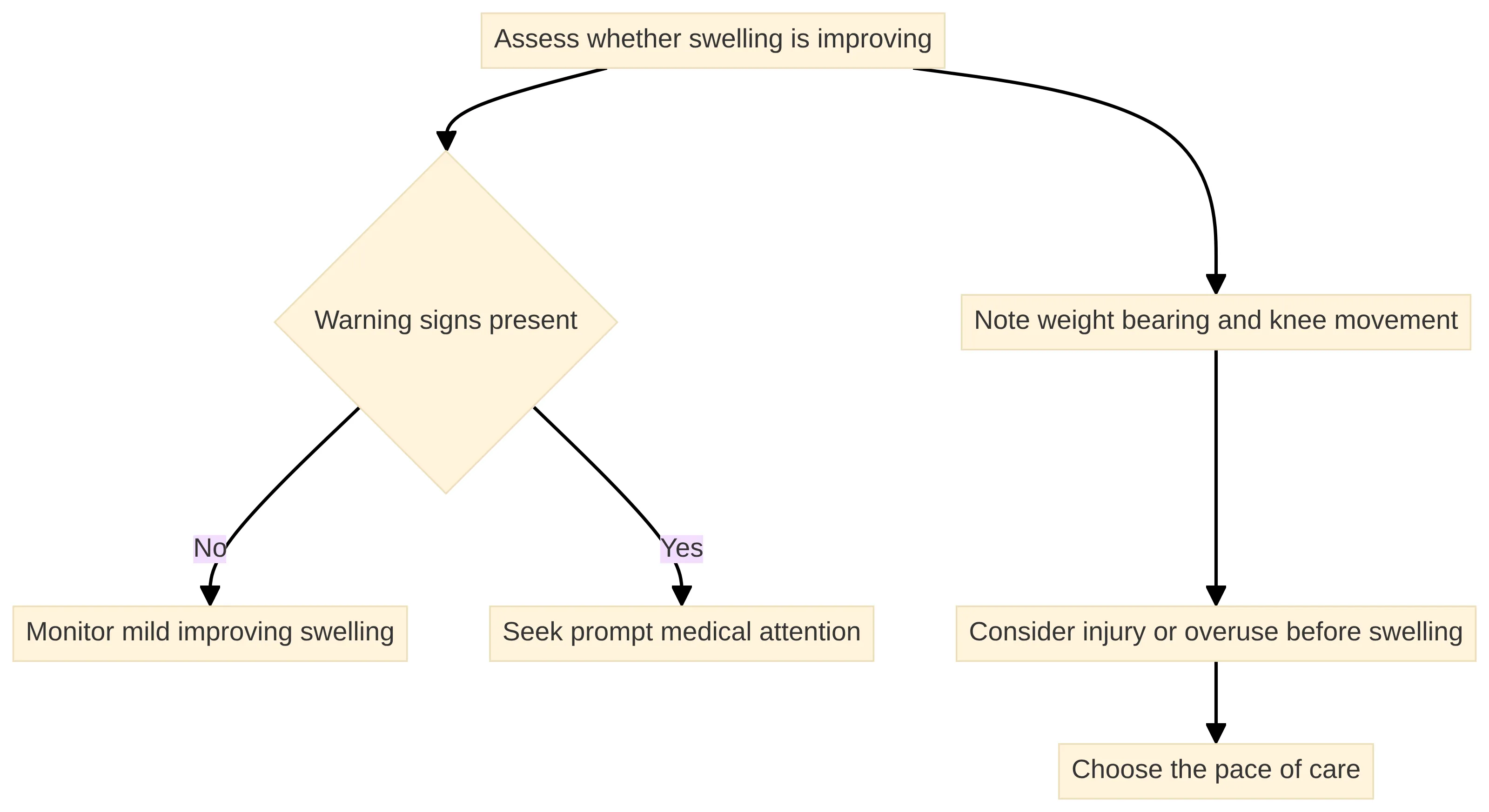
The symptom pattern around knee swelling helps you choose between monitoring, prompt evaluation, and urgent evaluation. Think in three broad pathways:
- Mild and improving: Mild swelling may improve with rest. If the swelling is clearly improving and no warning sign is present, cautious monitoring may be reasonable while you pay attention to whether the pattern changes.
- Persistent or significant: Persistent or severe swelling should be medically evaluated, even when you cannot identify a specific injury. Ongoing swelling leaves the underlying cause unresolved.
- Warning signs present: Fever with swelling, acute atraumatic pain with swelling and fever, rapid swelling after an injury, severe pain, inability to bear weight, or marked redness and tenderness warrants prompt medical attention.
The direction of change matters more than a single snapshot. Improving mild swelling supports a different pace from swelling that stays the same, grows, or interferes with weight bearing. Do not treat temporary improvement as proof that the cause is harmless, and do not treat the presence of fluid alone as proof that a procedure is needed.
A change in pace is a change in the decision. New warmth, redness, fever, severe pain, or loss of the ability to bear weight should move you away from routine monitoring. Persistent unexplained swelling should move you toward an evaluation even if the pain is tolerable.
A simple symptom sort can keep the next decision concrete:
- Ask whether the swelling is getting better, staying the same, or worsening.
- Note whether you can bear weight and move the knee.
- Look for warmth, redness, marked tenderness, or fever.
- Consider whether an injury or overuse preceded the change.
Use the result to choose the pace of care, not to name the condition. That distinction is especially important when findings seem mixed. A knee may have only modest visible swelling but still require prompt attention if fever, marked redness, extreme tenderness, severe pain, or inability to bear weight is present. Conversely, the absence of one warning sign does not explain persistent swelling or identify its cause. Treat the observations as a set of decision signals: worsening or rapid change argues against waiting; loss of function raises the need for prompt assessment; and a mild, clearly improving pattern without warning signs is the narrow situation described in this article as potentially suitable for monitoring. If the pattern changes after you have chosen to monitor, reassess the pace rather than assuming the original decision still applies. One reassuring detail should not cancel a more concerning one, and one concerning detail should not be dismissed because the swelling looks modest. The practical value of this sort is prioritization: it helps you communicate the timeline and functional change clearly while leaving diagnosis and treatment selection to an evaluation.
Seek Urgent Evaluation When Infection Is Possible
A serious joint infection can present with pain in one joint, swelling, warmth, redness, and painful movement or touch. Fever may also occur and can be low grade. Acute, atraumatic joint pain with swelling and fever warrants prompt medical evaluation because septic arthritis must be considered.
History can also affect how urgently a clinician considers infection. Relevant factors include diabetes, rheumatoid arthritis, recent joint surgery, a knee prosthesis, a skin infection, or medicines that suppress the immune system. These factors do not diagnose septic arthritis, and their absence does not rule it out. Fever may be low grade, so the absence of a dramatic fever should not become the reader’s test for whether a hot, painful, swollen knee deserves assessment. Report the timing, symptoms, and relevant medical history promptly. The review also notes that conditions such as crystal-induced arthritis, cellulitis, Lyme disease, osteomyelitis, reactive arthritis, rheumatoid arthritis, or other problems can mimic infection. That overlap is another reason to separate urgency from self-diagnosis: the pattern may warrant prompt evaluation even when the final cause is not infection. Because several causes can overlap in appearance, base the urgency decision on the combination of symptoms and history rather than on one reassuring feature. You may not know whether the knee is infected, inflamed, injured, or affected by another condition; prompt evaluation is how that uncertainty is addressed before treatment choices are made. Do not use a known history of arthritis to explain away a new hot or unusually painful swelling, and do not use a recent activity increase to rule out non-traumatic causes.
Delayed diagnosis and treatment of septic arthritis can cause permanent harm and may be life-threatening. That possibility changes the appropriate response to a hot, painful, swollen knee, especially when fever is present without a clear injury. Do not wait for a routine treatment discussion when this pattern occurs; seek prompt medical evaluation.
A lack of a known injury does not make acute swelling with fever a monitoring situation. The concern is not whether you can name the condition at home. The concern is whether the pattern requires timely assessment and, if indicated, analysis of joint fluid.
Treat Other Red Flags as Reasons for Prompt Medical Attention
Rapid swelling after an injury, fever with joint swelling, severe pain, inability to bear weight, marked redness with extreme tenderness, or persistent swelling without an injury warrants prompt medical attention. These signs do not identify one diagnosis, but they do make waiting for the knee to settle without assessment a poor choice.
Rapid swelling after a knee injury deserves a different response from a small amount of swelling that is steadily improving. The speed of the swelling and the loss of function provide information about how quickly you should seek care, even though they cannot tell you whether the problem involves a ligament, fracture, or another structure.
Inability to bear weight is a practical boundary. If you cannot put weight on the knee, or if severe pain prevents normal movement, seek prompt medical attention rather than trying to test the knee with more activity. Marked redness and extreme tenderness create the same boundary, particularly when they occur with swelling or fever.
Persistent swelling without an injury also deserves medical evaluation. The absence of a dramatic event does not explain away an effusion that remains present, and mild swelling that does not improve no longer fits the limited monitoring pathway.
When a warning sign appears, make the immediate goal assessment rather than symptom interpretation. Tell the evaluating clinician when the swelling began, whether an injury occurred, whether fever or redness is present, and whether you can bear weight. Those details help communicate why the timing of the visit matters.
Monitor Only When Swelling Is Mild and Improving
Mild swelling may improve with rest, but persistent or severe swelling should be medically evaluated. Monitoring is therefore a narrow option: the swelling should be mild, the overall pattern should be improving, and none of the warning signs should be present. Monitoring is not a conclusion about the cause.
While you monitor mild improving swelling, pay attention to the features that would change the decision:
- swelling that becomes rapid or more pronounced;
- increasing warmth, redness, or tenderness;
- worsening pain with movement or weight bearing;
- new difficulty bearing weight;
- fever or a general change that accompanies the knee symptoms; or
- swelling that stops improving or persists without an injury.
Any of these changes should move you toward prompt medical attention rather than continued observation.
Improvement does not provide clearance for a demanding activity or establish that the joint is ready for sport. It only supports a cautious monitoring pathway when the swelling is mild and no warning sign has appeared. If you want to understand why the swelling occurred or it keeps returning, arrange an evaluation instead of repeatedly restarting the same cycle.
Monitoring works only while the original conditions remain true. If the swelling is no longer improving, becomes more painful, affects weight bearing, or develops warmth, redness, tenderness, or fever, stop treating observation as the plan. The next step is medical evaluation.
Keep Activity Decisions Conservative While Arranging Care
Rest may be part of monitoring when knee swelling is mild and improving. That general point does not provide an individualized exercise plan, medication plan, or return-to-sport schedule. The cause, severity, and functional effect still need to guide any more specific activity decision.
A swollen knee should not be tested by repeatedly pushing through severe pain or inability to bear weight. Severe pain and inability to bear weight are warning signs that warrant prompt medical attention. If normal walking is not possible, change the plan from activity experimentation to evaluation.
Walking, hiking, running, court sports, and other demanding activities place different demands on a knee, so fluid alone cannot tell you which activity is appropriate. If you are in Palo Alto or elsewhere in the Bay Area and want to remain active, bring the activity that triggered or worsened the swelling into the clinical conversation. Until the knee is assessed when symptoms persist, keep your decisions conservative rather than treating temporary symptom relief as proof that the underlying issue has resolved.
Activity modification is not a substitute for finding the cause of persistent swelling. Keep the activity question separate from the diagnostic question.
Understand What an Evaluation Is Trying to Establish
A knee evaluation is trying to establish what is producing the pain and swelling, not merely to describe that fluid is present. At RegenCore Method, we combine an examination, imaging review, and diagnostic procedures to confirm the source of pain. A cause-focused assessment gives the treatment discussion a clinical question to answer.
The evaluation needs to connect several parts of your story:
- how quickly the swelling appeared;
- whether an injury or overuse preceded it;
- whether warmth, redness, fever, stiffness, or reduced motion is present;
- whether you can bear weight; and
- whether the swelling is improving, persistent, or recurring.
The symptom pattern does not replace examination, imaging review, or diagnostic procedures. It helps direct those parts of the evaluation.
The evaluation may need to distinguish a traumatic problem from arthritis, gout, inflammatory arthritis, or infection. Those possibilities can overlap in how they feel, while the next treatment decision may differ. If infection is a concern, clinicians use joint-fluid studies from joint aspiration to help confirm or rule out septic arthritis. That sequence gives the evaluation a practical output beyond the statement that fluid is present: it helps clarify which cause remains most relevant, how much uncertainty remains, whether fluid analysis is part of the next question, and whether a treatment discussion is appropriately focused. The goal is not to collect a treatment label for the symptom. It is to connect the reported timeline, examination, imaging review, and any relevant diagnostic procedure to the condition being considered. If the cause remains unclear, that uncertainty is itself important information; it means the conversation should stay focused on clarification rather than treating swelling as proof that a particular intervention fits.
An evaluation should come before selecting a regenerative or other non-surgical treatment for unexplained swelling. A treatment label cannot establish why the knee is swollen, and a scan or symptom alone should not be treated as the entire decision.
Your history is most useful when it describes sequence and function rather than only intensity. Note what happened before the swelling, how quickly it appeared, whether the knee became warm or red, and whether you can move it and bear weight. A clear history helps the evaluation focus on the differences between possible causes without turning your own description into a diagnosis.
Know When Joint-Fluid Analysis May Matter
Joint aspiration removes and analyzes fluid from the joint. The analysis can help evaluate infection, gout, bleeding, or inflammatory arthritis.
Fluid analysis matters because different causes of a painful swollen joint can look similar from the outside. Blood testing and imaging may assist with evaluation, but they do not replace the role of joint-fluid studies when septic arthritis is a concern. Delaying the diagnosis of a serious joint infection can cause permanent harm and may be life-threatening.
Those tools answer different parts of the question. The history and examination describe the pattern and function; imaging review can be part of assessing the source of pain; and synovial-fluid studies examine the fluid itself when infection, gout, bleeding, or inflammatory arthritis is under consideration. No single symptom, blood result, or image should be treated as a diagnosis in isolation. The useful question is not whether one test can explain every swollen knee, but which unresolved possibility the next part of the evaluation is intended to clarify. That keeps testing proportional to the clinical question and prevents a reader from interpreting the mention of aspiration as either an automatic procedure or evidence that infection has already been established.
Joint aspiration is a clinical procedure, not a step to arrange or interpret on your own. Your symptoms, examination, and the clinician’s concern about infection, gout, bleeding, or inflammatory arthritis determine whether fluid analysis enters the evaluation. Do not use the possibility of aspiration as a reason to delay prompt care when warning signs are present.
A useful question for an evaluation is whether the pattern of swelling makes fluid analysis relevant. That question keeps the conversation focused on the cause of the effusion rather than jumping straight to a procedure intended to manage symptoms.
Joint-fluid analysis belongs to a cause-focused evaluation when the clinical pattern raises the relevant concern. It is not a general explanation for every swollen knee, and it does not mean that infection, gout, bleeding, or inflammatory arthritis is present. The purpose is to help distinguish conditions that can require different treatment. Keeping that role clear prevents two opposite misunderstandings. The possibility of aspiration does not mean that every swollen knee needs the procedure, and the absence of a planned aspiration does not establish that the swelling is harmless. The relevant question is whether the symptom pattern and clinical assessment raise one of the concerns that fluid analysis can help evaluate. If they do, clarifying that concern belongs ahead of choosing a regenerative option. If they do not, the clinician can continue evaluating the other possible causes without treating joint-fluid analysis as an automatic step. This is why the phrase fluid on the knee should remain a description of the problem under evaluation, not a shortcut to a procedure.
Place Non-Surgical Options After the Cause Is Assessed
Non-surgical options belong after the cause and severity of knee swelling have been assessed. Joint swelling can arise from conditions that require different forms of evaluation and treatment, so the presence of fluid alone does not identify PRP, BMAC, shockwave therapy, or another option as the right choice. The first question is what is producing the swelling.
At RegenCore Method, we offer PRP for conditions including knee osteoarthritis and patellar tendinopathy. That is a description of what we offer, not a determination that PRP fits every swollen knee. An evaluation still needs to establish whether the condition under discussion matches the treatment category.
RegenCore Method offers non-surgical care, but whether an option fits depends on the condition established during evaluation.
A non-surgical discussion should answer three questions before it becomes a treatment decision:
- What is causing the swelling?
- What problem is the proposed option intended to address?
- What other information is still needed?
If those questions remain unanswered, treatment shopping is premature. The treatment category should follow the clinical question, not replace it. These questions also create a useful decision boundary for a consultation. A specific discussion should identify the condition being assessed, explain what the proposed option is intended to address, and name any information that could change the recommendation. Those three parts are different: knowing that a knee is swollen does not establish the condition; knowing the condition does not by itself establish that a particular treatment is appropriate; and acknowledging uncertainty prevents a general service description from sounding like an individual recommendation. This framework applies whether the discussion involves PRP, BMAC, shockwave therapy, EMTT, or another non-surgical option. It keeps the reader’s goal of remaining active in view without allowing that goal to substitute for evaluation. It also gives the reader a concrete way to recognize when the conversation has moved from a general overview to a recommendation tied to the findings of the assessment.
Use Personalized Evaluation to Make Treatment Discussion Specific
Use the evaluation findings to connect the general question about knee swelling with the specific question of whether a non-surgical option addresses the condition being assessed.
Your treatment discussion becomes more specific when you bring the full symptom pattern rather than only the phrase “fluid on the knee.” Be ready to describe:
- when you first noticed the swelling;
- whether the knee was injured or overused beforehand;
- whether the swelling appeared rapidly or gradually;
- whether warmth, redness, fever, stiffness, or reduced motion is present;
- how weight bearing affects you; and
- whether the swelling is improving, persistent, or recurring.
These details do not diagnose the knee, but they help place the evaluation at the right level of urgency.
The RegenCore Method discussion can then distinguish the problem being evaluated from the treatments we offer. We also provide other non-surgical treatments, including shockwave therapy and EMTT. Suitability remains a clinical question, not a conclusion drawn from swelling alone.
If your goal is to continue walking, hiking, or participating in sports around Palo Alto or the wider Bay Area, state that goal during the evaluation. Activity goals can make the treatment conversation more practical, while examination, imaging review, and diagnostic procedures keep the discussion connected to the source of pain.
Useful questions for a treatment discussion include:
- What possible causes of the swelling need to be considered first?
- What does the examination and imaging review suggest about the source of pain?
- Would joint-fluid analysis be relevant to this symptom pattern?
- What condition is the proposed treatment intended to address?
- Does the treatment offering described by RegenCore Method include the condition under discussion?
- What information would change the recommendation?
These questions keep the focus on suitability rather than on choosing a procedure before the evaluation is complete.
A useful treatment conversation should leave you with a clear explanation of the suspected source of pain, the information used to assess it, and the reason a proposed option is being considered. If PRP or BMAC enters the discussion, ask which supported condition it is intended to address and what remains uncertain. That keeps a general treatment offering separate from an individual recommendation. You can also ask the clinician to state which findings support the proposed treatment, which findings are still unresolved, and what additional evaluation would change the discussion. We offer BMAC for moderate to advanced knee osteoarthritis and, in select candidates, cartilage injury or severe or chronic tendon injuries. These categories explain the conditions the practice describes treating; they do not establish that a reader with swelling qualifies. The useful outcome of the appointment is therefore not simply a choice between PRP and BMAC. It is a clearer connection between the symptom pattern, the assessed condition, the purpose of the proposed option, and the limits of what is known. That structure can help an adult who wants to keep hiking, walking, or participating in sports in the Bay Area make a decision without confusing an available treatment with a diagnosis or promise.
Choose the Appropriate Bay Area Next Step
For adults in Palo Alto and the Bay Area, the useful next conversation is specific: explain when the fluid appeared, describe any warning signs, discuss how the knee affects weight bearing and activity, and ask which evaluation steps are appropriate before treatment options are considered. A qualified professional should determine whether a particular treatment fits your circumstances.
Questions to Bring to an Evaluation for Fluid on the Knee
What does fluid on the knee indicate?
Fluid on the knee, or joint effusion, is a symptom indicating excess fluid in or around the joint. It can result from various underlying conditions such as injury, arthritis, or infection.
What are common causes of knee fluid?
Common causes of knee fluid include traumatic injuries like ligament tears, overuse, osteoarthritis, gout, inflammatory arthritis, and joint infections.
How can I manage mild swelling in my knee?
Mild swelling may improve with rest and monitoring. However, if the swelling persists or worsens, you should seek medical evaluation.
What is the role of joint aspiration in evaluating knee fluid?
Joint aspiration is a procedure that removes and analyzes fluid from the knee joint. It helps diagnose conditions like infection, gout, or inflammatory arthritis.
What non-surgical treatment options are available for knee conditions?
Non-surgical treatment options include Platelet-Rich Plasma (PRP) therapy and Bone Marrow Aspirate Concentrate (BMAC), which may be considered after a thorough evaluation.
How does the RegenCore Method approach knee evaluations?
The RegenCore Method combines a detailed examination, imaging review, and diagnostic procedures to determine the source of knee pain and swelling before discussing treatment options.
Next step
Have a question for RegenCore?
Concierge regenerative & orthobiologic orthopedics in San Francisco and Palo Alto. Research-backed, non-surgical treatment — PRP, bone marrow concentrate (BMAC), stem cell therapy, shockwave, EMTT and spinal disc care — to help the body heal itself.
Get in touch